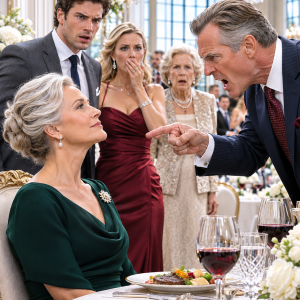
Shane’s attorney argued that the transfers were legitimate business arrangements. Grace questioned the records, the timing, and the written instructions.
Then Kenny was called to testify.
He sat stiffly in the witness chair, looking toward his attorney before answering each question.
Grace showed him one of the statements.
“Mr. Whitaker, did your brother transfer these funds into an account you controlled?”
“Yes.”
“Were those funds payment for services you provided to his business?”
Kenny hesitated.
“No.”
Grace placed the handwritten instruction in front of him.
“Why did he ask you to hold the money until the divorce was final?”
Kenny looked toward Shane.
Shane was staring at the table.
For several seconds, nobody spoke.
Then Kenny answered.
“He didn’t want the money showing in his accounts during the divorce.”
I heard Elora draw a breath behind me.
Grace asked another question.
“Did you understand that was the purpose when you agreed to hold it?”
Kenny swallowed.
“Yes.”
He lowered his eyes.
I turned slightly and saw Elora sitting with both hands clasped around her cane.
She wasn’t smiling. She looked devastated.
I’d imagined that hearing the truth confirmed might bring her relief. Instead, she was watching one son admit he’d helped another deceive his wife and daughter.
For a mother, there was no victory in that moment.
After reviewing the evidence and arguments, the court granted relief concerning the concealed marital assets. The financial consequences included a substantial payment to me, along with adjustments arising from the child-support review.
It wasn’t a magical ending, and it didn’t erase five difficult years. But the records had been examined, and Shane could no longer dismiss my concerns as bitterness over our divorce.
Outside the courtroom, Elora approached me.
“Are you all right, honey?”
I nodded, though my eyes were wet.
“I think I will be.”
She looked toward the courthouse doors.
“I wish it hadn’t come to this.”
“So do I.”
Then she took my hand, and we walked to the parking lot together.
What We Did With the Money
When the payments eventually arrived, I sat at my kitchen table with a notebook and calculator.
I paid off my car, reduced the mortgage, and opened a college savings account for Ivy. With less debt hanging over us, I could finally cut back on overtime and spend more evenings at home.
The first thing I bought Ivy was a pair of purple sneakers with silver laces.
She’d been admiring them in a store window for months.
“Are these really mine?” she asked when she opened the box.
“Every bit of them.”
She wore them around the house until bedtime, then placed them carefully beside her bed.
I wanted to help Elora too.
Her roof leaked, her furnace was old, and the back steps where she’d fallen still needed repairs. But when I offered to pay for the work, she refused.
“That money belongs to you and Ivy.”
“And you’re the reason we got it back.”
“I didn’t do it to be paid.”
I knew she meant it.
So I suggested we fix the steps together.
That April, Patricia, Ivy, and I helped a local carpenter replace the damaged boards and install sturdy handrails. Ivy carried supplies and handed us tools while Elora watched from the kitchen window.
When the work was finished, Elora came outside.
She carefully walked down the steps, holding both railings, then turned and climbed back up.
At the top, she looked at us with tears in her eyes.
“They’re perfect.”
That evening, we ate pot roast at her kitchen table and played gin rummy until late.
Elora won three games.
I suspected she was still cheating a little.
The Blue Envelope
Ivy turned ten in June.
We had a small birthday party in our backyard, with her school friends, a cake decorated with cats, and far too many balloons.
After the guests left, Elora sat beside Ivy on the porch steps.
“Sweetheart, I have one more present for you.”
She looked at me.
I went inside and retrieved the blue envelope from my dresser. I’d kept it there for eight months without opening it.
Ivy carefully unfolded the paper inside. There was a letter and a small bundle wrapped in tissue.
She opened the bundle first.
Inside was a thin gold ring with a tiny sapphire.
“It belonged to my grandmother,” Elora explained. “Then my mother wore it, and eventually I did. I always wanted you to have it.”
Ivy held it against her finger. It was much too large.
“It’s beautiful, Grandma.”
“You’ll grow into it. For now, we can keep it safe.”
Then Ivy read the letter aloud.
Dear Ivy,
When you’re older, you may hear that your grandmother took sides against her own son. I want you to understand why.
Your mother helped me when I needed her, even though she didn’t owe me anything. She made sure I was comfortable, drove me to my appointments, and never made me feel like a burden.
I saw how hard she worked to give you a good life. I also learned something that wasn’t right, and I decided I couldn’t stay quiet about it.
Family isn’t just about sharing a name. It’s about doing what’s right for the people you love, even when it’s difficult.
When you’re old enough to wear this ring, I hope you’ll remember the women who wore it before you. We weren’t perfect, sweetheart. But we tried to be brave when it mattered.
All my love,
Grandma Elora.
Ivy put down the letter and threw her arms around her grandmother.
Elora held her on the porch steps while the evening light faded over the backyard.
I watched them together and thought about everything that had happened since the day Elora called me crying.
She’d lost the easy relationship she’d once had with her children. I knew that hurt her deeply.
But she hadn’t lost Ivy.
And she hadn’t lost me.
The Family We Still Had
A little over a year later, Shane finally called his mother.
He apologized for the way he’d treated her and asked whether he could visit at Thanksgiving. Elora told him he was welcome, but only if he could sit at the same table as me and acknowledge what he’d done.
She asked whether I was comfortable with that.
I thought about the years I’d spent working extra shifts, the money he’d hidden, and how often Ivy had waited for him to visit.
Then I thought about Elora, sitting in my guest room with a broken leg, afraid that telling the truth might cost her children.
“He can come,” I said. “But I can’t promise everything will be the way it was.”
“I wouldn’t ask you to.”
Shane arrived carrying a store-bought pumpkin pie. He was quieter than I remembered, and for most of dinner, he barely looked at me.
Afterward, while Ivy helped Elora clear the table, he approached me.
“Mara, I’m sorry. For the money, for lying, and for leaving you to handle so much on your own.”
He glanced toward the kitchen.
“Especially when it came to Ivy.”
I didn’t tell him it was all right.
It wasn’t.
But I said, “Thank you for saying that.”
He nodded and sat down.
Later, he played a hand of gin rummy with Ivy. She beat him badly, and Elora laughed so hard she had to put down her cards.
It wasn’t a perfect Thanksgiving. There were awkward silences and conversations nobody knew how to begin. But for the first time in years, nobody was pretending that the past hadn’t happened.
Last week, I went into the attic to put away Ivy’s winter clothes. As I moved Shane’s old filing cabinet, I noticed a small yellow note taped to the back.
It was written in Elora’s familiar cursive.
Thank you for letting me stay.
And I’m sorry about the dust.
Love, E.
I stood there smiling through my tears.
For years, I’d believed that helping Elora was simply what family did. I never expected anything in return.
Neither had she.
I left the note exactly where I found it.
Then I went downstairs, where Ivy was waiting with a deck of cards, wearing her purple sneakers and the little sapphire ring on a chain around her neck.
“Mom, Grandma’s coming over. Can we make her favorite pie?”
I looked at my daughter and smiled.
“Of course, sweetheart.”
And when Elora arrived that evening, Ivy opened the door before I could reach it.