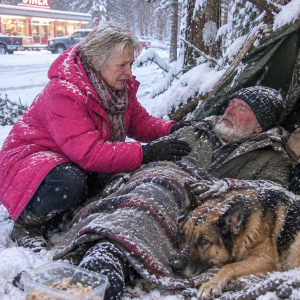
A Seven-Year-Old Girl Pulled Her Twin Brothers Through a Blizzard to My Locked Gates. When I Opened Her Frozen Coat, I Found a Letter That Changed Everything.
The Night Someone Came to My Gates
For nearly eight years, I believed the safest life was one that nobody could interrupt.
My name is Dr. Wesley Hartwell. I was forty-three years old, a successful trauma surgeon living in a secluded mountain estate outside Leavenworth, Washington. My home had everything a man could want: beautiful rooms, breathtaking views, expensive furniture, and a security system that could recognize movement along the property before anyone reached the driveway.
What it didn’t have was laughter.
I had spent years convincing myself that silence was peaceful. I worked long hours at the hospital, came home to an empty house, and rarely invited anyone inside.
Then, on a freezing January night, a little girl appeared outside my gates and changed everything I thought I knew about family.
The snowstorm had begun before sunset. By nine o’clock, the mountains were buried beneath thick white drifts, and the wind was shaking the tall pine trees surrounding my property.
I was reviewing hospital reports in my study when my security monitor suddenly flashed.
Movement detected at the north entrance.
At first, I assumed a branch had fallen near the sensors.
But when I opened the camera feed, I saw something that made me lean closer.
A small figure was struggling through the snow.
She was pulling a red plastic sled with two smaller children bundled together beneath a blanket.
The girl stumbled, caught herself, and continued toward the iron gates.
Then she fell.
For several seconds, she didn’t move.
I grabbed my winter coat and ran toward the front door.
I had no idea that the child lying outside was someone I had once promised to protect.
Three Children in the Snow
By the time I reached the gates, the cold had worked its way through my gloves.
The little girl was lying beside the sled, her fingers still wrapped around its rope.
Her dark hair was covered in snow, and her cheeks were frighteningly pale.
I knelt beside her.
“Sweetheart, can you hear me?”
Her eyelids fluttered.
She looked at me with a pair of familiar gray eyes.
“Uncle Wes?”
My heart seemed to stop.
“Addie?”
It was Adelaide, my younger sister’s seven-year-old daughter.
The last time I had seen her, she was a baby in her mother’s arms.
I looked toward the sled.
Two little boys, perhaps three years old, were huddled beneath a damp blanket. Their small faces were pale, and one was quietly calling for his mother.
“Please,” Adelaide whispered. “My brothers are so cold.”
I immediately contacted emergency services and explained the situation. Then I carried the children into my heated entryway, away from the wind, and began assessing them while waiting for help.
My housekeeper, Mrs. Beatrice Collins, came rushing downstairs.
“Doctor Hartwell, what happened?”
“Three children were outside the gates. Bring dry blankets, and tell the ambulance crew we’re inside.”
Adelaide was barely responsive.
I carefully removed her wet outer clothing, keeping her warm while avoiding any sudden movements. As I opened her coat, something stiff pressed against my hand.
A thick envelope had been tucked into the inner lining.
It was wrapped in clear plastic and secured with several strips of tape.
On the front, written in familiar handwriting, were five words:
For Wesley. Please read everything.
My sister’s handwriting.
I stared at the envelope.
After eight years of silence, Cecilia had finally found a way to reach me.
And she had sent her children through a snowstorm to do it.
The Sister I Refused to Forgive
Cecilia Hartwell was five years younger than me.
When our parents passed away, I was twenty-six and she was barely twenty-one. I had already started my medical career, and she was still trying to decide what she wanted from life.
I became protective of her, perhaps too protective.
I wanted her to have stability, financial security, and a husband who treated her with kindness.
Instead, she fell in love with a man named Travis Barlow.
Travis was charming whenever other people were watching. He could make an entire room laugh, and he always knew exactly what to say.
But I noticed things that worried me.
He frequently changed jobs, borrowed money, and blamed everyone else when his plans failed.
When Cecilia announced their engagement, I told her I thought she was making a mistake.
She accused me of judging a man I barely knew.
Our arguments grew worse.
One evening, she arrived at my house and told me she had already married Travis.
I was furious.
“You know what I think of him, Cecilia.”
“I know exactly what you think,” she replied. “But you don’t get to choose my life.”
“I’m trying to protect you.”
“Then why does being around you feel like I’m always disappointing someone?”
Those words hurt more than I admitted.
Instead of listening, I gave her a choice.
“If you walk away with him tonight, don’t expect me to keep fixing everything.”
Cecilia stood silently for a moment.
Then she picked up her handbag.
“I never wanted you to fix my life, Wesley. I just wanted you to be my brother.”
She left.
I didn’t follow her.
And for the next eight years, I told myself she had made her decision.
The Envelope Inside Her Coat
The paramedics arrived and transported all three children to the hospital.
I followed them, making calls along the way to ensure the pediatric emergency team was prepared.
Adelaide and her brothers, Hudson and Felix, were suffering from significant cold exposure. Fortunately, they received prompt medical attention, and their conditions gradually stabilized.
I stayed at the hospital through the night.
Around three in the morning, I finally opened the envelope.
Inside were several documents, a small silver necklace, and a letter.
The first page began:
Dear Wes,
If you’re reading this, it means Addie found you.
I’m sorry that I couldn’t bring them myself.
My hands tightened around the paper.
Cecilia explained that her marriage had become increasingly difficult. Travis had accumulated debts, moved the family repeatedly, and gradually separated her from friends who might have helped.
She had tried contacting me twice, but both letters were returned after she used an outdated address.
Eventually, she stopped trying.
I thought you hated me, she wrote. And I was too ashamed to find out whether that was true.
I swallowed hard.
The next paragraph was worse.
Cecilia had developed a serious heart condition. She had been receiving treatment, but her health had deteriorated during the previous months.
She had made arrangements with a family support organization, yet an unexpected change in circumstances had left the children without the assistance she expected.
A neighbor had agreed to help them reach me, but severe weather had interrupted their journey. Their vehicle became stranded several miles from my property.
Cecilia had taught Adelaide my address and told her that if anything went wrong, she should ask for Uncle Wesley.
I told her you lived behind big iron gates, the letter continued. I also told her you were a doctor who helped people when they needed him most.
Then came the sentence that made my eyes fill with tears.
Whatever happened between us, I never stopped believing you were a good man.
I turned to the final page.
Please don’t let my children grow up believing that one mistake can cost them their family forever.
For a long time, I couldn’t move.
I had spent years believing Cecilia had chosen a man over her brother.
But she had spent those same years believing her brother no longer wanted her.
The Truth Adelaide Had Been Carrying
The next morning, Adelaide opened her eyes.
I was sitting beside her hospital bed when she noticed me.
“Uncle Wes?”
“I’m right here, sweetheart.”
Related Posts

“HELLO, THOMAS. I THOUGHT IT WAS TIME I PAID A VISIT TO THE HOME YOU BOUGHT WITH OUR RETIREMENT SAVINGS!” I Said Calmly As My Husband Walked Into His Secret Boston Penthouse With His Mistress. For Eight Months, He Had Secretly Transferred $287,000 From The Retirement Fund We’d Built Together To Buy A Luxury Penthouse For His Mistress. He Thought I’d Never Discover It, Much Less Find The Key And Be Waiting Inside. But There I Was, Sitting On The Expensive Leather Sofa, With The Property Records And Bank Statements Spread Out On The Table In Front Of Me…
“THAT’S ENOUGH, MOM! THIS IS MY HOUSE, AND YOU’LL KEEP QUIET!” My Son Snapped Before Sl@pping Me Across the Face. I’m 73, and All I’d Asked Was for His Wife to Stop Smoking Around Me Because of My Lung Problems. Instead of Checking on Me, They Went Out to Dinner and Left Me Sitting There in Tears. Fifteen Minutes Later, I Made Three Phone Calls. The Next Morning, When My Son Opened His Front Door, the Color Drained From His Face…
At Her Twin Sons’ Funeral, Her Mother-in-Law Blamed Her for Everything—Until Her Four-Year-Old Daughter Whispered About the Bottles, and Her Husband’s Hidden Promise Changed How She Remembered That Night

“Mom, The Twins Won’t Wake Up—and We Haven’t Eaten Since Saturday,” My Eight-Year-Old Whispered. I Rushed to Their Father’s Dark Apartment—Then Police Found Him Three Blocks Away With a Secret He Never Meant Me to See