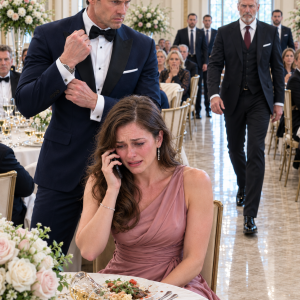
Mrs. Collins did.
Straight to voicemail.
“Again.”
“Margaret—”
“Again.”
By evening, Mrs. Collins had called several times.
My mother had only recently come home after her stroke. She needed help walking and could barely use her right arm.
But she kept asking for the phone.
“Sarah doesn’t disappear.”
Mrs. Collins reminded her gently:
“You haven’t seen Sarah in sixteen years.”
My mother looked at her.
“She’s still my daughter.”
The next morning, Margaret insisted they contact authorities and start checking possible routes into Cypress Hollow.
Someone suggested I might have changed my mind.
According to Mrs. Collins, my mother became furious.
“My daughter said she was coming.”
She tried to push herself up from her chair.
Mrs. Collins stopped her.
Margaret pointed toward the road with her good hand.
“If Sarah said she was coming, then she was coming. Something happened.”
That sentence eventually reached Henry Dawson, a forestry worker helping check rural access roads after the storms.
On the fifth day, Henry drove farther down an old service route than the previous search vehicles had gone.
By then, I had almost stopped shouting.
My voice was gone.
My water bottle was empty.
So when I heard an engine somewhere beyond the trees, I grabbed the bottle and hit it against the truck roof.
Once.
Twice.
Again.
The engine stopped.
I hit harder.
“Hey!”
A man’s voice.
I started crying before I saw him.
“Over here!”
Branches moved.
Then Henry appeared above the embankment.
He looked at the truck, then at me.
“Ma’am, don’t move.”
I laughed.
I don’t know why.
“Wasn’t planning on it.”
He climbed down.
His eyes dropped to my stomach.
“Are you pregnant?”
“Seven months.”
His face changed immediately.
He reached for his radio.
That was the moment I finally stopped trying to save myself.
Someone else had found us.
The First Question I Asked
When I woke in the hospital, Dr. Whitaker was beside my bed.
The strange dressing was gone.
So were the larvae.
There was an IV in my arm and monitors around me.
I looked down.
My stomach was still there.
“My baby?”
He nodded toward the monitor.
“Heartbeat is stable.”
I stared at him.
“Stable?”
“Your daughter is still with us.”
I covered my face.
For five days I had forced myself not to cry because crying wasted energy and made it harder to think.
Now I couldn’t stop.
Dr. Whitaker waited.
Finally, I asked:
“My leg?”
“You still have it.”
I lowered my hands.
“Still?”
He pulled a chair closer.
“Sarah, you had a serious wound, dehydration, fever, and significant contamination. We’re treating the infection and we’ve cleaned the injury properly.”
I looked toward my bandaged thigh.
“The larvae?”
He paused.
“Tell me exactly what you did.”
So I did.
Not proudly.
Not as a trick.
I explained the disaster-response case I had seen years earlier and what I knew about controlled maggot therapy.
I also told him I knew what I had done wasn’t the same thing.
“I didn’t have sterile larvae.”
“No.”
“I didn’t have a controlled environment.”
“Definitely not.”
“I knew I could make things worse.”
He nodded.
“Then why did you do it?”
I looked at my stomach.
“Because by the third day I thought nobody was coming.”
Dr. Whitaker sat quietly.
Then he said:
“What you did was an extreme survival measure in an extreme situation. It was dangerous. It is not something anyone should attempt outside medical supervision.”
“I know.”
“But judging by what we saw when you arrived, the activity was concentrated heavily in the compromised tissue.”
I waited.
“Did it save my leg?”
He shook his head slightly.
“I can’t give one thing all the credit. Your initial bleeding control mattered. Your medical knowledge mattered. The rescue timing mattered. Surgery and antibiotics mattered.”
He glanced at my chart.
“But it may have bought you time.”
That was enough for me.
“Can I walk again?”
“That’s the plan.”
I nodded.
Then I asked for my phone.
The Number I Hadn’t Called in Sixteen Years
A nurse brought me a hospital phone instead.
“Your mother has been calling.”
I stared at her.
“My mother?”
“Margaret Bennett?”
I nodded.
The nurse smiled.
“That woman has been calling this floor all morning.”
My throat tightened.
“Can you call her?”
The nurse dialed and handed me the receiver.
It rang once.
“Hello?”
I knew the voice immediately.
Older.
Weaker.
Still hers.
I couldn’t speak.
“Hello?”
I swallowed.
“Mom.”
Nothing came through the receiver for several seconds.
Then I heard my mother inhale.
“Sarah?”
“Yeah.”
Her voice broke.
“You’re alive.”
I closed my eyes.
Sixteen years, and that was how we started.
Not with an explanation.
Not with an apology.
Just proof that I was still here.
“I’m alive.”
I heard her crying.
“I thought—”
She stopped.
“I know.”
“No, you don’t.”
I waited.
“They kept saying maybe you changed your mind. Maybe you weren’t coming.”
“I was coming.”
“I knew it.”
I wiped my cheek.
“Mom, I need to tell you something.”
“You need to rest.”
That was so exactly like her that I almost laughed.
“No. I need to say it.”
She became quiet.
“What I said when I left…”
Neither of us needed reminding.
“I was twenty. I was angry. I shouldn’t have said it.”
Her breathing trembled through the receiver.
“I’m sorry.”
“Sarah—”
“Sixteen years, Mom.”
“I know.”
“Why didn’t you call me?”
There was a long silence.
Then she said:
“I kept waiting for you to call.”