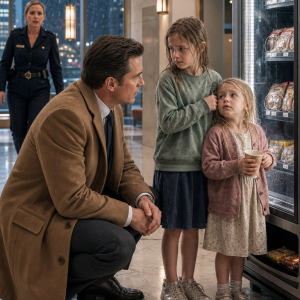
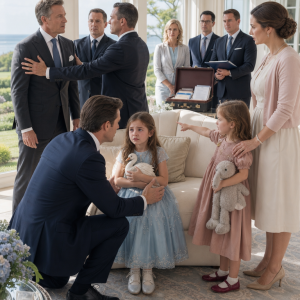
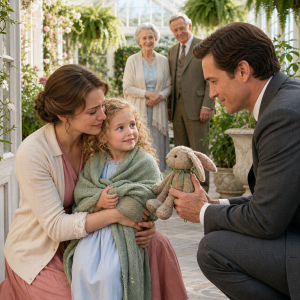
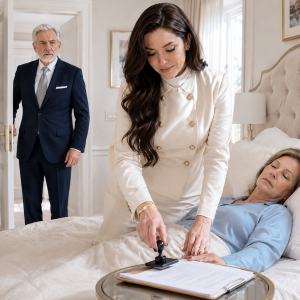
She reached for Luke’s hand. “We need to go.”
Arthur looked fully at her, disbelief slowly giving way to recognition. “Claire?”
She stopped because running would frighten the children.
“Mr. Whitmore.”
“These children—”
“Are mine.”
“They’re five, aren’t they?”
Maisie supplied the information. “We’re triplets. I came last by two minutes, but I’m not the baby.”
Arthur’s face lost its color. Both boys carried Grant’s brown eyes, straight brows, and cleft chin. When Maisie frowned, she looked remarkably like Grant’s older sister.
Claire tightened her hold on the children’s hands. “Please leave us alone.”
“Does Grant know?”
Her composure thinned. “He knew I had a medical appointment that morning. He chose not to ask why.”
“That isn’t what I asked.”
“No,” she said. “He doesn’t know.”
Arthur lowered his voice. “Claire, whatever happened between you two, he should be told.”
“You were not in that room. You did not watch him place a price beside my name while their first photograph sat in my bag.” She softened her tone. “I have spent five years giving them stability. I will not let anyone turn them into a family claim.”
Arthur’s expression held regret. “I won’t approach them. But I cannot pretend I didn’t see them.”
Claire led them away before her voice could fail. Behind her, Arthur remained beside the arrivals board, watching the four of them disappear into the crowd.
Ten minutes later, he called his longtime investigator. “Nathan, confirm where Claire has lived and review the timeline around her divorce. No contact and no intrusion. There are three children, and unless my eyes have betrayed me, Grant has no idea who has returned.”
The Truth Grant Had Purchased
Arthur soon confirmed Claire’s preservation company, the inn, and the triplets’ birth month. The dates made coincidence impossible. She had never sought additional support, used the Whitmore name in business, or spoken publicly about Grant.
Grant was in Savannah overseeing a riverfront hotel when Arthur requested breakfast. At thirty-nine, he had acquired nearly everything he once believed would satisfy him. Evelyn had remained for less than a year after the divorce. The love he had idealized was merely a memory preserved by distance; tested by ordinary days, it offered neither of them a home.
Grant never remarried.
Arthur placed a photograph from Claire’s company website on the breakfast table. She stood in the center with three laughing children around her.
Grant stared at the boys first. His coffee cup stopped halfway to his mouth.
“Who are they?”
“You already know.”
Grant set down the cup too quickly, sending coffee across the saucer. “No.”
“They were born a little more than seven months after your divorce.”
“Why didn’t she tell me?”
Arthur’s gaze hardened. “Perhaps because you gave her six million dollars and told her to vanish before asking what she had come home to share.”
Grant pushed back from the table. He remembered the handbag clutched against Claire’s side, her hand resting protectively over it, and the strange, broken laugh after the transfer arrived. For five years he had interpreted that moment as proof that she cared more about money than marriage. Now the memory rearranged itself with merciless clarity.
“Three?” he whispered.
“Two boys and a girl. Owen, Luke, and Maisie.”
Grant closed his eyes. Their names carried an intimacy he had not earned. “Where are they?”
“Claire is presenting at the Bellweather this afternoon. Understand this: those children are not missing pieces in your life. They are complete people with a mother who carried every responsibility.”
“I didn’t know.”
“No, but you created the conditions in which she believed telling you would place them at risk.” Arthur leaned forward. “If you approach her with lawyers, influence, or entitlement, you will confirm every reason she stayed away.”
Grant’s first impulse had been to call counsel. Money and authority had solved so many problems that he reached for them even when they had caused the wound.
That afternoon, Claire completed her presentation beneath the Bellweather chandeliers. When the applause ended, she saw Grant standing at the back of the room.
Silver touched his temples, but the sight of him still tightened her chest. He waited until the audience dispersed before approaching.
“Arthur told me.”
“Of course he did.”
“Are they mine?”
Claire’s eyes flashed. “They are not property.”
“That isn’t what I meant.”
“It is how men in your family speak when they believe something belongs to them.”
Grant absorbed the rebuke. “You should have told me.”
“I came home to tell you. I had the ultrasound in my bag and three pairs of socks beneath it. You handed me a contract before I could take them out.”
His face tightened as if the words had struck somewhere physical. “Claire…”
“You said you no longer loved me. You asked me to disappear. So I believed you.”
“I would never have sent my children away.”
“Perhaps not. Perhaps you would have stayed for them and resented me. Perhaps your lawyers would have designed a schedule around your convenience. I was frightened, Grant, and I had one morning to make a decision while the man I trusted treated our marriage like a failed investment.”
He lowered his head. For once, he had no polished defense.
“May I meet them?”
“Not today.”
“Then tomorrow. Or next month. Tell me what I have to do.”
Claire studied him carefully. “You begin by accepting that there may be nothing you can do. They do not owe you a place in their lives simply because you have discovered them.”
“I understand.”
“No,” she said quietly. “You are beginning to.”
Three Questions at a Garden Table

Grant did not send attorneys or arrive uninvited. Instead, he wrote to Claire, acknowledging that he had confused an old longing with love and used money to avoid an honest conversation.
At the end, he wrote, “I am asking for one conversation, supervised by you, in whatever place makes them comfortable. If your answer is no, I will respect it. I will still establish funds for their education with no conditions and no access attached, because responsibility should not be used as a key.”
Claire read the letter three times. It was the first evidence that he understood generosity could become control when tied to obedience.