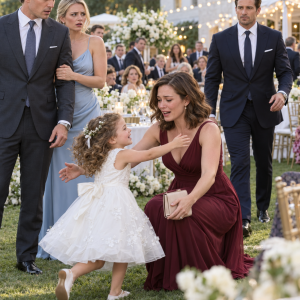
He rested both hands on his cane.
“Meredith is an adult, Claire. She doesn’t need my permission to decide how she spends her money.”
“She’s abandoning her family.”
“She’s arranging care for her daughter and recovering from an accident. That sounds like taking care of her family to me.”
Claire’s eyes filled with tears, and for a moment, I saw the younger sister I’d spent years trying to protect.
“I thought you were different,” she said to me. “I thought you actually cared whether I was okay.”
“I do care. But I can’t keep being responsible for making sure you never have a difficult month.”
She wiped her face with the back of her hand.
“Well, don’t expect me to come running when you need something.”
I looked at the hospital bed, the brace on my ankle, and the phone lying beside Dad’s letter.
“Claire, I needed something yesterday.”
She had no answer.
THE FIRST MONTH WITHOUT MY MONEY
I was discharged several days later with instructions to avoid putting weight on my injured ankle and to accept help with lifting Lily. The care agency arranged a schedule that covered the hours I couldn’t manage safely, and Natalie checked in regularly.
For the first time since Lily’s birth, I had professional support instead of promises that someone would help when it suited them.
The first week was exhausting. I needed assistance getting around the house, and even simple things like preparing a bottle required planning. Some nights I lay awake wondering whether I’d been too harsh with Mom, especially when I remembered the good things she’d done for me as a child.
She had taken me to school when Dad worked late, stayed up with me during fevers, and taught me how to make her mother’s chicken soup. Those memories didn’t disappear because she’d hurt me.
But neither did what she’d said from the airport.
Daniel confirmed that the recurring support had been voluntary and that, based on the documents he’d reviewed, I had no continuing contractual obligation to make those gifts. He advised me to keep records of the cancellation and to address any new requests individually rather than reopening an automatic arrangement.
I followed his advice.
When the third business day arrived, Mom sent three messages before noon.
“The money isn’t here.”
“Meredith, I need you to fix this today.”
“You cannot leave your mother without enough money to pay her bills.”
I didn’t respond immediately. Instead, I fed Lily, took my medication, and sat in the living room while the caregiver helped with the laundry.
That evening, I sent one message.
“The monthly payments have ended. I won’t be restarting them. If you’re having trouble covering essentials, I hope you’ll review your budget and look into available assistance. I’m not discussing this again today.”
Mom replied almost instantly.
“After everything I’ve done for you, this is how you repay me? Your father would be ashamed.”
I picked up Dad’s letter from the side table and read the last paragraph again.
Don’t let anyone convince you that love disappears when you stop paying.
I folded the paper carefully and put it back in its envelope.
THE CONVERSATION AT GRANDPA’S HOUSE
Three weeks after the accident, Grandpa invited Mom, Claire, and me to his house for a conversation. I was still using crutches, so Natalie drove me and stayed with Lily in the living room while we talked at the kitchen table.
Mom had returned from her cruise looking tired and irritated. Claire sat beside her, arms crossed, while Grandpa poured coffee into four mismatched mugs.
“I agreed to come because I thought we were going to discuss how Meredith can make things right,” Mom announced.
Grandpa set the coffeepot down.
“We’re here to listen to each other. Nobody is making Meredith write a check.”
Mom turned toward me.
“Do you know how humiliating it is to have to ask Claire to cover my groceries?”
I glanced at Claire, who looked away.
“I’m sorry you’re worried about money,” I said. “But I can’t be the only person responsible for your expenses.”
“You earn more than the rest of us combined.”
“That doesn’t mean I have unlimited money. I have a mortgage, childcare costs, medical bills, and a daughter to raise.”
Mom waved her hand.
“You’ve always managed before.”
Grandpa reached into his shirt pocket and took out a copy of Dad’s letter.
“Ellen, do you remember what Richard said about the girls before he died?”
Mom stiffened.
“I don’t see what my late husband’s private opinions have to do with this.”
“He was worried that Meredith would spend her life fixing problems that weren’t hers to solve.”
“Richard worried about everything toward the end. He wasn’t himself.”
Grandpa didn’t raise his voice.
“He was himself enough to know his daughters. And he was clear about what he wanted for both of them.”
Mom turned to me.
“So that’s it? You’re taking a letter written by a sick man and using it as an excuse to abandon me?”
I looked at the woman who had raised me, trying to find the version of her who’d once sat beside my bed when I was frightened.
“Mom, I don’t want to abandon you. I want a relationship where I can call you because I need my mother, not because you need another payment.”
She pressed her lips together.
“I can’t believe you’re making me sound like some kind of monster.”
“I’m telling you what happened. I was hurt, I asked for help, and you told me my sister would never cause that kind of inconvenience.”
Claire leaned forward.
“Can we stop bringing me into every conversation? This is between you and Mom.”
“You were on the phone telling her to refuse,” I replied.
Claire looked down at her coffee.
For several minutes, nobody spoke. Then Mom asked whether I would at least consider paying part of her rent until she could reorganize her finances.
I thought about it carefully.
“Not today. I need time to understand my own expenses and recover. You have options you haven’t explored yet, and I can’t keep making those decisions for you.”
Mom looked disappointed, but she didn’t shout.
The conversation ended without an apology or a reconciliation. Still, it was the first family meeting I could remember where I left without agreeing to pay for something.
THE YELLOW CARDIGAN
By the time Lily was four months old, I could walk short distances without crutches. The agency had reduced its hours, and Natalie still visited on weekends.
Mom and Claire contacted me occasionally, usually about practical matters. I answered when I felt able, but I no longer treated every message as an emergency. Grandpa came by most Sundays, bringing groceries I hadn’t requested and insisting that he was only there because Lily smiled whenever she saw him.
One afternoon, while putting away clothes Lily had outgrown, I found the tiny yellow cardigan Mom had bought before she was born.
It was soft, with white buttons shaped like little flowers. Mom had been so excited when she chose it that she’d called me from the store to ask whether newborns needed sweaters in spring.
I sat on the nursery floor holding it, remembering that conversation. The woman who’d bought the cardigan had sounded genuinely happy about becoming a grandmother. The woman who’d refused to help after the accident had sounded annoyed that her plans might be interrupted.
Both memories belonged to the same person.
I took a photograph of Lily wearing the cardigan, now slightly too small, and sent it to Mom without asking for anything.
A few minutes later, she replied.
“She’s beautiful. Thank you for sending this.”
I didn’t know whether our relationship would ever become what I’d hoped it could be. I wasn’t ready to trust her with an emergency, and I wasn’t going to pretend the cruise had been a misunderstanding.
But I could send a photograph without sending a payment.
That evening, Grandpa called to ask how Lily was doing. I told him about the cardigan, and he listened while I explained that I’d finally packed away most of her newborn clothes.
“She’s growing fast,” he said.
“Too fast. I wish Dad could have met her.”
Grandpa was quiet for a moment.
“He would have loved her, Meredith.”
After we hung up, I placed Dad’s letter in a small wooden box beside Lily’s baby book. The hospital bracelet I’d worn after the accident was tucked inside the envelope, a reminder of the day I’d finally read what my father had wanted me to know.
Then I carried Lily into the living room, settled into the rocking chair, and watched her reach for the little white buttons on her cardigan.
For once, my phone was silent, and I didn’t feel the need to check whether anyone was waiting for me to solve their problem.