Six Days After My Son Was Born, My Husband Took Me to Court—But He Never Expected the Burgundy Binder in My Hands
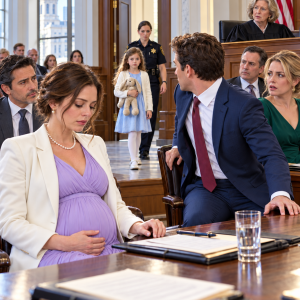
Six days after giving birth to my son, I walked into a family courtroom in Richmond, Virginia, carrying a newborn in one arm and a thick burgundy binder in the other.
My husband, Preston Calloway, was already seated beside his attorney.
His mother, Marjorie, sat directly behind him, dressed as though she were attending a charity luncheon instead of a hearing that could decide where my baby would spend the first months of his life.
Beside her sat Celeste Harrow.
The woman Preston had repeatedly called “a family friend.”
The woman who had somehow begun appearing at every family dinner during the final months of my pregnancy.
The woman who had recently started wearing a delicate pearl bracelet that looked exactly like one Preston had once given me.
Preston glanced at the binder in my hands and smiled.
It was not a warm smile.
It was the expression of a man who believed he had already arranged the ending.
His petition claimed that I had suddenly become emotionally unreliable after childbirth, left our home without explanation, and hidden our son from him.
None of that was true.
And inside the binder were months of records proving it.
When the judge entered the room, I tightened my hold around my sleeping baby and reminded myself of one thing.
For months, Preston had told everyone what kind of woman I was.
Today, I was finally going to show them what kind of husband he had been.
The Story He Had Prepared Before Our Son Was Born
Judge Evelyn Mercer looked over Preston’s petition first.
His attorney, Graham Pike, spoke smoothly.
“Your Honor, Mr. Calloway is simply asking for immediate access to his newborn son. Mrs. Calloway left the marital residence shortly after delivery and has demonstrated concerning behavior during a very vulnerable period.”
I felt my body tense.
That sentence had been carefully designed.
Concerning behavior.
Vulnerable period.
Words that sounded reasonable until someone asked what they actually meant.
Judge Mercer turned toward me.
“Mrs. Calloway, do you have counsel today?”
“Not yet, Your Honor.”
“And what are you carrying?”
I looked down at the binder.
“Records I believe the court should see before making any temporary custody decision.”
Graham immediately stood.
“Your Honor, we have not had an opportunity to review whatever Mrs. Calloway has assembled. Given that she delivered less than a week ago, we also have concerns about how accurately she may be interpreting ordinary family disagreements.”
Ordinary family disagreements.
There it was again.
A polished phrase intended to erase months of pressure.
Judge Mercer raised one hand.
“You will have time to respond, Mr. Pike.”
Then she looked at me.
“Bring the binder forward.”
My legs felt weak as I approached the clerk.
My son, Owen, slept against my shoulder, unaware that half the adults in the room were arguing over his future.
I placed the binder on the desk.
The first page read:
Documented Timeline of Financial Restriction, Custody Preparation, Medical Concerns, and Communication Prior to Delivery.
Judge Mercer read the title twice.
Preston stopped smiling.
The Medical Notes He Never Knew Existed
The first section contained records from my prenatal appointments.
Nothing dramatic.
Nothing exaggerated.
Just small details written down by people Preston had forgotten were watching.
One nurse had noted that I became noticeably quiet whenever my husband entered the examination room.
Another recorded that Preston answered questions for me even when the questions were directed at me.
Then came a note from Dr. Serena Caldwell, my obstetrician.
Three weeks before Owen was born, I had asked to speak with her privately.
I told her Preston had begun saying things like:
“A responsible mother knows when she needs someone else making decisions.”
And:
“If you become difficult after the baby arrives, I’ll have no choice but to protect him from the confusion.”
At the time, I kept telling myself he was simply anxious about becoming a father.
Dr. Caldwell did not tell me what to think.
She simply wrote down what I had told her and quietly gave me information for a patient advocate.
That documentation was now sitting in front of a judge.
Judge Mercer looked toward Preston.
“Were you aware your wife had expressed concerns about custody before the child was born?”
Preston shifted in his chair.
“She was anxious throughout the pregnancy.”
“That was not my question.”
His attorney leaned toward him, but Preston answered.
“No. I wasn’t aware she had said those things to her doctor.”
I almost laughed.
Of course he was not aware.
He believed private conversations belonged only to him.
The Address I Supposedly Hid
The next part of Preston’s petition claimed he had no idea where Owen and I were staying.
According to his filing, I had taken the baby from the hospital and disappeared.
Judge Mercer asked me directly.
“Mrs. Calloway, where did you go after being discharged?”
“To my friend April Bennett’s house.”
“Did your husband know the address?”
“Yes, Your Honor.”
Preston turned sharply toward me.
I opened my diaper bag and handed the clerk a printed page.
“The messages are under Section Four.”
Judge Mercer found them.
The exchange had taken place the morning I left the hospital.
My message read:
“I’m being discharged this afternoon. Since you said you would not come unless I signed the temporary custody documents, I’m going to April’s house with Owen. The address is 46 Hawthorne Ridge. Please communicate with me by text and arrange any visit in advance.”
Preston had answered:
“You’re making this much worse than necessary.”
I replied:
“Owen is healthy and being cared for. You know exactly where we are.”
Then Preston wrote:
“If you make me handle this through court, I won’t make it easy for you.”
Judge Mercer remained silent for several seconds.
Then she looked at Graham.
“Mr. Pike, the petition states Mrs. Calloway’s location was unknown.”
Graham’s expression tightened.
“My client’s position was that he did not have meaningful access.”
“That is different from not knowing the location.”
No one spoke.
I looked at Preston.
For the first time that morning, uncertainty appeared in his face.
The Money Disappeared Before I Left
The financial section was not about some enormous hidden fortune.
It was more ordinary than that.
And perhaps that made it worse.
Before pregnancy, I had worked as a children’s librarian.
I loved my job.
Preston eventually convinced me to leave.