The Empty Place Setting

“Put that plate back, Nora. June doesn’t get dinner.”
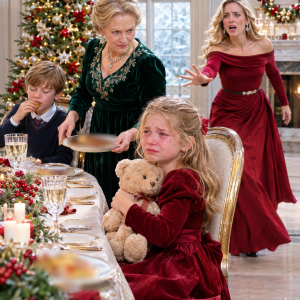
My mother said it from the head of the table, one hand resting on the silver serving spoon, as if she were announcing a rule everyone should have known already. My eight-year-old daughter sat beside me with her knitted fox tucked in her lap, staring at the empty space in front of her. Across the table, my nephew was already reaching for another slice of ham.
My sister laughed.
I did not raise my voice. I did not ask my mother to reconsider. I picked up June’s coat, helped her into it, and carried the pecan pie I had baked out to the car. We drove home through the Christmas lights in silence, and by the time we reached our apartment, June’s stomach had begun to growl.
That night, at 9:47, my father sent me a text.
“We need the rent money tomorrow.”
I looked at the message for a long moment before answering.
“Ask your favorite grandchild’s parents.”
Then I opened my laptop and sent an email that changed what my parents thought would happen in January.
Christmas at my parents’ house in Roseville, Iowa, always began at three. My mother, Patricia, believed that arriving at three meant you were late, so June and I pulled into the driveway at 2:40, carrying two pies and a sweet potato casserole. The house was a large, comfortable rental on a quiet street, with pale siding and an old maple tree in the front yard. My mother complained about the kitchen being too small, though it had more counter space than the apartment where June and I lived.
My parents had moved there after my father’s small repair shop closed and they sold the house where I had grown up. They told everyone at church that Dad’s pension covered the rent. My mother, who worked a few mornings a week at the church office, made a point of saying she had never accepted help from anyone.
I knew better. For more than five years, I had been sending them the rent money.
I was a procurement coordinator for the county school district. My work involved comparing invoices, checking dates, and making sure a number on one page matched the number on another. I liked details. At home, though, I had spent years trying not to notice how much of my family’s comfort rested on my willingness to stay quiet.
June had spent the morning braiding her own hair. One braid was a little tighter than the other, but she was proud of them. She wore a forest-green velvet dress she had picked out in November, and carried Pepper, a small orange fox her other grandmother had knitted for her. June’s paternal grandmother had driven hours to see her in school plays and had made Pepper shortly before she passed away the previous spring. One ear was longer than the other, and June loved it exactly that way.
“Can Pepper sit at the table?” she asked as I turned off the car.
“She can sit on your lap, sweetheart. Grandma likes the table a certain way.”
June nodded, accepting the answer with the solemnity of a child who has learned that some rules cannot be negotiated.
Inside, torn wrapping paper covered the living room rug. My sister, Beth, sat on the sofa beside her husband, Dean, while Dad watched a football game from his recliner. Their son, Eli, was surrounded by new toys: a game console, a remote-control truck, and a large mug my mother had ordered for him. Gold letters on the mug read, “Grandma’s Favorite.”
At Thanksgiving, she had shown it to me with a laugh.
“It’s just a joke,” she’d said. “He knows we love all the grandchildren.”
June’s gift was a thin coloring book with a bright clearance sticker still on the back. She thanked her grandmother as if it were something precious, then sat down with Pepper and began coloring.
For years, I had followed the same private routine at family gatherings: smile, help in the kitchen, keep June occupied, and leave without giving anyone a reason to criticize us. I had hoped that if I could just make each visit easy enough, my mother might eventually soften toward my daughter.
I was still hoping when Eli walked over to June’s chair.
“What is that thing?” he asked. “It looks like a rat.”
“She’s a fox,” June said. “Her name is Pepper.”
Eli grabbed the toy by its long ear and swung it in a circle. June stood up, reaching for it, but he swung it again. The seam tore, and white stuffing drifted onto the rug. June pulled Pepper against her chest, her face flushing as she looked at the damaged ear.
Then she said something she had been holding in for months.
“You ruin everything. That’s why nobody wants to sit with you at lunch.”
Eli stared at her, then burst into tears and ran to my mother. I knew what June had said was cruel. I also knew she had watched Eli struggle to make friends at school and had once told me she felt sorry for him. If anyone in the room had asked, I would have helped the children apologize to each other. June could own her words. Eli could own what he had done to Pepper.
Nobody asked.
My mother set down the carving knife and led us into the dining room. She served Dad, Beth, Dean, and Eli. She gave Eli a generous helping of ham and potatoes, then put more on his plate when he asked. When she reached my place, I picked up the empty plate in front of June and held it out.
“Put that plate back, Nora. June doesn’t get dinner.”
I thought I had misheard her.
“What did you say?”
“She made Eli cry,” my mother replied. “She can sit there and think about it while the rest of us eat.”
Beth laughed, leaning toward June.
“Maybe next time you’ll think before you say something mean.”
Eli had already stopped crying. He looked at my mother and asked for more ham.
“Of course, honey,” she said, reaching for a clean plate.
Dad stared at the table. Dean studied his vegetables. June held Pepper in her lap and looked at the blank space where her dinner should have been. She was trying not to let anyone see how embarrassed she felt.
I knew that expression. When I was nine, my sister had cried over a wishbone, and my mother had taken my dinner away because I had won the larger piece. I remembered the smell of the food, my stomach tightening, and my father watching the game through the open doorway instead of looking at me. I had told myself that if I stayed very still, my mother might change her mind.
She did not.
When June was born, I had promised myself she would never have to sit at an empty place setting while the adults who claimed to love her ate around her. Now I could feel that old promise pressing against my chest.
I could have argued. I could have begged. My mother would have turned either choice into proof that I was unreasonable. So I put down my fork and stood.
“Come on, sweetheart. We’re going home.”
“Here we go,” my mother said, rolling her eyes. “You always turn everything into a scene.”
Dad finally spoke.
“Nora, sit down. It’s Christmas.”
“Exactly,” I said, helping June with her coat. “That’s why we’re leaving.”
I walked into the kitchen and picked up the pecan pie I had brought. My mother started to rise from her chair.
“You can’t take that.”
“I made it. June and I will have it at home.”
We left the pumpkin pie behind. I was angry, but not so angry that I wanted to deprive the rest of the family of dessert.
On the drive home, June’s stomach growled. She pressed both hands against it and looked at me as if she had done something wrong.
“Sorry,” she whispered.
“Don’t apologize for being hungry,” I told her. “Your stomach is doing exactly what it’s supposed to do.”
At home, I made cinnamon toast while she sat at the kitchen table with Pepper. She asked whether her words to Eli had been mean. I told her they had, and that she would need to apologize for using something painful about school to hurt him.
Then I told her what my mother had done.
“Grandma was wrong to keep dinner from you. That wasn’t a fair consequence, and it wasn’t your fault. You deserved to eat.”
June nodded, though she did not look entirely convinced. She ate toast and some pie, then went to bed with Pepper tucked beneath her arm.
At 9:47, Dad’s text arrived.