“Oh, sweetheart. I’m so sorry. I’m so, so sorry.”
She leaned against my shoulder, and for a moment neither of us spoke.
Then, in a small voice that sounded much younger than eight, she asked, “Is Daddy okay?”
That question has stayed with me more clearly than almost anything else from that evening.
After everything she had experienced, after walking through unfamiliar streets in the winter cold while trying to protect her little sister, she was still worried about her father.
“Daddy’s okay, honey,” I told her, smoothing her hair. “He’s going to be okay. I need you to tell me what happened at Grandma’s house.”
She looked down at the blanket.
“Grandma was mad.”
I waited, afraid that if I interrupted, she might stop talking.
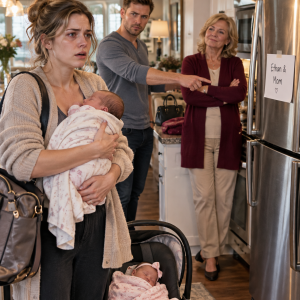
Hannah explained that she had rung the doorbell twice before my mother opened it, and that instead of welcoming them inside, Grandma had asked where I was.
“I told her you went to see Daddy,” Hannah said. “But she said you weren’t supposed to leave us without asking.”
According to Hannah, my mother had been upset about an earlier disagreement between us and believed I had been expecting too much help from her. She told Hannah that I needed to learn to make arrangements properly, then instructed both girls to wait outside while she closed the door.
Hannah had assumed she would return.
She stood on the porch with Ellie beside her, watching the light through the narrow window next to the door, and when several minutes passed without anyone appearing, she knocked again.
This time, nobody answered.
“I told Ellie maybe Grandma was getting our coats ready,” Hannah said quietly. “But then it got colder, and she started crying.”
My daughters were already wearing winter jackets, but neither had gloves thick enough for a long walk, and Ellie had left her hat in the car.
Hannah said she had tried the doorbell once more before deciding they should go home.
She knew the general direction of our neighborhood, having traveled that road many times in the car, but she didn’t understand how far away it really was or how confusing the streets would become after dark.
At first, Ellie walked beside her, holding tightly to her hand, but as the wind grew stronger, she began complaining that her feet hurt.
Hannah tried to encourage her.
“I told her we could see our Christmas tree when we got home,” she whispered. “I said Daddy would come home soon, too.”
Eventually, Ellie became too tired to continue, so Hannah lifted her little sister into her arms and carried her as far as she could.
She stopped several times to rest, then kept going because she didn’t know what else to do.
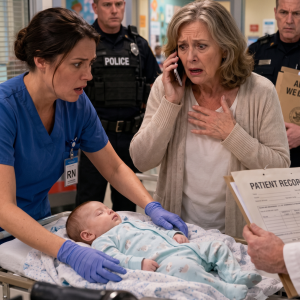
A passing driver eventually noticed the two girls near a neighborhood intersection and stopped to help. The woman called emergency services, wrapped the children in an extra coat from her car, and stayed beside them until assistance arrived.
Hannah remembered telling the officer my phone number, something Daniel and I had practiced with her for emergencies.
After that, her memories became unclear.
I listened without interrupting, holding her hand beneath the blanket, while an understanding slowly settled over me that I could hardly bear to accept.
My little girl had been placed in a situation no child should have to manage, and instead of waiting for someone to rescue her, she had spent every bit of strength she possessed trying to bring her sister home.
The Conversation My Parents Could Not Explain
Daniel was awake when I returned to his hospital room later that evening, after the doctors had assured me that both girls were improving and would remain under observation.
He took one look at me and reached for my hand.
“Where are they?”
I sat beside him and explained everything, beginning with the call from the officer and ending with Hannah’s account of the closed door.
Daniel listened without speaking, but I could see the muscles tightening along his jaw.
When I finished, he looked toward the telephone on the bedside table.
“Call your parents.”
I hesitated, not because I wanted to protect them, but because I was afraid of what they might say.
My father answered after several rings.
“Rebecca?”
“Dad, did you see the girls leave your house?”
There was a pause long enough for me to hear the television playing somewhere behind him.
“Well, yes,” he finally admitted. “I saw them walking down the driveway.”
I closed my eyes.
“You saw an eight-year-old leaving with a three-year-old, and you didn’t go after them?”
He began explaining that my mother had been upset, that she believed I had taken their generosity for granted, and that she wanted me to understand that I couldn’t simply arrive whenever I needed childcare.
His words seemed to drift around the room without making sense.
“Dad, Ellie is three,” I said. “Hannah is eight. They didn’t know how to get home.”
He sighed.
“Your mother thought you’d come back once you realized they weren’t inside.”
“But you watched them walk away.”
Another silence followed.
Then I heard my mother’s voice in the background.
“Give me the phone.”
A moment later, she was speaking directly to me, her tone carrying the familiar impatience I had heard throughout my childhood.
“Rebecca, you can’t keep expecting us to rearrange our lives whenever something comes up.”
I looked at Daniel, who was watching me with an expression I had rarely seen on his face.