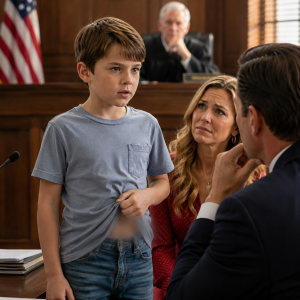
Pike and Evan faced extensive federal proceedings. Travis received consideration for cooperating and surrendering the records he had taken. Brooke accepted responsibility for falsifying sections of the guardianship petition and accessing my private files. Michael admitted his financial misconduct and coercive behavior; because he cooperated fully and had no prior record, the court imposed strict probation, restitution, counseling, and community service.
Some people thought I should have demanded harsher consequences. They misunderstood me. Justice required the truth to become public, the vulnerable to be protected, and each participant to carry responsibility for his or her choices. It did not require me to stop loving my son, nor did love require me to rescue him from the results of what he had done.
Michael moved into a small apartment across town. For four months, I did not invite him home. Every Sunday he sent one message: “I hope you’re doing all right.” I rarely replied. Then, in late March, I wrote: “Coffee. Tuesday. Ten.”
He arrived five minutes early and sat at the table George had built. He looked neither successful nor defeated, only stripped of the performance he had worn for years.
“I do not expect forgiveness,” he said.
“Good. Tell me the truth instead.”
He admitted that he had been selfish, frightened, and eager to blame me for problems he had created. At last he said, “I needed you to be weak, because then taking your choices felt like helping. When you proved you were still stronger than I was, I punished you for it.”
I placed a key on the table. His eyes widened.
“What is that?”
“Your father’s workshop.”
“Why are you giving it to me?”
“The roof leaks.”
He laughed, surprised, and after a moment I joined him. Our reconciliation began there, not with a grand declaration, but with old shingles and a bucket of roofing nails.
Over the following year, Michael repaired the workshop, then the porch and upstairs bathroom. I paid him nothing, and he asked for nothing. Brooke lived separately, attended counseling, found steady work, and paid restitution. Eventually she sent me a letter that did not plead for absolution. She wrote that she had turned age into a weapon and care into control, that she was ashamed, and that I owed her no response. Because she asked for nothing, I believed her more than I had believed all her courtroom tears. Three months later, I called. We spoke for twelve minutes. It was enough for a beginning.
Claire became my friend and brought me a box of unopened letters George had prepared. One was addressed to Michael. The final paragraph read, “Money eventually reveals what you value. If you ever choose it over your mother, stop, because you are about to lose something no account can return.”
Michael wiped his eyes. “Would it have changed me if I had read it sooner?”
“I don’t know. Wisdom is famous for arriving just after it would have been most convenient.”
He smiled. “Dad would have liked that.”
“Your father would have repeated it at dinner and claimed it was his.”
The laughter that followed made the kitchen feel occupied by all three of us again.
George had transferred Hawthorne Hall to Harbor Light years earlier. His instructions proposed transforming the estate into a center offering free legal guidance and financial counseling to older adults facing exploitation. “Turn the place where they concealed money into a place where people learn to protect their freedom,” he had written.
One year after the courtroom hearing, the Donnelly-Ashford Center for Financial Dignity opened its doors. Michael installed the sign himself. From the front steps, I told the crowd that age does not erase autonomy, that concern without respect can become control, and that love demanding ownership is not love at all.
Part Six: The Home We Built Again
After the opening ceremony, I wandered through the old library, now bright with afternoon sun. Beneath the mantel lay one last envelope from George, directing me behind a portrait. A small wall safe held the wedding ring I had believed lost thirty-three years earlier and a note explaining that he had found it beneath our porch steps and planned to return it on our fiftieth anniversary. I slid it onto my finger. It still fit.
Beneath the velvet lining was a photograph of George, Nathan, Dean Keller, and a young woman whom Claire recognized as her mother. The woman’s maiden name was Pike. Lawrence Pike was her older brother. Claire’s mother had worked in his office, discovered coded transfers, and secretly aided Nathan’s investigation. Dean and George had helped her leave Iowa safely when Lawrence threatened to ruin her career and take her little girl from her. Nathan later married her, and together they concealed the family connection so Claire could grow without Lawrence’s name attached to her life.
Claire was furious, as I had been, at learning that love had once again been used to justify silence. Her mother offered an apology without excuses. They did not repair everything in one conversation, but they began. Some doors, I learned, should be opened privately and slowly.
The final recovered value eventually reached $190,842,611. Most went to beneficiaries, while a portion permanently funded the center. I met an eighty-nine-year-old former school custodian whose lost retirement funds had forced him and his wife to sell their home decades earlier. He arrived holding her photograph and said she had always believed someone would put the matter right. I wished aloud that she could have seen it. He touched the photograph gently and said, “I believe she can.”
My relationship with Michael remained imperfect, which is to say it became real. He completed probation and began volunteering at the center twice a week. At first, I assumed guilt brought him there. Then I watched him sit patiently with an older widower whose checking account showed unexplained withdrawals. There was no audience and no praise waiting for him, only steady attention. Responsibility was teaching what comfort never had.
Brooke and Michael eventually chose counseling together and, much later, built a different marriage in a house that was emphatically not mine. The first time Brooke returned to my porch, she asked whether I wanted her inside.
“You helped change my locks once,” I said.
Her face tightened until I added, “So you can help me oil the hinges.”
She laughed through tears. It was not complete forgiveness, but healing rarely arrives complete. More often it comes carrying a toolbox.
On my seventy-fourth birthday, Michael arranged a gathering at the center. A screen displayed thousands of names followed by the amount returned. Then he stood before the beneficiaries, staff members, and families and said, “My mother spent her career following money because she believed numbers revealed the truth. I spent years believing money could solve my failures, and I nearly lost the person who had spent her life helping me survive mine. I cannot undo what I did, but I can become someone who would never do it again.”
Forgiveness did not arrive like thunder. It came as the quiet knowledge that I no longer wished to carry one terrible season into every remaining year. I embraced my son, then held out an arm to Brooke. None of us pretended the past had vanished. We simply stopped giving it authority over every future moment.
Years later, people still asked what happened to the eleven million dollars, and I corrected them with the final figure. When they asked what happened to my family, I gave a shorter answer: we became honest. Not perfect—honest.
Michael never regained access to my accounts. That boundary remained. Brooke never again called herself my caregiver; she learned that care is earned through trust. Claire became the daughter of my heart. The center expanded into five states, and the estate once associated with hidden retirement funds became a place where older people found advocates who listened before deciding what was best for them.
On my eightieth birthday, Michael gave me a handsome cane with a silver handle. Engraved along its side were the words STILL DANGEROUS TO HERSELF, borrowed from his original guardianship petition. I raised the cane; he ran around the kitchen while Brooke and Claire shouted at both of us. I caught him near the pantry, mostly because he was laughing too hard to escape.
That evening, I sat beneath the maple tree while fireflies moved across the yard. The woman who had entered court in a navy coat believed she was fighting only for her house, her savings, and the right to make her own decisions. She could not have known that she was about to uncover her husband’s unfinished work, return nearly two hundred million dollars to thousands of families, lose her son for a season, and find him again as a humbler man.
Reconciliation was not a journey backward. It was the work of building a future sturdy enough to hold the truth. George’s greatest secret was not the account, the hidden archive, or the vault beneath Hawthorne Hall. It was the choice he had prepared for me. When the moment arrived, I chose neither greed nor revenge nor silence. I chose justice, and when justice had been served, I chose something harder: love with boundaries, truth, and my own name still firmly attached to my life.
The next morning, a woman named Margaret arrived at the center between her two daughters. She believed someone had been taking money from her account; her daughters feared she had become confused. I invited all three into the consultation room, opened a yellow legal pad, and looked directly at Margaret.
“Tell me what you have noticed.”
Her shoulders eased. Then she began.
I listened, because justice does not always begin beneath courtroom lights or inside a vault. Sometimes it begins when one person looks at another and says, without taking away her voice, that she deserves to be heard.