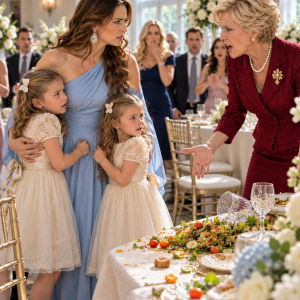
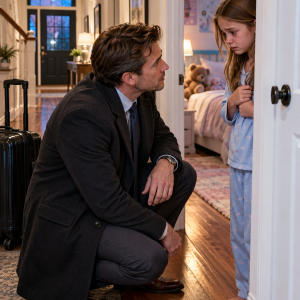
Three weeks earlier, Sadie had returned from my mother’s house wearing a loose cardigan despite the warm weather. She had complained that her wrist hurt, but Brooke said she had stumbled while playing in the backyard. My mother confirmed it, and I believed them.
Dr. Hart turned to Sadie.
“Has anyone hurt you before?”
Sadie looked at me, then at Lorraine.
My mother rose suddenly.
“She’s tired and confused. She doesn’t need to answer any more questions.”
Dr. Hart stepped between her and Sadie.
“Please sit down, ma’am.”
Sadie’s lower lip trembled.
“Aunt Brooke gets mad when Grandma watches me.”
My mother moved toward her, but Dr. Hart blocked the way and reached for the telephone. Hospital security arrived first, followed by two police officers and a child-support specialist named Rebecca Sloan.
One officer asked Lorraine to wait outside. She refused until he warned that she would be escorted out if she continued interfering.
“This is a family matter,” she insisted. “You’re frightening a child over a misunderstanding.”
The older officer, Patrick Nolan, answered calmly.
“A physician has identified injuries from separate occasions. We are required to examine what happened.”
As they led my mother into the hallway, she turned toward me.
“You’re allowing strangers to tear this family apart.”
Even then, she behaved as though the greatest harm was not what had happened to Sadie, but the possibility that someone outside the family might learn about it.
The Secret Sadie Had Carried

Rebecca interviewed Sadie in a smaller room while I watched through a window with Grant, who had arrived after arranging for a neighbor to care for our dog. Rebecca used simple, careful questions and never suggested an answer.
Sadie explained that Brooke was usually at Lorraine’s house during her visits. Brooke became angry when Sadie spoke too loudly, touched anything on the bathroom counter, or asked to telephone us.
The wrist injury had not happened outdoors.
Sadie had spilled orange juice on a stack of magazines. Brooke twisted her arm behind her and pushed her against the dining table. When the wrist began swelling, my mother placed it in a wrap, covered it with a sweater, and told Sadie not to worry me.
The older injury near her jaw happened after she refused to finish a plate of food.
“Grandma said Aunt Brooke was under a lot of pressure,” Sadie whispered. “She said I had to stop making things difficult.”
Grant turned away from the window. His face had gone pale.
Months earlier, he had told me he did not want Sadie staying at my mother’s house while Brooke lived there. He had noticed the way Brooke mocked her for being sensitive and how Sadie became quiet whenever her aunt entered a room.
I had defended my family.
I had accused Grant of judging Brooke based on her worst moments. Now I understood that those moments had been warnings, and I had helped explain them away.
Police found Brooke at my mother’s home before noon. She had packed two bags and requested a car to take her to the airport. At first, she called the birthday incident an accident. Then she claimed Sadie had invented the earlier events. Finally, she suggested Grant and I had influenced our daughter because we resented her.
The birthday recording told a different story.
Several parents had preserved the video, and one had continued filming after Sadie fell. In the background, my mother’s voice could be heard clearly.
“Brooke, I told you—not so hard this time.”
Those few words changed the investigation. They indicated that Lorraine had witnessed similar behavior before.
Investigators later reviewed messages between my mother and sister. One from Brooke referred to Sadie’s swollen wrist and asked what would happen if I noticed. Lorraine’s response was brief.
“Keep the cardigan on her. I’ll say she slipped outside.”
I read the printed exchange beside Sadie’s hospital bed. My grief did not disappear, but beneath it, something firm began to take shape.
I looked at Officer Nolan.
“Please document everything both of them did. I will cooperate fully.”
My mother was ordered to have no contact with Sadie while the case proceeded. She telephoned repeatedly until Grant turned off my phone. By evening, relatives were sending messages. Some asked about Sadie, but others said I was ruining Brooke’s life over a joke. An uncle suggested that children often exaggerated. A cousin claimed Sadie might simply have fragile bones.
“They weren’t in that examination room,” Grant said. “They didn’t see those images, and they didn’t hear her speak.”
Sadie remained in the hospital overnight. Her cheek would heal, but her wrist had mended incorrectly and required months of physical therapy.
The deeper wounds were harder to measure.
That night, she awakened crying and asked a nurse to check whether Brooke was in the hallway. I sat beside her until morning, holding her uninjured hand.
“I’m sorry I didn’t know,” I told her.
She stared at the blanket.
“Grandma said you’d be mad if I told you.”