“We need $1.1 million.”
Those were almost the first words my father said to me after nineteen years.
He was standing outside my condo in Dallas with one hand in his coat pocket. My mother stood beside him holding a leather purse against her stomach. Neither of them had called first.
I was thirty-five years old.
The last time I had seen my father, I was sixteen, standing on our front porch with two wooden crutches under my arms and my clothes stuffed into a black trash bag.
Now Robert Carter looked past me into my condo as though he were checking whether I could afford what he was about to ask for.
“It’s for Jessica,” Mom said.
I kept one hand on the door.
“Of course it is.”
Dad frowned.
“Can we come inside?”
“No.”
For a few seconds, nobody moved.
Mom finally lowered her voice.
“Your sister is having some problems with an audit. It’s complicated, Emily. She needs help before things get worse.”
“And you need $1.1 million?”
Dad corrected me.
“She needs it.”
That distinction told me almost everything I needed to know.
Nineteen Years and One Request
I asked the obvious question.
“Why are you asking me?”
Dad looked irritated that I had made him explain.
“Because you have it.”
Not because you’re her sister.
Not because we didn’t know where else to turn.
Because you have it.
Mom touched his sleeve.
“Emily, please. We know you’ve done well for yourself.”
I almost laughed.
They knew I had done well.
Apparently that was the extent of what they knew about me.
They didn’t know I drank my coffee black now. They didn’t know I’d moved twice in the last five years. They didn’t know Linda, my mother’s younger sister, had needed knee surgery the previous spring and I’d spent four nights sleeping in a chair beside her hospital bed.
They didn’t know anything that couldn’t be found through a Google search.
But they knew I had money.
I was the founder of Carter Property Investments, a commercial real-estate investment company I’d built from a borrowed desk, a used laptop, and three small clients. We now had offices in Dallas and Austin.
Dad nodded toward my living room.
“You clearly aren’t struggling.”
I looked at him.
“Is that your argument?”
“My argument is that family helps family.”
That sentence brought back the black trash bag.
I could still remember the way it stretched around the corners of my textbooks.
I had lost my left leg when I was ten after a serious illness. At first my parents had been attentive. Mom slept beside me in the hospital. Dad carried me from the car when I came home.
Then recovery became inconvenient.
Physical therapy cost money. Prosthetics needed replacing as I grew. I moved slower. I needed rides.
Jessica didn’t.
She was three years younger than me, healthy, outgoing, pretty in the effortless way my mother valued.
When Jessica needed dance lessons, they found the money.
When I needed better crutches, Dad told me the old ones still worked.
By sixteen, I had learned not to ask.
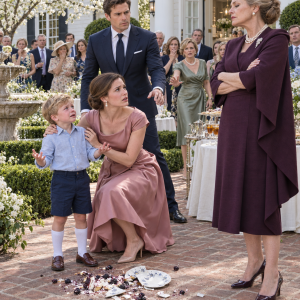
Then came the family photo.
Mom had hired a photographer because Jessica had won some school award. Relatives were at the house, and Dad had opened wine.
I caught one crutch on the edge of a rug.
I fell.
A glass went down with me and red wine spread across Mom’s cream-colored carpet.
Dad didn’t yell immediately.
He walked into the kitchen, pulled a black trash bag from under the sink, and threw it beside me.
“Pack whatever you need.”
I thought he was trying to scare me.
He wasn’t.
Mom stood beside the staircase while I put clothes into the bag.
She never told him to stop.
Aunt Linda picked me up forty minutes later.
I never moved back.
So when my father stood outside my condo nineteen years later and told me family helped family, I didn’t argue with him.
I simply said:
“I’m not giving Jessica $1.1 million.”
Mom’s face changed.
“You haven’t even heard what happened.”
“Then tell me.”
Neither of them did.
That was when I became interested.
Dad finally said the audit would begin in less than two weeks.
“There are discrepancies that need to be corrected.”
“What kind of discrepancies?”
“Accounting.”
“At Jessica’s company?”
Mom looked at Dad.
He answered.
“At a foundation.”
“Which foundation?”
Another pause.
“The Brooks Family Foundation.”
That name I knew.
Daniel Brooks, Jessica’s fiancé, was the son of Michael Brooks, founder of Brooks Development Group.
My company had been discussing a joint commercial project with them for nearly four months.
My parents apparently didn’t know that.
I kept my face still.
“Why does Jessica owe their foundation $1.1 million?”
Mom immediately shook her head.
“She doesn’t owe it.”
“Then why does she need exactly $1.1 million before an audit?”
Dad stepped closer.
“You’re making this harder than it needs to be.”
I moved the door toward the frame.
“No. I’m making you answer a question.”
He didn’t.
I closed the door.
Then I called someone who could.
The Number That Didn’t Make Sense
The next morning, I asked a private investigator I’d used on two previous business matters to look into Jessica’s financial situation.
I gave him one instruction.
Find out why $1.1 million mattered.
I didn’t call Jessica. I didn’t call Daniel. I went to work and waited.
Three days later, the investigator called.
“The audit isn’t the beginning of this.”
I turned away from my office window.
“What is?”
“A car accident.”
A month earlier, a twenty-four-year-old woman named Megan Wilson had been struck by a vehicle late at night outside Dallas.
She survived, but her injuries were severe.
She could no longer walk.
The vehicle had allegedly left before police arrived.
There were questions about who had been driving.
And Jessica’s name had surfaced.
I sat down.
“Are you sure?”
“Enough that you should keep listening.”
Megan had previously worked for a company connected to Brooks Development Group. After the accident, her family had reportedly been approached through intermediaries about a private financial settlement.
They refused.
Then things became strange.
A witness became difficult to locate.
Security footage from a nearby business was reportedly unavailable.
Jessica’s name disappeared from conversations where it had initially appeared.
But that still didn’t explain $1.1 million.
The investigator called again two days later.
This time he had the answer.
Jessica had access to accounts connected to the Brooks Family Foundation.
The foundation funded medical programs for children.
Over several months, approximately $1.1 million had been routed through questionable vendors and invoices.
The audit was scheduled in twelve days.
I leaned back in my chair.
“She took it?”
“That’s what the records appear to suggest.”
I looked at the legal pad on my desk where I had written the number.
$1,100,000.
My parents hadn’t come to ask me to save Jessica from an audit.