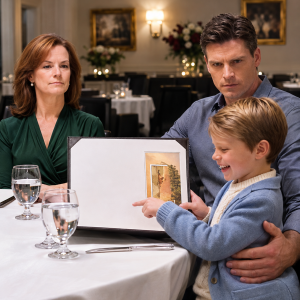
The Evening I Finally Chose My Son

My mother had always insisted that nothing was more important than family, and for most of my thirty-three years, I had arranged my entire life around those words, believing that being a good daughter meant showing up whenever someone needed me, even when doing so required sacrifices that nobody else seemed willing to make.
It took a shattered dinner plate, a ruined Christmas sweater, and the frightened expression on my nine-year-old son’s face for me to understand how differently my mother and I defined love.
My name is Natalie Bennett, and I work as a senior procurement manager for a regional medical equipment distributor in Pittsburgh, Pennsylvania. My responsibilities involve negotiating supplier contracts, overseeing purchasing budgets, and making certain that every substantial expenditure serves a legitimate purpose.
I had built a comfortable life through years of careful decisions, long working hours, and a willingness to postpone things I wanted until I could genuinely afford them.
Unfortunately, my family had come to regard that comfortable life as something they were entitled to share without accepting any of the responsibilities that had made it possible.
Seven years earlier, my father, Raymond, had lost his position as a maintenance supervisor at a manufacturing facility outside Pittsburgh. Although he received a modest severance package, my parents continued spending as though another paycheck would arrive every Friday, and by the following spring, they were facing the possibility of losing their four-bedroom home near Cranberry Township.
At the time, I was recently divorced, raising my two-year-old son, Oliver, and living in an apartment where the heating pipes rattled whenever the temperature dropped below freezing.
Nevertheless, when my father called to explain their situation, I immediately began looking for a solution.
Rather than simply covering their overdue mortgage payments, I arranged to purchase the property myself, using a substantial portion of my savings and financing the remainder through a bank.
My longtime friend and attorney, Meredith Collins, prepared a rental agreement allowing my parents to remain in their home for four hundred dollars a month, considerably less than what I would be spending on the property.
My mother, Patricia, objected to signing a long-term lease.
“We’re your parents, Natalie, not strangers renting a house from you. Let’s keep it month-to-month until your father gets back on his feet.”
I agreed because I genuinely believed the arrangement would be temporary.
My father never returned to full-time employment, and the temporary arrangement gradually became a permanent expectation.
Then there was my younger brother, Brandon.
Two years younger than me, Brandon had always possessed the remarkable ability to turn his mistakes into somebody else’s responsibility. When he lost his apartment after falling behind on rent, my mother persuaded me to let him occupy a townhouse I had purchased as a long-term investment for Oliver’s education.
The property could have rented for fourteen hundred dollars a month, but I agreed to accept five hundred from my brother.
Even that proved difficult for him.
When Brandon announced that he had found work installing commercial fencing and needed a reliable pickup truck, my parents once again approached me.
“Your brother finally has a chance to build something for himself,” my mother explained. “Surely you wouldn’t stand in the way of that just because his credit isn’t as good as yours.”
I helped finance the truck, which carried a monthly payment of $780, and arranged for the payments to come directly from my account, with the understanding that Brandon would reimburse me.
He did so twice.
Over the following years, I also paid for family telephone plans, my parents’ automobile insurance, major household repairs, and a monthly allowance of six hundred dollars that my mother insisted she needed for groceries and other essentials.
Whenever I considered reducing that assistance, I remembered the sacrifices my parents had made when I was young, and I convinced myself that helping them was simply part of being a responsible adult daughter.
What I failed to recognize was that my generosity had gradually stopped being appreciated and had become something my family believed they could demand.
The Little Boy Who Never Quite Belonged
Oliver was nine years old when everything changed, and although I realize every mother sees something extraordinary in her child, there was a gentleness about my son that seemed increasingly rare in the world around him.
He loved building elaborate wooden models, reading books about wildlife, and collecting interesting stones during our walks through the neighborhood. He could spend an entire afternoon watching birds outside our kitchen window, carefully recording their colors and markings in a little notebook.
He was also exceptionally considerate, remembering people’s birthdays, offering to carry groceries, and thanking restaurant servers without needing to be reminded.
My parents, however, regarded his quiet personality as a weakness.
My father preferred Brandon’s two sons, who enjoyed football, wrestling, and noisy competitions in the backyard, while my mother frequently suggested that Oliver needed to become tougher.
“You worry about that child too much,” she would tell me. “He’s going to have a difficult time in the real world if you keep protecting his feelings.”
Sometimes she made those remarks while Oliver was sitting close enough to hear every word, and although I occasionally defended him, I usually tried to redirect the conversation rather than create an argument.
Looking back, I wish I had understood that keeping the peace between adults should never have come at the expense of a child’s confidence.
On December 28, we were invited to my parents’ annual year-end dinner, a gathering my mother considered an important family tradition.
Oliver had received a beautiful powder-blue knitted sweater for Christmas, decorated with a small embroidered golden retriever near the chest, and he had chosen to wear it because he wanted to look especially nice for his grandparents.
Before we left home, he stood in front of the hallway mirror, carefully smoothing his brown hair and adjusting the sleeves.
“Do you think Grandma will let me help with dinner this time?” he asked. “Mrs. Henderson taught us how to measure ingredients properly at school.”
“You can certainly offer, sweetheart,” I replied, although experience told me that my mother would probably send him away from the kitchen.
We arrived shortly after four-thirty, carrying a homemade apple crumble and a small arrangement of winter flowers.
My father was watching television in the living room, while Brandon stood near the kitchen counter, talking loudly about another disagreement he had experienced at work.
My mother accepted the flowers without much enthusiasm, then looked Oliver up and down.
“Goodness, Natalie, couldn’t you find him a more grown-up sweater? He’s nine, not four.”
Oliver glanced down at the little embroidered dog.
“I picked it myself, Grandma. I really like dogs.”
“Well, go sit somewhere and stay out of the kitchen. I’ve got enough to do without children getting in my way.”
He quietly walked into the living room, carrying the wildlife book he had brought from home.
I watched him settle into an armchair, and although something about his disappointed expression troubled me, I continued helping my mother prepare dinner, telling myself that the evening would soon improve.
Instead, it became the last family dinner we would ever attend.
The Request That Changed Everything
We gathered around the dining table at approximately five-thirty, with roasted turkey, mashed potatoes, green beans, glazed carrots, and my mother’s carefully polished wedding china arranged before us.
For the first twenty minutes, Brandon dominated the conversation, complaining about his supervisor and explaining why he deserved to be running his own business rather than working for someone else.
My parents listened with the same admiration they had shown whenever he announced another ambitious plan.
Eventually, Brandon leaned back in his chair and turned toward me.
“Actually, Nat, I’ve found an opportunity that could change everything for me.”
I continued cutting Oliver’s turkey into smaller pieces.
“What kind of opportunity?”
“There’s a contractor retiring near Greensburg, and he’s selling a commercial excavator for seventy-five thousand. With that machine, I could start taking my own land-clearing jobs instead of answering to somebody who doesn’t know half as much as I do.”
My mother smiled proudly.
“Your brother has always had an entrepreneurial spirit.”
Brandon nodded before looking directly at me.
“I’ve arranged most of it. I just need forty thousand dollars for the down payment, and I need it by Tuesday.”
For a moment, I wondered whether I had misunderstood him.
“You’re asking me for forty thousand dollars?”
“You can transfer it Monday morning. I’ll pay you back once the jobs start coming in.”
There was no hesitation in his voice, no embarrassment about requesting such a substantial amount, and certainly no acknowledgment of the money he already owed me.
I placed my silverware beside my plate.
“Brandon, I’m not financing another business venture for you.”
His smile disappeared.
“Come on, Natalie. You have the money.”
“You’re behind on your rent, and you haven’t contributed toward your truck payments in four months. I’m already covering expenses that were supposed to be your responsibility, and I have a child whose future I need to consider.”
My father reached for the television remote and turned off the football game playing in the adjoining room.
“Your brother is trying to improve his circumstances,” he said sternly. “You ought to be encouraging him instead of finding reasons to hold him back.”
“I’ve been encouraging him financially for years, Dad. I’ve done the same for you and Mom, but there has to be a limit.”
My mother pushed her chair backward.
“There it is again, reminding us about your money as though we’re beneath you. We raised you, Natalie. We gave you everything we could, and now you sit here acting like helping your own family is some terrible burden.”
I tried to explain that I had never regretted helping them when they genuinely needed assistance, but that supporting Brandon’s latest business idea was entirely different from preventing my parents from losing their home.
Before I could finish, Oliver spoke.
His voice was small, and he looked genuinely distressed by the way everyone was speaking to me.
“Grandma, please don’t be angry with Mom. She works really hard, and she already pays for Uncle Brandon’s truck. She told me helping family is important, even when people forget to say thank you.”
The room became completely silent.
Brandon leaned forward so abruptly that Oliver recoiled against his chair.
“Nobody asked you, kid. Keep your mouth shut when grown-ups are talking.”
“Don’t speak to my son like that,” I said immediately.
Related Posts

My Mother-in-Law and I Were Shopping When We Caught My Husband Holding Another Woman’s Hand. “Don’t Make a Scene, Sweetheart. Let Me Handle This,” She Whispered. Before Sunrise the Next Morning, I Overheard Him Asking His Father to Let That Woman and Her Four-Year-Old Daughter Move In—While I Was Still Staying Upstairs. My Mother-in-Law Walked In With a Black Folder and Exposed a Secret $35,000 Transfer. He Tried to Explain, but When She Placed One More Document in Front of Me, He Suddenly Had Nothing Left to Say…

Just 4 Days After I Gave Birth, My Husband Locked Me and Our Newborn Daughter Out of Our Home, Leaving My Belongings in Garbage Bags and Her Little Cradle in the Freezing Rain. He Opened a $3,000 Bottle of Champagne and Bragged Online That He Had Finally Gotten Rid of the Woman Holding Back His Career. His Mother and Sister Celebrated. I Quietly Blocked Them All. But at 7:15 the Next Morning, Just Hours Before His Big Promotion, His CEO Called My Private Number and Said in a Cold, Measured Voice, “Does Your Husband Have Any Idea Who You Really Are?”

“You’re Just a Maid! Don’t Tell Me What My Children Need!” The Millionaire Fired His 24-Year-Old Housekeeper After She Calmed His Three-Month-Old Triplets With a Simple Lullaby — Something Five Professional Nannies Had Failed to Do. Before Sunrise, He Was Begging Her for Help. But When He Asked Who Had Taught Her That Song, She Told Him About a Woman Who Had Spent 16 Years Preparing Coffee for Someone Who Never Came Home. The Moment She Revealed the Woman’s Name, He Finally Understood Whose Heart He Had Broken Long Before His Own Life Fell Apart…

My Wealthy In-Laws Threw Every Piece of Clothing My 8-Year-Old Daughter Owned Into the Trash, Laughing That She Looked Too Cheap to Belong to Their Family. When My Little Girl Begged for the Yellow Dress I Had Sewn for Her, They Told Her to Dig Through the Garbage. I Silently Packed Our Bags and Walked Out as They Mocked Me, Certain I’d Return Begging. Two Weeks Later, Their Attorney Arrived at the Mansion With a Letter—and a $14.6 Million Secret They Never Imagined I Was Keeping.