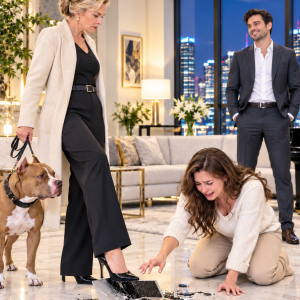
“I’m choosing my wife and my daughter.”
Margaret stared at him.
“That should never have required a choice.”
Nobody spoke for several seconds.
Then a voice came from the doorway.
“Mr. Pembroke?”
It was Mr. Hale, who had managed the house for more than thirty years.
Charles turned.
“What is it?”
Mr. Hale looked at Margaret, then at the collar.
“Mrs. Pembroke didn’t buy that.”
Margaret went pale.
Charles frowned.
“What?”
Mr. Hale stepped into the room.
“It was delivered three days ago.”
I looked at Margaret.
She wouldn’t meet my eyes.
“Delivered by whom?” I asked.
“There wasn’t a return address.”
Mr. Hale pointed toward the collar.
“It came in that velvet box. There was also a note.”
Charles turned to his wife.
“Margaret?”
She stood.
“It doesn’t matter.”
“Where is the note?”
“I threw it away.”
My father spoke for the first time in several minutes.
“Why?”
Margaret looked at him.
“Because it was nonsense.”
“Then why use the collar?”
She had no answer.
Mr. Hale did.
“I found part of the note in Mrs. Pembroke’s study wastebasket yesterday. I didn’t understand it, so I kept it.”
He reached into the inside pocket of his jacket.
Margaret moved toward him.
“Hale, don’t.”
Charles stepped between them.
“Give it to me.”
Mr. Hale handed him two torn pieces of cream-colored paper.
Charles put them together on the coffee table.
I could read only part of the message from where I stood.
Then I saw my name.
Nora.
I stepped closer.
Charles read it once.
Then again.
His hand went flat against the table.
“What does it say?” Wesley asked.
Charles didn’t answer.
I picked up the pieces.
The message was short.
The person who sent it knew my full name.
They knew about June.
And the last sentence said:
Tell Nora what this family buried before Wesley was born.
My father looked at Charles.
“What did your family bury?”
Charles stared at the torn paper for so long that June made a small sound against Wesley’s chest.
Finally, Charles raised his eyes.
“Not what.”
His voice was barely above a whisper.
“Who.”

Eleanor Pembroke
Her name was Eleanor.
Charles’s younger sister.
I had been married to Wesley for four years and had never heard her name.
There were no photographs of her in the hallways. No portrait in the family room. No story about an aunt who moved away.
Nothing.
Charles sat down.
“Eleanor left in 1984.”
“Left where?” Wesley asked.
“We didn’t know.”
Margaret folded her arms.
Charles looked at her.
“That’s not entirely true, is it?”
Margaret said nothing.
He turned back to us.
Eleanor had been twenty-four. She painted. She wanted to study art seriously, and she had fallen in love with a man named Daniel Reyes.
The Pembrokes disapproved of both choices.
Daniel didn’t come from money. His father repaired heating systems. His mother worked in a hospital cafeteria.
Charles’s parents made their opinion clear.
Eleanor was expected to end the relationship.
She didn’t.
“My father told her if she walked out with Daniel, she shouldn’t expect to walk back in,” Charles said.
I looked around the room.
The portraits.
The silver frames.
The old furniture nobody was allowed to move.
Then I looked at Margaret.
“What happened to her?”
Margaret’s eyes were on the collar.
“She left.”
“And?”
“And we stopped talking about her.”
That answer bothered me more than anything Charles had said.
Not because it was complicated.
Because it wasn’t.
A person had been there.
Then the family agreed not to mention her.
Charles stood abruptly.
“Her room is still upstairs.”
Wesley looked surprised.
“What room?”
Charles walked toward the hallway.
We followed him to the third floor.
At the end of a narrow hall was a white door I had passed several times without thinking about it.
Charles unlocked it.
Dust covered the dresser and the small writing desk. Rolled canvases stood in one corner. There were books on painting, an old denim jacket behind the door, and a photograph of a young woman laughing beside a dark-haired man.
Eleanor and Daniel.
Margaret stayed near the doorway.
I opened one of the desk drawers.
Inside were letters tied together with faded blue ribbon.
Charles picked one up.
“These were here?”
Margaret’s face changed.
“Some of them.”
Charles turned.
“Some?”
She came farther into the room and touched the back of the desk chair.
“Your mother kept the letters Eleanor wrote before she left. Afterward, she wouldn’t read anything that came from her.”
“How do you know?”
Margaret looked toward the photograph.
“Because Eleanor wrote to me too.”
That stopped everyone.
Margaret sat down.
For the first time since I had known her, she looked small in that house.
“When I married Charles, your grandmother hated me.”
Wesley frowned.
“Grandmother adored you.”
Margaret gave a short, humorless laugh.
“Eventually.”
She rubbed one thumb across the other.
“My father owned a pharmacy. I didn’t have the right family, the right friends, or the right clothes. Eleanor was the only person here who didn’t make me feel like I had wandered in through the service entrance.”
I didn’t say anything.
Margaret looked at me.
“She told me something once.”
Her voice caught slightly.
“She said, ‘Don’t let this house teach you how to disappear.’”
The room went quiet.
Margaret looked down at her hands.
“And yesterday I put that collar in front of your daughter.”
I waited.
She looked at June.
Then at me.
“I’m sorry.”
I nodded once.
“I heard you.”
She seemed surprised.
“That’s all?”
“An apology isn’t the same as repair.”
Margaret’s eyes filled, but I didn’t move toward her.
“You don’t have to convince me today,” I said. “You have to behave differently tomorrow. And the day after that.”
She lowered her head.
On the desk beside Charles was another envelope.
Unlike the others, it wasn’t yellowed.