“Evelyn, this is why the recovery team found you.”
I gripped the desk.
All those years I had believed chance had brought that aircraft overhead.
It had been my father.
Then another truth arrived.
“You knew when I came home?” I asked.
His eyes filled.
“Yes.”
I remembered him standing in the kitchen the morning after I returned, drinking coffee while I hid my injuries beneath an oversized sweater.
He had asked me to drive Adam to the airport.
“You knew,” I repeated, “and you treated me like I had come home from an ordinary business trip.”
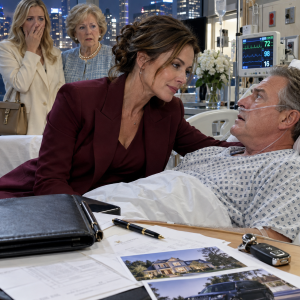
“I was warned that if Voss realized I knew you were involved, he would know the investigation had reached our family.”
“So you protected me by pretending I meant nothing?”
My father closed his eyes.
“At first, distance was protection. After a while, it became habit, and eventually it became cowardice. I don’t have a better excuse.”
My anger remained, but for the first time it had somewhere real to go.
Then Adam learned that our father had also quietly blocked several of his career transfers because Voss had been using him to remain close to our family.
Adam looked at me with a bitter half smile.
“All these years I thought you were the family disappointment.”
I almost laughed.
He shook his head.
“Turns out I was the decoy.”
The Man Who Was Supposed to Be Gone
Before anyone could answer, Hart received security footage from the gate.
The man who had left the envelope was identified as Miles Rowan, another member of Ember Glass.
One of the three who had reached the final ridge.
The problem was that Miles Rowan had officially been listed among those who never returned.
Seconds later, the security feed disappeared and the lights throughout the house went out.
People outside shouted in confusion while the backup generator inexplicably remained silent, but before Hart could move toward the study door, three knocks sounded from the hallway, followed by two, then three more.
My body recognized the sequence before my mind did.
Ember Glass.
I opened the door.
Miles stood there, older and thinner than I remembered, a pale scar running along his jaw.
“Hello, Evelyn.”
I could barely speak.
“Miles?”
He glanced toward the dark windows.
“We don’t have much time.”
Hart demanded answers, and Miles admitted he had reopened the archive using Adam’s credentials because he needed Voss to believe old evidence was surfacing, forcing anyone connected to the operation to reveal themselves.
Then he looked at me.
“There’s something else you need to know.”
He removed an old surveillance photograph showing a woman meeting one of Voss’s overseas contacts seven years earlier.
From behind, she looked like me.
Same height.
Same build.
Same hair.
For years, Miles said, he had believed I had betrayed the team.
Then I noticed the woman’s wrist.
There was no broken-circle mark.
There was a silver bracelet.
I knew that bracelet.
I had seen it at Christmas dinners, birthday parties, and summer cookouts throughout my childhood.
Slowly, I turned toward my mother.
She was already staring at the photograph.
“Mom,” Adam whispered.
My mother began shaking her head.
I held up the picture.
“You know this bracelet.”
Tears appeared in her eyes.
“Yes.”
“Whose was it?”
She looked at my father, then at me.
“My sister’s.”
For a moment I thought I had misunderstood her.
My mother’s younger sister, Caroline, had vanished in a boating accident nine years earlier, two years before Ember Glass, and although she had been my favorite aunt, our family eventually learned to speak about her in the past tense because that was what everyone told us we had to accept.
Miles shook his head.
“Caroline never went down with that boat.”
My mother stared at him.
“There was an investigation.”
“There was a story,” he replied.
I remembered Caroline as she had been when I was young, always arriving with foreign postcards tucked inside her purse and stories from relief projects in places I had only seen on maps, and I remembered the small brass compass she had given me when I was seventeen, telling me that when I became lost, direction mattered more than speed.
I had carried that compass overseas.
I still owned it.
General Hart moved closer to Miles.
“If Caroline Parker wasn’t doing humanitarian work, what was she doing?”
Miles looked at me before answering.
“Sometimes she was doing humanitarian work.”
“And the rest of the time?”
His expression became grave.
“She provided access.”
“Access to what?”
Outside the darkened study, confused voices drifted through my parents’ house while my mother stood perfectly still, staring at the photograph of the sister she had mourned for nine years.
Miles answered slowly.
“People. Routes. Medical shipments. Diplomatic cargo.”
And suddenly I understood why a woman my family had buried only in memory might have been standing halfway around the world, wearing my mother’s bracelet, beside the man whose secrets had nearly erased me.
What I did not yet understand was why.
Or whether Caroline had spent all those years hiding from us—
or waiting for us to finally find her.