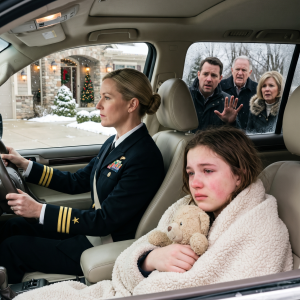
“I should have made that clearer much sooner.”
The Morning After
My parents stayed overnight.
Elsie slept in my room with the lamp on.
Around two in the morning, I woke and found her sitting upright beside me.
“Daddy?”
“I’m here.”
“Is Brielle coming back tomorrow?”
“No.”
“Are you sure?”
“Yes.”
She lay down again but kept one hand around my wrist.
That was when I understood how long fear can remain inside a child even after the person causing it is gone.
The next morning, I contacted a family attorney and a therapist who specialized in young children.
I also saved copies of every relevant recording.
The following weeks involved interviews, paperwork, professional assessments, and many conversations I never imagined having.
I will not pretend any of it was simple.
But one thing was simple.
Brielle never lived in our house again.
Our brief marriage ended.
Learning How to Be Safe Again
For several weeks, Elsie followed me everywhere.
If I walked outside to collect the mail, she ran to the front window.
If I went upstairs, she called my name.
If I grabbed my car keys, she immediately asked,
“Where are you going?”
At first, I felt enormous guilt.
I kept thinking about every clue I had missed.
Why had Elsie become quieter?
Why had she suddenly started saying she was not hungry at breakfast?
Why had she cried twice when I mentioned leaving for work?
I had explained all of it away.
A growth phase.
Preschool stress.
Missing Hannah.
The therapist eventually told me something I needed to hear: guilt could help me change, but it could not become the center of Elsie’s recovery.
She needed predictability.
So I changed my routine.
I arranged to work from home most days.
My parents visited regularly.
Paige began taking Elsie to the library every Saturday.
We created small rituals.
Breakfast together.
A note beside her lunch.
A phone call if I had to leave the house.
Most importantly, I stopped assuming children always explain fear in adult language.
Sometimes they say, “She’s scary.”
Sometimes they stop eating.
Sometimes they cling to your sleeve.
Sometimes they simply wait for one safe moment to tell you the truth.
Six Months Later
One Saturday afternoon, nearly six months after that dinner, I was working on my laptop at the patio table while Elsie played in the backyard.
She wore denim overalls and bright yellow rain boots even though there had not been rain for three days.
She crouched near the fence, studying something in the grass.
Then she ran toward me.
“Daddy, look!”
In her palm was a tiny white flower.
“I found the smallest flower in Indiana.”
I smiled.
“That sounds scientifically proven.”
She giggled.
It was a real giggle.
Not nervous.
Not cautious.
Just happy.
Then she climbed onto the swing.
“Push me high.”
I walked behind her.
“How high?”
She thought about it.
“High, but not scary.”
So I pushed gently.
She laughed every time she came back toward me.
As I watched her, I thought about Hannah.
For years, I believed being a good father meant rebuilding everything we lost.
I thought Elsie needed the family shape I had imagined before she was born.
A mother.
A father.
A perfect house.
A normal childhood.
I finally understood that children do not need a picture-perfect family.
They need people who make home feel safe.
The Question Before Bed
That night, I tucked Elsie under her blanket.
She placed her rabbit beneath her chin.
“Door open?”
“Of course.”
“Hall light too?”
“You got it.”
I kissed her forehead and started walking toward the hallway.
“Daddy?”
I turned around.
“Yeah?”
She hesitated.
“If I tell you something weird again, will you listen?”
I walked back to her bed.
“Every single time.”
“Even if grown-ups say I’m making it up?”
I brushed a strand of hair away from her face.
“Especially then. I’ll listen first, and we’ll figure out the truth together.”
She smiled and closed her eyes.
I sat beside her for another minute.
Our family was smaller than the one I once thought we needed.
There was no new wife downstairs.
No carefully staged family photographs.
No perfect story to show other people.
There was only a father, a little girl, an old stuffed rabbit, and a hallway light glowing through an open bedroom door.
And for the first time in a long time, that felt like more than enough.
A child may not have the vocabulary to explain a complicated situation clearly, but when their behavior suddenly changes and they repeatedly express fear around one particular person, the adults who love them should listen carefully instead of dismissing those signals as imagination.
Building a new relationship after losing someone important should never require a child to erase the memory of the parent they lost, because healthy love makes room for the past rather than treating it as competition.
Trust is necessary in every family, but trust should never become an excuse to ignore small changes in a child’s mood, eating habits, sleep, confidence, or willingness to be left alone with someone they once seemed comfortable around.
A person can appear patient, caring, generous, and charming in front of other adults while behaving very differently in private, which is why genuine character is often revealed in the way someone treats people who have less power than they do.
Parents do not need to be perfect to protect their children, but they do need to be willing to admit when they missed something, correct their course quickly, and place a child’s emotional safety above appearances, embarrassment, or the desire to preserve a relationship.
A family does not become complete because it looks traditional from the outside; it becomes complete when the people inside the home feel respected, heard, protected, and free to speak without fearing that love will be taken away from them.
When a child finally finds the courage to reveal something frightening, one of the most powerful responses an adult can give is not anger, panic, or disbelief, but a calm promise that the child has been heard and will not have to face the situation alone.
Starting over can feel like failure when a marriage or relationship ends quickly, but walking away from an unhealthy situation can sometimes be the clearest proof that a person has finally understood what deserves to be protected most.
Healing after a frightening experience rarely happens in one dramatic moment; it is usually rebuilt through ordinary things such as consistent routines, open doors, patient conversations, trustworthy adults, and repeated proof that home is safe again.
The strongest promise a parent can make is not that nothing difficult will ever happen, because no one can guarantee that, but that when something feels wrong, their child can come to them, tell the truth, and know they will be taken seriously.