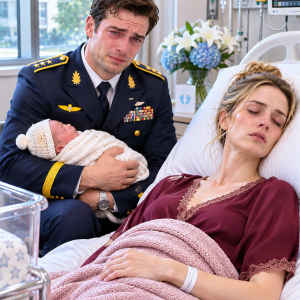
He stared at the documents.
“You’re ending our marriage over one vacation?”
I shook my head.
“No. I’m ending our marriage because when our three-day-old son needed help, you chose to leave. And when I told you he was in intensive care, you chose not to come back.”
For once, Patricia had nothing to say.
The Recording That Changed Everything
Spencer tried to argue that I had misunderstood the situation.
He insisted that his mother believed Oliver was fine and that he had no reason to think the problem was serious.
But the messages told a different story.
I had clearly informed him that our newborn son was receiving treatment in intensive care.
The hospital records confirmed when Oliver arrived and what care he required.
The security footage showed when Spencer and Patricia left the house.
And the emergency call placed by Evelyn helped establish how quickly I had sought assistance afterward.
Rebecca explained that the evidence would be reviewed through the appropriate legal process.
Spencer looked toward his mother.
“You told me Mallory was just panicking.”
Patricia straightened her shoulders.
“I thought she was. How was I supposed to know?”
I finally spoke.
“You didn’t have to know what was wrong with Oliver. You only had to let me call for help.”
The room fell silent.
That was the truth I wanted them to understand.
I had not expected Patricia to diagnose a heart condition.
I had not expected Spencer to become a medical expert.
I had simply expected them to take a newborn’s breathing difficulties seriously.
Instead, they had treated my concern as an inconvenience.
And no apology could erase those choices.
A Courtroom, a Mother’s Promise, and a New Beginning
The months that followed were not easy.
There were meetings with attorneys, medical appointments, financial discussions, and difficult conversations about Oliver’s future.
Spencer initially argued that he should have the same parenting arrangements as any other father.
I did not oppose his relationship with Oliver simply because our marriage had ended.
But I insisted that our son’s medical needs, safety, and stability had to come first.
During the proceedings, the court reviewed the available records, including the emergency response timeline, medical documentation, relevant messages, and security footage.
The judge also considered the circumstances surrounding Spencer’s absence and the arrangements needed for Oliver’s ongoing care.
Ultimately, I was granted primary physical custody, with Spencer’s parenting time subject to conditions designed to support Oliver’s medical needs and well-being.
Patricia was not permitted to have unsupervised contact with Oliver under the initial court arrangements.
The divorce was finalized after the financial matters were resolved.
I did not walk out of the courtroom feeling victorious.
I walked out feeling relieved.
Because the decision I had made was never about punishing Spencer or humiliating Patricia.
It was about making sure that Oliver would grow up in a home where his needs were never dismissed as an inconvenience.
As the months passed, Oliver continued receiving specialist care.
There were follow-up visits, medications, and moments when I still felt frightened by how fragile life could be.
But there were beautiful moments, too.
His first real smile.
The way his tiny fingers wrapped around mine.
The peaceful afternoons when sunlight filled our living room and I could hear him breathing softly in his crib.
Evelyn remained part of our lives.
Sometimes she came over with homemade soup. Sometimes she simply sat beside me while Oliver slept.
One afternoon, she watched him smile and said something that stayed with me.
“Look at that little boy, Mallory. He has so much life ahead of him.”
I smiled through tears.
“And I’m going to make sure he knows how loved he is.”
I used to believe that a successful marriage meant keeping everyone happy, avoiding disagreements, and making sacrifices without complaint.
Now I understood something different.
A loving family is not defined by how carefully everyone maintains appearances.
It is defined by what people do when someone vulnerable needs them.
My son was three days old when I learned that lesson.
He could not speak for himself.
He could not explain what was wrong.
He could only depend on the adults around him to recognize that he needed help.
And when the people I trusted walked away, I found the strength to act.
Today, when I look at Oliver, I no longer think first about the morning his father left.
I think about the neighbor who opened her door.
The paramedics who came when we called.
The doctors and nurses who cared for him.
And the moment I realized that protecting my child mattered more than preserving a marriage that had already lost its foundation.
Spencer and Patricia returned from Hawaii expecting everything to be exactly as they had left it.
But they were wrong.
Because while they were away, I had stopped waiting for them to become the people I needed.
I had become the mother my son needed me to be.
A Message to Every Parent Who Has Ever Felt Unheard
A mother’s concern should never be dismissed simply because someone else believes she is being overly emotional, because sometimes the smallest changes in a child’s behavior are the very signs that deserve immediate attention.
True love is not measured by expensive vacations, beautiful promises, or photographs of a perfect family, but by the willingness to stay beside the people who need us when life becomes frightening and uncertain.
A parent does not need to understand every medical condition to recognize that a child struggling to breathe deserves immediate professional care, compassion, and the full attention of the adults responsible for that child’s safety.
When someone repeatedly makes you question your judgment, remember that protecting your child is more important than keeping another person comfortable, especially when your instincts are telling you that something is seriously wrong.
The people who truly belong in your life are not always the ones connected to you by marriage or blood, because sometimes a caring neighbor can demonstrate more kindness in five minutes than a relative has shown in years.
Walking away from an unhealthy relationship does not mean you have failed to protect your family; sometimes it means you have finally found the courage to create a safer and more peaceful future for the people who depend on you.
Never underestimate the strength of a mother who has spent sleepless nights beside her child’s hospital bed, because behind her exhaustion may be a determination that no amount of criticism or disappointment can take away.
An apology can begin the process of rebuilding trust, but meaningful change requires accountability, consistent actions, and a genuine understanding of how deeply someone’s choices have affected the people they were supposed to support.
Children may be too young to remember every difficult moment their parents experience, but the security, patience, and unconditional love they receive can help shape the confidence and peace they carry throughout their lives.
And perhaps the most important lesson of all is that a family’s greatest treasure is not its money, reputation, or beautiful home, but the quiet certainty that when someone needs help, the people who love them will never turn away.