The Name No One Had Entered

Brigadier General Calvin Rourke asked for my call sign because he expected the entire hall to laugh.
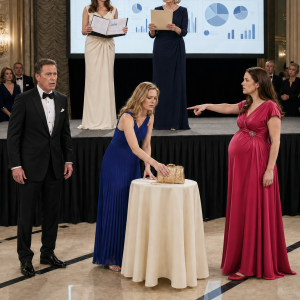
The Joint Crisis Leadership Academy in Colorado Springs was filled with senior officers, federal emergency directors, aerospace commanders, and eighteen graduates seated beneath the stage in formal uniforms. Our class was unusually uniform in appearance—all white Americans from different states and professional backgrounds—but nearly everything else about us differed, from our specialties to the experiences that had brought us there.
At the far end of the first row sat me, Major Claire Halston, an Air Force emergency-operations planner whose file still showed an empty space beside CALL SIGN.
For four weeks, General Rourke had treated that blank line as evidence that I had not earned my place. He questioned my decisions longer than anyone else’s, assigned me additional evaluations, and corrected minor mistakes before an audience while overlooking larger ones made by officers he already respected. I had endured it because I believed the academy mattered more than my pride, although by graduation night, I had grown tired of pretending his treatment was simply rigorous instruction.
Rourke lifted his glass and spoke into the microphone.
“Major Halston, stand up.”
I rose as hundreds of faces turned toward me.
“Twenty-eight days with this class,” he said, “and you are still the only officer without a call sign. What exactly are we supposed to call you?”
“I haven’t been assigned one, General.”
A thin smile appeared on his face.
“Perhaps no one found anything memorable.”
A few guests offered uneasy laughter, but none of my classmates joined them. All eighteen remained silent, their attention fixed not on me but on Rourke, and for the first time that evening, uncertainty entered his expression.
What he had never asked was why the people who had trained beside me had deliberately left that part of my record empty.
I met his eyes.
“With respect, sir, you may want to ask the class.”
Rourke turned toward the graduates.
“Did any of you choose a name for Major Halston?”
Colonel Ryan Foster, our team leader, stood.
“We did, sir.”
“Then why wasn’t it submitted?”
Ryan glanced at me before answering.
“Because she didn’t earn it in a classroom.”
The hall became still.
“Where did she earn it?” Rourke demanded.
Before Ryan could answer, the rear doors opened and Lieutenant General Samuel Danner entered carrying a charcoal-gray folder. Danner oversaw national emergency coordination for several military commands and rarely attended public ceremonies. Conversations stopped wherever he walked, not because he demanded attention but because his presence usually meant something had already gone seriously wrong.
He approached the stage and looked directly at me.
“Major Halston, your former call sign has been restored.”
A murmur spread through the audience.
Rourke lowered his glass.
“Sir, I believe there may be some confusion.”
“There isn’t.”
Danner stopped beside the podium.
“Her former designation was Sentinel.”
Rourke’s smile disappeared. Sentinel had belonged to a classified overseas coordination unit whose work was discussed only in restricted briefings. Years earlier, an unknown planner using that name had rebuilt an evacuation route after the original plan collapsed, remaining at her station until the last aircraft crossed into safe airspace.
Few people knew that planner had been me.
Rourke recovered quickly.
“Whatever Major Halston accomplished before attending this academy, my evaluation concerned her performance here.”
Danner opened the folder.
“Then let us discuss her performance here.”
When the Exercise Became Real
Three nights earlier, our class had begun its final field evaluation at an isolated training range in southern Utah. The exercise required us to establish a temporary command post, restore damaged communications, locate a simulated hazardous-material shipment, and coordinate an evacuation before an approaching storm closed the mountain roads.
The instructors had made everything difficult by design. Satellite signals became unreliable, maps contradicted one another, vehicles were reassigned without warning, and one of our communications towers failed within the first hour. The objective was not to see whether we could follow a perfect plan. It was to see who could continue thinking after the plan stopped being useful.
Shortly after two in the morning, I was monitoring an auxiliary frequency when I noticed a weak, repeating transmission. It appeared for several seconds, vanished, and returned with fragments of a voice hidden beneath static.
Captain Luke Barrett, an aviation rescue specialist seated beside me, leaned closer.
“Is that one of the exercise signals?”
“The coding pattern is wrong.”
The transmission returned, and this time we heard three words clearly.
“Road washed out.”
Then came coordinates, a child crying in the background, and a woman saying that water was rising around their vehicle.
Luke looked toward the operations clock. We were eleven minutes from completing the main objective, and contacting outside authorities without authorization could invalidate the entire team’s evaluation.
“Could they be testing whether you break protocol?” he asked.
“Yes.”
“And if they aren’t?”
The radio answered that question for us. A man’s voice came through, faint and unsteady, explaining that he and his wife had two children in the vehicle and could no longer open the rear doors.
I contacted Exercise Control.
“Control, confirm whether the distress traffic on the auxiliary frequency is simulated.”
The response came immediately.
“Sentinel Two, maintain exercise parameters.”
Luke and I looked at each other. No instructor was supposed to know my former call sign, and it had not been used openly in years.
Control corrected itself.
“Major Halston, continue the assigned mission.”
“That does not answer my question. Is the transmission part of the exercise?”
After a long pause, the controller repeated the order.
Ryan entered the communications tent while I was reaching for the terrain map.
“What’s happening?”
I explained the signal and showed him the coordinates. The stranded family was less than seven miles away, but the fastest route crossed the boundary of our authorized training sector.
Ryan studied the map.
“If we leave, the whole class fails.”
“If the call is real, a family may not have time to wait for another team.”
“Control ordered us to continue.”
“Control refused to confirm the signal was simulated.”
He looked at Luke.
“What do you think?”
Luke answered quietly.
“If Claire is wrong, we lose a grade. If she is right, we arrive before that family loses its way out.”
Ryan closed his eyes briefly, then reached for his radio.
“All teams, mission change. Prepare for civilian extraction.”
We abandoned the graded objective and moved toward the coordinates through heavy rain. Twenty minutes later, we found a sport-utility vehicle trapped beside a flooded service road, its rear wheels sinking into mud as water swept around the doors. A fair-haired father stood on the roof holding a small girl beneath his jacket, while his wife remained inside with their younger son.
There was no grand speech and no time for one. Ryan organized ropes and anchor points, Luke entered the water with two rescue technicians, and I coordinated our position with county responders while redirecting our transport vehicles to higher ground. One child was so frightened that he clung to Luke’s neck even after reaching safety. The mother kept apologizing for putting us at risk, as though needing help were something for which a person should feel ashamed.
Everyone was safe before sunrise.
Back in the graduation hall, General Danner closed the folder.
“The class abandoned a graded mission to respond to a genuine emergency. General Rourke, you were informed that the transmission might be real four minutes before Major Halston identified it.”
Rourke’s face lost its color.
“The coordinates had not been verified.”
“That is true.”
“My responsibility was to protect the trainees from an uncontrolled situation.”
“That is also true,” Danner replied. “But you ordered Control to withhold the information because you did not want the evaluation interrupted.”
“County teams were already responding.”
“Major Halston did not know that. She had incomplete information, conflicting orders, and every professional incentive to remain silent, yet she recognized that a human life cannot be reduced to an inconvenience on a score sheet.”
No one in the hall moved.
Rourke turned toward me, and when he spoke again, his voice was quieter.
“I believed pressure would reveal whether you belonged here. Instead, it revealed the assumptions I brought with me. I mistook restraint for uncertainty, and I was wrong.”
His apology did not erase the previous month, but the willingness to offer it publicly mattered.
Then Danner looked toward my classmates.
“Colonel Foster, what name did the class choose?”
Ryan smiled.
“Beacon.”
My throat tightened.
During our second week, corrupted navigation data had sent three teams in different directions. I had climbed to an observation ridge, found an old civil-defense light on a distant tower, and used it to rebuild our position. Ryan joked afterward that whenever every instrument failed, we should find Halston because she would eventually locate something that still made sense.
But the joke had changed during the rescue.
“A beacon doesn’t order anyone where to go,” Ryan explained. “It stays visible long enough for people to find their own way.”
General Danner turned to me.
“Which name do you want, Major?”
I looked at the eighteen people who had stood beside me in the rain.
“Beacon.”
The Man in the Photograph

I expected the ceremony to continue. Instead, General Danner removed a photograph from his folder and handed it to me.
It showed a concrete loading yard outside an aerospace storage facility in Dayton, Ohio. A tall man stood beside a dark vehicle, his face turned partly away from the camera. His hair was grayer and a scar marked his left cheek, but I recognized him immediately.
Colonel Graham Mercer had commanded my classified coordination unit four years earlier. During our final overseas operation, a communications corridor failed while several aircraft were still waiting for revised routes. Graham placed a coded drive in my vest, ordered me onto the last transport, and remained behind to restore the relay manually.
No reliable report of him had surfaced afterward.
For four years, I had lived with the belief that I had abandoned the man who taught me everything I knew about judgment under pressure.
“When was this taken?” I asked.
“Five days ago,” Danner replied.
“Where is he?”
“We do not know. He left the facility before surveillance teams arrived.”
Danner gave me a second page containing a message received through an encrypted server:
BEACON IS COMPROMISED. TRUST NO COMMAND.
The name Beacon had never been submitted, entered into a system, or spoken over an official frequency. My classmates had begun using it privately twelve days earlier.