“Not really. She asked me not to leave her.”
He wrote something down.
That was all.
No conclusions.
No dramatic declarations.
Just questions.
And strangely, I was grateful for that.
I did not want anyone to believe me simply because I was Lily’s father.
I wanted someone to look carefully at what had happened.
Within twenty minutes, the paramedics decided Lily should be evaluated at the hospital.
I rode with her.
Rebecca remained at the house while the officers continued speaking with her.
During the ride, Lily lay beneath several blankets while I sat beside her holding her hand.
She seemed very small.
I kept thinking about the previous months.
There had been bruises.
Nothing I had considered alarming at the time—a mark on her arm after playing in the yard, tenderness near her shoulder after she supposedly bumped into a dresser, a small bruise along her hip that Rebecca said came from Lily slipping on the stairs.
Children collected bruises.
At least that was what I had told myself.
But memory changes when new information enters it.
Suddenly, every explanation I had accepted returned to me carrying a different weight.
What the Doctors Found

The hospital was only about fifteen minutes away, but the drive felt much longer.
A nurse met us at the entrance and took Lily into an examination room. I answered questions about her medical history while another nurse checked her temperature and helped her into a hospital gown.
Her fever was still present.
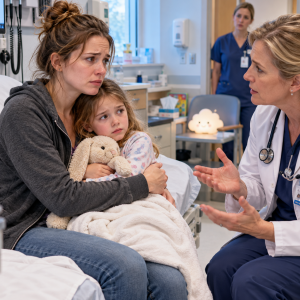
The physician on duty, Dr. Elaine Foster, examined her carefully and ordered imaging because of the pain along her side.
I stayed close enough that Lily could see me.
Whenever someone new entered the room, her eyes searched for mine.
“You’re staying?” she asked once.
“The whole time.”
“Promise?”
“Promise.”
I had made plenty of promises as a father.
I had promised trips to the zoo, pancakes on Saturday mornings, another chapter before bedtime, a puppy when she was older.
That promise felt different.
While we waited, Lily fell asleep.
I sat beside the bed staring at her and wondering how many things I had misunderstood simply because I wanted my family to remain intact.
That realization was painful because my intentions had seemed so reasonable.
I wanted Lily to have both parents.
I wanted our home to survive.
I wanted to believe Rebecca could change.
I wanted to avoid making a decision that would permanently alter our daughter’s childhood.
Those desires sounded responsible when I repeated them to myself.
But sitting in that hospital room, I began to understand that preserving the shape of a family and protecting the people inside it are not always the same thing.
Dr. Foster eventually returned.
She pulled a chair toward me rather than standing.
That alone told me the news was important.
“Mr. Mercer, the imaging shows that Lily has injuries to three ribs.”
For a moment, I thought I had misunderstood.
“Three?”
“Yes.”
I looked at Lily.
She was still sleeping.
“Could that happen from a fall?”
Dr. Foster chose her words carefully.
“There are different ways this kind of injury can happen. What matters right now is that she’s safe, comfortable, and properly evaluated. We’ll document everything we find.”
I nodded.
I appreciated that she did not speculate.
Everyone that evening seemed to understand something I was only beginning to learn: when something serious happens, facts matter more than dramatic theories.
Three ribs.
The number repeated itself in my head.
I remembered Lily becoming quiet whenever Rebecca entered a room in a certain mood.
I remembered once asking why she had stopped wanting her mother to help with bath time.
“Mommy gets mad when I’m slow,” she had said.
I had spoken to Rebecca about it.
Rebecca cried.
She told me she was exhausted.
I believed her.
Then there had been the afternoon Lily accidentally knocked a ceramic bowl from the counter. I came into the kitchen afterward and found her standing perfectly still while Rebecca swept the pieces from the floor.
Lily’s hands had been trembling.
I remembered asking whether everything was okay.
“Of course,” Rebecca had replied.
And I had accepted that answer.
Now I sat beside my daughter and wondered how many times she had tried to tell me something without knowing the words.
The Neighbor Across the Fence
Nearly an hour later, Officer Grant arrived at the hospital.
By then Lily had been given medication for her discomfort and was sleeping beneath two warm blankets.
The officer stopped just inside the room.
His expression was different from the one he had worn at our house.
“Mr. Mercer, can I speak with you for a minute?”
I stepped into the hallway.
He was holding his phone.
“One of your neighbors contacted us.”
My stomach tightened.
“Who?”
“A gentleman who lives behind you, across the side fence. He saw the emergency vehicles and called because he thought he might have something relevant.”
I knew immediately who he meant.
Thomas Whitaker was a retired high school science teacher in his late sixties who lived alone with an elderly golden retriever named Sam. We spoke occasionally over the fence in summer, mostly about lawn care, weather and baseball.
“What does he have?”
Officer Grant glanced toward Lily’s room before answering.
“He has an exterior security camera. Part of your backyard is visible from it.”
I stared at him.
“Did it record tonight?”
“It appears so.”
For the first time since arriving at the hospital, I felt genuinely unsteady.
Until then, the evening consisted of separate accounts.
Mine.
Rebecca’s.
Whatever Lily eventually felt comfortable explaining.
But a camera had no marriage to defend.
It had no custody arrangement to worry about.
It had no reason to make one parent look better than the other.
It had simply been there.
“What does it show?” I asked.
Officer Grant did not answer immediately.
Instead, he unlocked his phone.
“The angle isn’t ideal. The camera wasn’t installed to watch your property. It covers Mr. Whitaker’s driveway and catches part of your yard in the background.”
“But it recorded before I got home?”
He looked at me.
“Yes.”
Those three letters—yes—changed the entire evening.
Rebecca had said Lily fell.
She had also said she was teaching her a lesson.
I had arrived too late to know what happened before I opened that kitchen door.
But the recording had begun earlier.
Officer Grant showed me only a brief portion on his phone.
The picture was distant and slightly grainy. There were no perfect close-ups, no clear dialogue, nothing resembling the convenient evidence people see in television dramas.
It was simply a fixed camera capturing an ordinary winter backyard.
And yet that ordinariness made it more powerful.
“Can you tell what happened?” I asked.
“We’re reviewing it carefully,” he said. “I don’t want to tell you what it establishes before we’ve examined the complete recording.”
I wanted an answer immediately.
Every instinct in me wanted someone to tell me exactly what had happened to my child.
But another part of me understood his caution.
For months, our family had survived on explanations.
Rebecca had explanations.
I had explanations.
Even Lily, in the way children sometimes do, had learned to minimize uncomfortable things because that made the adults around her calmer.
I did not need another explanation.
I needed facts.
“What happens to the recording?”
“We’ll preserve it and review it alongside the medical findings and everyone’s statements. Don’t ask your neighbor to alter, trim or resend anything differently. We want the original material preserved.”