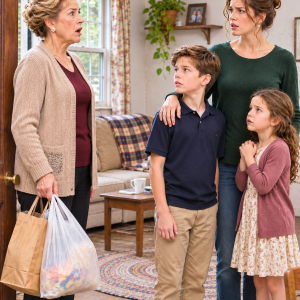
“Can any of you name one visit when I was treated like a member of the family instead of the person responsible for serving everyone?”
Grant lowered his eyes.
Audra continued.
“Did anyone ever ask whether I was tired, whether I could afford the groceries, or whether I even wanted twelve people staying here?”
Paige looked down at the photographs.
“I thought you enjoyed having everyone around.”
“I enjoyed belonging to a family. I did not enjoy disappearing so the rest of you could feel comfortable.”
Maribel closed her folder sharply.
“This feels humiliating.”
Before Audra could answer, Nolan stood.
“No, Mom. What was humiliating was all of us arriving here knowing Audra had just undergone surgery and still expecting her to take care of us.”
Maribel stared at him.
“Nolan—”
“I was the worst one. Audra told me she could not manage the visit, and I told her to find a way. I treated her health as an inconvenience because I did not want to disappoint any of you.”
He turned toward Audra.
“I was wrong.”
It was not enough to erase twenty-two years, but it was the first time Nolan had defended her in front of his family.
For the first time, he was not asking her to protect everyone else’s feelings.
He was finally acknowledging hers.
New Rules for Their Marriage
The family left quietly that evening.
There were no dramatic promises and no instant transformation.
Maribel did not apologize.
Grant said very little.
But everyone carried a folder home.
Several days later, Audra and Nolan sat together at the kitchen table.
Nolan wrapped both hands around his coffee cup.
“I am afraid I have damaged our marriage beyond repair.”
Audra answered honestly.
“Forgiveness does not mean returning to the same life.”
“I know.”
“An apology only matters if your behavior changes when no one is watching.”
Nolan nodded.
Together, they created new household rules.
No overnight guest would be invited without both of them agreeing.
Relatives would contribute to groceries, transportation, and cleaning.
Parents would remain responsible for their own children.
Long visits would require hotel accommodations.
Most importantly, Audra would never again be expected to sacrifice her health to protect someone else’s comfort.
Nolan began attending physical therapy appointments with her.
He learned how to prepare simple meals, manage laundry, organize appointments, and maintain the house.
He did not stop when Audra became stronger.
He continued after she could walk without assistance.
The First Real Apology
Six weeks later, they invited only Nolan’s parents for lunch.
Maribel arrived carrying a large casserole dish.
It was the first time in twenty-two years that she had brought a complete meal.
She placed it on the kitchen counter without meeting Audra’s eyes.
“I thought this might save you from having to cook so much.”
During lunch, Vaughn called and announced that he wanted to stop by the following day.
Nolan answered immediately.
“Tomorrow does not work for us. Next time, ask first and give us enough time to plan.”
Audra looked across the table.
Nolan met her eyes and smiled.
He had finally said “us” in a way that included her voice.
As Maribel prepared to leave, she paused near the front door.
“Audra, about what happened…”
Her voice weakened.
“I did not understand how much you were doing. Or perhaps I understood, but pretending not to notice made my life easier.”
Audra waited.
Maribel took a breath.
“I am sorry.”
Audra did not immediately say everything was fine.
It was not.
But she opened her arms.
The embrace was brief, quiet, and sincere.
Walking at Her Own Pace
Several months later, when Audra had fully recovered, Nolan planned a weekend trip to Door County, Wisconsin.
He booked the hotel, packed the car, planned the route, and handled every detail himself.
He did not invite anyone else.
On their first morning, Audra woke to silence.
There were no children calling from another room.
No relatives demanding coffee.
No list of meals waiting to be prepared.
She opened the window and watched sunlight spread across the water.
Nolan approached her.
“What would you like to do today?”
The question affected her more deeply than any expensive gift could have.
For twenty-two years, people had told Audra what they needed from her.
Almost no one had asked what she wanted.
She took Nolan’s hand.
“I would like to walk slowly along the shore.”
He nodded.
“Then we will walk at your pace.”
They left the hotel and followed the quiet path near the water.
Audra walked without pain, without medical support, and without the familiar feeling that she was responsible for carrying everyone else’s comfort.
For the first time, she was not rushing ahead to prepare the way.
She was not walking behind everyone while cleaning up what they left behind.
She was walking at her own speed.
And Nolan, finally, was walking beside her.
Kindness is a beautiful gift, but when people begin treating your generosity as an obligation, setting a firm boundary becomes an act of self-respect rather than selfishness.
The work performed quietly inside a home may be invisible to those who benefit from it, but that does not make the time, effort, exhaustion, and emotional cost any less real.
A loving partner should never ask you to place your health at risk simply because protecting you would inconvenience relatives, disrupt traditions, or require an uncomfortable conversation.
People often claim they did not know how much you were doing, when the truth is that your silence allowed them to enjoy the benefits without facing the cost.
Saying no does not destroy healthy relationships; it reveals which relationships were built on mutual care and which ones depended entirely on your willingness to keep sacrificing.
An apology becomes meaningful only when it is followed by consistent action, changed habits, clearer boundaries, and respect that continues even after the immediate conflict has passed.
You are allowed to protect the home you built, the health you are trying to recover, and the peace you have spent years giving away to people who rarely noticed your needs.
A person can love their family deeply while still refusing to be their unpaid host, constant problem-solver, childcare provider, driver, cook, cleaner, and emotional shield.
Sometimes the moment you stop rescuing everyone is the moment they finally understand how much weight you had been carrying for them all along.
The greatest sign of healing is not simply learning to walk without pain, but learning that you no longer have to rush ahead for others or remain behind cleaning up their lives—you are allowed to move at your own pace.