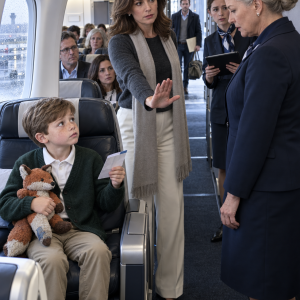
“Where were you?”
I could have blamed letters, employees, timing, or misunderstandings, all of which would have contained pieces of truth, but none would have given him what he needed.
“I didn’t know where to look, and I should have paid better attention. I’m sorry I wasn’t here sooner.”
He thought for a moment. “Do you know how to make a flying house?”
“Not yet.”
“I can teach you.”
That was the beginning, not a conclusion. There was no single morning when I became familiar enough to be trusted. It happened through spilled juice, preschool concerts, fevers, bedtime stories, and long afternoons when nothing memorable occurred. By spring, I had reorganized my leadership team, stopped treating constant availability as evidence of devotion, and established rules ensuring that no employee’s family communication could be filtered by an assistant. Nathan, who had once sent emails at two in the morning and expected answers, began taking Sundays with his own family.
Claire did not immediately welcome me back into her heart simply because I became dependable with the twins. She was kind, cautious, and entirely unwilling to confuse remorse with change. That restraint, although painful, saved us from rebuilding the same relationship with better intentions and the same weaknesses.
We began talking after the children went to sleep. She told me how lonely the pregnancy had been, while I told her about the fear I had hidden beneath work—the collapse of my father’s hardware store, my younger brother’s fragile start in life, and my private conviction that if I earned enough money, nothing I loved could ever become uncertain again.
“Money gave you control,” she said one evening.
“It gave me the appearance of control.”
“And work gave you somewhere to avoid being afraid.”
I smiled without humor. “You always were annoyingly perceptive.”
“I’ve improved with age.”
So had I, though not quickly enough to boast about it.
By autumn, our company’s new regional program was bringing monitoring equipment to smaller hospitals, and Claire, who coordinated family education for a nonprofit, was selected by an independent committee to advise the program. In meetings she challenged my deadlines in front of senior executives and smiled while doing it.
After one meeting, I caught up with her in the hallway. “You contradicted me in front of eighteen people.”
“Seventeen. Nathan agreed with me.”
“You were right.”
She stopped. “Should I call a doctor?”
I laughed, and because she laughed too, something long closed between us opened a little.
Our first real date took place at a small neighborhood restaurant where we had once shared dessert because we could not afford two. Halfway through dinner, Claire accused me of trying to recreate the past.
“I don’t want the past back,” I told her. “We loved each other, but I made you compete with everything I was afraid to lose, and you waited too long to say how much that was hurting you. I want what we are becoming now—the children, the difficult conversations, your weak coffee, and even the way you correct me in meetings.”
Her eyes filled. “My coffee is perfectly good.”
“Then our future will require compromise.”
She reached across the table and took my hand. “I still love you, Grant.”
Nothing about those words restored what had been. They offered us something harder and better: the chance to build honestly.
The Picture With Four People

One year after the flight, we traveled together for Christmas, all four of us seated in the same row. Nathan sent a message saying the office needed nothing from me until the following week, and I turned off my phone before takeoff.
Halfway to Minneapolis, a red crayon rolled from Owen’s tray and stopped against my shoe. Claire saw it and placed her hand over mine as I bent to retrieve it.
“Escaped again,” I said.
Owen held out his hand. “I need it for our family.”
His picture showed four figures beneath a green tree, with no empty corner and no unfinished stranger waiting at the edge of the page. I had signed contracts worth hundreds of millions of dollars without losing my composure, yet that uneven drawing made speaking difficult.
“Are you okay?” Claire asked.
“Yes.”
For once, the answer was complete.
That evening at her mother’s house, Claire gave me a small wooden frame containing a red crayon, with a note beneath it: For what finds us when we finally look up. A second envelope held a photograph of the four of us at an apple orchard, laughing at something beyond the camera. On the back she had written three words: You kept coming.
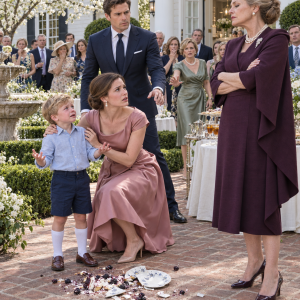
Two years later, Claire and I married in her brother’s backyard beneath strings of white lights. Owen carried the rings, Maisie scattered nearly all the flower petals in one enthusiastic pile, and Nathan turned off his phone during the ceremony, which may have been the clearest proof that people and companies can change.
I did not promise Claire perfection. I promised presence, honesty, and the courage to return when life became crowded. She promised not to expect me to read her mind and to tell me promptly whenever I became impossible.
People still ask about the Hartwell purchase, which became one of the strongest decisions our company ever made. They discuss expansion, valuation, and strategy, then ask whether I knew that Christmas Eve would redirect my career. I tell them the truth: the most important event that night was not a signature.
A red crayon rolled against my shoe, a little boy looked up at me with my own eyes, and twenty rows behind the life I had built was the life I had nearly failed to notice.
I once believed ambition required sacrifice, but now I believe ambition first requires a definition, because unless a person decides what success means, the world will happily define it as whatever can be counted. I still build things, take risks, and work hard, but success also means knowing that Owen dislikes seams in his socks, that Maisie wants her strawberries cut lengthwise, and that Claire still makes coffee too weak.
Every Christmas Eve, Owen places a red crayon beside my plate. The first year he did it, I asked why.
“So you don’t forget how you found us,” he said.
I looked across the table at Maisie, at Claire, and at the boy who had unknowingly crossed the distance between my carefully defended life and everything that truly mattered.
“I didn’t find you,” I told him.
He frowned. “Yes, you did.”
I smiled and took Claire’s hand. “No, buddy. You found me.”
By then I understood that chance had brought the crayon to my shoe, but chance had not repaired a family. Returning had done that. Listening had done that. Keeping small promises had done that. Love, I finally learned, was not proven by the size of one grand gesture but by the quiet courage to keep showing up, long after the room had become ordinary and nobody was watching.