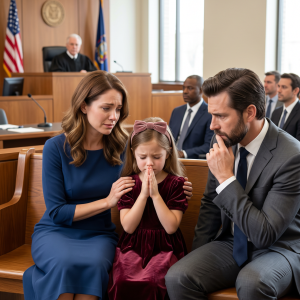
“Then you shouldn’t have any difficulty explaining them,” the judge replied.
The proposed settlement was not approved, and the court directed that the financial questions be reviewed before any final property judgment.
Temporary arrangements were also made to protect Owen from further conflict.
As we prepared to leave, I realized that the little boy who had entered the courthouse afraid of losing his family had unknowingly prevented me from surrendering my future.
But the greatest surprise was still waiting.
Part Three: The Letter Behind the Nursery Wall

Vanessa approached me near the courthouse entrance while Nathan spoke with his attorney, holding a cream-colored envelope that looked strangely familiar.
“I found this behind a loose piece of molding in the nursery,” she said. “I should have given it to you sooner.”
My name was written across the front in my mother’s careful handwriting.
My mother had passed away three years earlier, and seeing those familiar letters brought back the sound of her voice so vividly that I had to lean against the wall.
Inside was a partially torn letter warning me not to sign away any interest in the family business until I had spoken with the attorney who handled my father’s estate.
The most important sentence appeared near the bottom.
“Your father placed the controlling ownership of the company in a trust for you. Nathan was entrusted with managing it, not owning it.”
I read those words repeatedly, remembering how often my mother had encouraged me to understand our finances rather than allowing Nathan to handle every decision.
At the time, I had considered her advice unnecessarily cautious, because I believed marriage meant trusting someone without constantly checking what they were doing.
Now I wondered whether the trust I had offered had allowed my husband to keep me uninformed.
Rebecca drove Owen and me back to the large colonial house outside Lititz, where the nursery still smelled faintly of fresh paint and lavender laundry detergent.
While Owen colored at the kitchen table, Rebecca helped me examine the loose molding beneath the nursery window, where we discovered a small brass key attached to an old paper label bearing my maiden name, Caroline Bennett.
Behind a built-in wardrobe stood a narrow storage compartment that my father had constructed years before, when the house had belonged to my parents.
Inside was a wooden document box containing property records, bank statements, and another letter from my mother.
This letter directed me to contact an attorney named Eleanor Price, who had inherited responsibility for my father’s estate records after his longtime lawyer retired.
I telephoned her office that evening.
Eleanor listened carefully before explaining that my father, who had established a successful commercial property company, had created a trust intended to protect my financial independence.
Nathan had been appointed to manage the company’s daily operations for a limited period, but the underlying ownership was not his to distribute or conceal.
“Caroline, please bring everything you’ve found to my office tomorrow,” Eleanor said. “And until we’ve reviewed the original trust agreement, don’t sign another financial document.”
After the call, I sat beside Owen at the kitchen table while Rebecca prepared dinner.
He had drawn a picture of a woman with a round stomach, a little boy holding a rabbit, and a tiny baby beneath a bright yellow sun.
“That’s us,” he explained, pointing carefully to each figure.
“It certainly is,” I answered.
He looked at the drawing thoughtfully.
“Can the baby have a flower name?”
“What kind of flower?”
“Maybe Lily, because flowers come back after winter.”
I smiled for the first time in what felt like weeks.
“I think she’d be lucky to have a big brother who thinks about things like that.”
That evening, while Owen slept in the bedroom beside mine, I looked through the family photographs lining the upstairs hallway and began to understand that leaving a marriage did not require abandoning every good thing that had existed within it.
The house held painful memories, certainly, but it also held Owen’s first lost tooth, my mother’s Thanksgiving dinners, and the nursery where my daughter would soon sleep.
I was not ready to decide whether to keep it.
For the first time, however, I understood that the decision should belong to me.
Part Four: The Truth My Father Had Protected
The following morning, Eleanor Price welcomed Rebecca and me into a quiet office overlooking a tree-lined street, where she spread the original trust documents across a polished conference table and carefully explained what my father had arranged.
The trust held the controlling interest in Bennett Property Group, several commercial buildings, and a reserve account intended to provide financial security for me and my children.
Nathan had been authorized to manage the business for five years, subject to oversight, but he had continued exercising control long after that arrangement required review.
More troubling, preliminary records suggested that he had moved company funds through another entity connected to a former business adviser, Charles Ridley, whose involvement had never been disclosed to me.
“Your husband may have been entitled to compensation for his work,” Eleanor explained, “but managing a company doesn’t give someone the right to treat its assets as personal property.”
I thought about the years Nathan had told me the company was struggling, the vacations we could supposedly no longer afford, and the evenings he returned home complaining about financial pressure while quietly purchasing expensive gifts for Vanessa.
“Did my father know Nathan might do something like this?” I asked.
Eleanor considered her answer.
“I think your father understood that good intentions aren’t enough to protect a business, especially when one person controls the information and everyone else is expected to trust them.”
Later that afternoon, we visited my father’s retired attorney, an elderly gentleman named Walter Greene, who had kept the original beneficiary schedule in a secure archive.
He showed me the page bearing my father’s signature and my full legal name, then handed me a short personal note that had been preserved with the documents.
My father had written that he wanted his daughter to understand she was not merely receiving property, but inheriting the responsibility and freedom to make decisions about her own future.
I sat quietly with the paper in my hands, wishing I could tell him how much those words meant after years of believing that asking questions made me a difficult wife.
The financial review took several months.
Independent accountants confirmed that the business remained viable despite genuine financial difficulties, and that Nathan had transferred substantial assets into an affiliated company without proper authorization or disclosure.
The court set aside the proposed settlement, required complete financial disclosure, and allowed the parties to negotiate a new agreement based on verified ownership and marital interests.