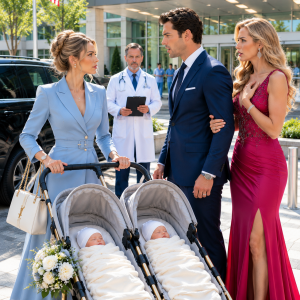
Vanessa’s eyes filled. “I never intended to damage your family.”
“You didn’t do it alone. Graham made his own choices.”
Her softness disappeared.
“You know Graham and I nearly married, don’t you? If my parents hadn’t interfered, he might never have chosen you.”
There it was—the sentence she had been saving for years.
“He always loved me,” she said.
To her surprise, I laughed.
“You believe a man refusing to choose either woman is proof of great love?”
Her expression hardened.
“If Graham truly wanted a life with you, he could have built one openly. Instead, he married me and kept you close enough to feel important. You accepted fragments because calling them destiny made them easier to accept.”
I stood and gathered my coat.
“If you want him now, you may have him openly. But never again suggest that your loneliness justified my son’s.”
The Cost of Arriving Too Late

The legal process lasted months.
Graham fought hardest over the company because he disliked discovering that the years I had spent helping him establish it mattered financially. During its earliest period, I had handled payroll, negotiated with suppliers, corrected billing errors, covered household expenses, and raised Caleb while Graham worked long hours.
His success had not appeared by itself, and neither had my sacrifices.
The money he had directed toward Vanessa and Landon was also considered in the settlement.
At first, Graham believed I was trying to frighten him. He brought flowers, came home before six, cooked elaborate dinners, and bought Caleb an expensive computer for college.
The box remained unopened outside Caleb’s room for two days.
Finally, Graham carried it inside.
“You’ll need this at school.”
Caleb looked up from his desk. “I already bought one.”
“This one is better.”
“I don’t want it.”
Graham forced a smile. “It’s from your dad.”
Caleb looked at the box.
“That’s why I don’t want it.”
Watching Graham stand in the hallway holding an expensive gift, I briefly saw the reflection of our seven-year-old son holding a wrinkled certificate while waiting for him.
I felt no satisfaction.
Only certainty.
Months later, Graham’s attorney submitted a recording connected to several financial transfers. On it, Vanessa could be heard demanding continued support because Landon would soon begin college.
Graham’s tired voice answered, “My own son stood before hundreds of people and said I hadn’t been there for him.”
Vanessa replied, “Landon sees you as his father.”
After a long pause, Graham said, “That’s the problem. I was so busy being a father to Landon that my own son stopped believing he had one.”
Five years earlier, those words might have changed our marriage.
Now they were simply accurate.
Regret can be sincere and still arrive too late to repair what was neglected.
On a rainy morning in November, Graham and I signed the final agreement. Outside the courthouse, he called my name.
“Did we really have to end this way?”
“We didn’t end today. We ended a little every time Caleb waited and you didn’t come.”
His eyes lowered.
“Can I still see him?”
“He’s eighteen. That decision belongs to him.”
“He won’t answer me.”
“Then you need to respect his silence.”
A Door That No Longer Opened
Caleb and I moved into a smaller condominium filled with morning sunlight. I returned to work full-time and eventually opened a consulting firm with a former colleague.
For the first time in years, I was not spending my energy repairing Graham’s choices. I was building a life that belonged to me.
A year after the divorce, Caleb was invited to present a renewable-energy design at a national student forum. He left one guest ticket on my kitchen counter.
At the convention center, I found Graham standing near security with white roses.
“Tell them to let me inside,” he pleaded.
“Did Caleb invite you?”
“He won’t answer me.”
“Then he has answered.”
Graham remained outside. When Caleb emerged hours later after placing second nationally, the roses were bending at their stems.
“I’m late again,” Graham said.
Caleb adjusted his backpack.
“You aren’t late. You missed it.”
“Please give me one chance to be part of your life.”
“You had hundreds.”
Graham’s eyes filled. “How can you shut me out if you don’t hate me?”
“I don’t hate you. I just don’t want to keep saving a seat for someone who taught me he probably won’t come.”
Months later, Graham appeared with a folder containing a proposed schedule—monthly dinners, alternating holidays, a summer trip, and father-son weekends.
Caleb refused it.
“Why won’t you try?” Graham asked. “Is this punishment?”
“When I’m around you, I become eight years old again,” Caleb explained. “I remember watching the window and thinking that if I earned better grades, maybe you would choose me next time. It took years to understand that your absence wasn’t proof that something was wrong with me.”
Graham lowered the folder.
“What am I supposed to do?”
“Respect my decision and let me live without waiting for you.”
For once, Graham listened.
The People Who Show Up
Four years after that first awards ceremony, Caleb graduated near the top of his university class and was selected to speak.
By then, he had become a confident young man whose father’s absence no longer controlled every important room.
From the podium, he searched the crowd until he found me.
“People often ask where perseverance comes from,” he began. “I learned it from my mother.”
Applause moved across the lawn.
“She taught me that love is not measured by promises, gifts, or names on official documents. It is measured by who shows up.”
My vision blurred.
“For years, I believed that if I became smarter, quieter, stronger, or easier to love, I might finally be chosen. My mother helped me understand that another person’s priorities do not determine my value.”
Near the edge of the crowd, I noticed Graham.
He carried no flowers and made no attempt to enter the family section. He simply stood at a respectful distance.
Caleb saw him too.
Graham slowly raised one hand.
Caleb did not walk toward him, but he offered a small nod. Graham returned it.
There was no sudden reunion, no embrace pretending eighteen years could be repaired in a minute. There was only acknowledgment.
You were part of my story.
Your choices hurt me.
I built a life anyway.
Then Caleb turned toward me.
“Pictures, Mom.”
As we posed, he placed his graduation cap on my head.
“Take that back. You earned it.”
His expression softened.
“We both did. You graduated from all of it too.”
He was right.
I had graduated from waiting, from explaining, from protecting Graham’s reputation, and from mistaking endurance for loyalty.
Several years later, Caleb visited my condominium one spring evening. Jasmine bloomed on the balcony, dinner warmed on the stove, and golden light rested across the kitchen table.
He opened the balcony door and breathed in.
“It smells like home.”
“It always was home.”
He looked around the small, bright room and shook his head gently.
“Not like this.”
For the first time in my adult life, nobody was missing. Nobody was late. No empty chair demanded an explanation, and no ringing telephone carried another excuse.
Families are not always broken on the day legal papers are signed. Sometimes the breaking happens gradually, through unanswered calls, abandoned promises, empty seats, and children who eventually stop asking when their father will arrive.
The papers merely acknowledge what years of waiting have already revealed.
The greatest thing Graham lost was not money, his company, or even his reputation. It was the certainty that Caleb and I would always remain beside the door, ready to forgive one more absence and believe one more promise.
He had been offered countless opportunities to choose us.
At last, we stopped waiting.
Nobody else had chosen us, so we chose each other—and finally, we chose ourselves.