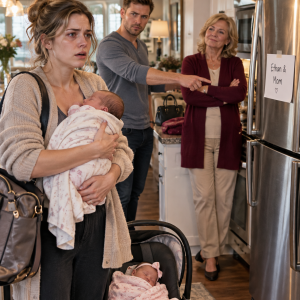
Russell leaned forward. “Do not use me to justify this, Adrienne.”
She turned toward him. “If you hadn’t helped Grant—”
“I would help him again,” he interrupted. “I helped because he is my brother, not because I was buying a claim on every year of his future.”
Their son, Caleb, arrived soon afterward. At twenty-nine, he worked for a freight-planning firm in Pittsburgh and had always declined my offers of an easy position. Adrienne reached for him when he entered.
“Everything I did was for you.”
Caleb stepped back. “No, Mom. You did it for what you decided I deserved.”
“You’re too young to understand what families owe one another.”
“I understand enough. I don’t want a chair in Uncle Grant’s company if someone has to lie, take what isn’t theirs, or put Aunt Claire in the ground to get it. I can build my own future. What I needed from you was a reason to be proud of how you lived.”
Adrienne began to sob. Russell closed his eyes, and I left the room feeling no satisfaction. Truth can bring accountability and still leave every person standing among ruins.
The Hardest Conversation
Claire needed weeks of treatment and rehabilitation before she could speak for long without becoming exhausted. During that time, specialists explained that the sedative had slowed her breathing and made her responses difficult to detect, but that a proper hospital evaluation would have revealed her condition. The cemetery accident had not brought her back. It had merely interrupted a chain of haste, dishonesty, and unquestioned authority.
When she was strong enough, I sat beside her hospital bed and apologized.
“For which part?” she asked, looking toward the window.
Her question was quiet, not cruel.
“For dismissing your concerns. For giving Bethany and Adrienne privileges they didn’t earn. For my mother’s silence. For trusting that clinic without asking questions. For closing the gate on Ruth.”
Claire folded her hands over the blanket. “Do you know what frightened me most?”
“What happened that night?”
She shook her head. “Having proof in my hands and not feeling safe enough to bring it to my own husband.”
I tried to take her hand, but she gently moved it away.
“I never believed you would intentionally harm me,” she continued. “But whenever the truth came near your relatives, your principles became negotiable. You always said we should keep a family problem small. What you meant was that I should carry the discomfort so no one else had to face consequences.”
I had no defense that did not prove her point.
“I needed to know that if the facts stood on one side and your relatives stood on the other, you would not ask me to step aside,” she said. “I still don’t know whether I can trust you the way I once did.”
In earlier years, I might have asked how long forgiveness would take or reminded her that I had acted as soon as I understood. Both responses would have made my impatience another burden for her to carry. So I sat there and listened.
The reviews continued for months. Accountants separated legitimate transactions from inflated prices, unnecessary intermediaries, concealed relationships, and improper benefits. Bethany answered for what she signed, accepted, and did to leave Claire helpless. My mother’s age and limited role were considered, but she still faced consequences for withholding information and discarding the wrapper. Dr. Keating could no longer call the case a mistake, and Adrienne faced the gravest responsibility for pushing a plan to steal records into a scheme that placed Claire within minutes of burial.
Several relatives called and urged me to handle everything privately.
“Family troubles belong inside the family,” one uncle told me.
“I believed that for years,” I replied. “That belief nearly put my living wife beneath the earth. Privacy cannot be used as shelter for wrongdoing.”
At the company, we removed automatic privileges for relatives, separated purchasing from auditing, required supplier relationships to be disclosed, and applied the same qualifications to every leadership candidate.
One longtime manager asked whether I worried about appearing cold toward my own people.
“I worried too much about appearing cold,” I told him. “That fear made me unfair to the person who shared my home.”
Claire eventually returned home but not to the company. I learned to rebuild trust through ordinary acts: putting my phone away during dinner, listening without preparing a rebuttal, attending counseling, and never treating kinship as evidence that someone must be right.
One evening, she found me at the sink washing a tower of pans.
“The mighty chief executive has become very manageable,” she said.
“I’m an apprentice husband,” I replied. “The training program may take a while.”
She laughed, and the sound was fragile but familiar. I did not ask whether it meant I had been forgiven. Trust is not a prize one requests after completing a few decent tasks. It is a home rebuilt slowly, with every board placed where the other person can see it.
The Gate We Left Open
I still owed Ruth an apology that could not be offered in a hospital corridor. In early spring, I drove to her row house near York and found her on the back porch sorting dried beans into a yellow bowl. A small garden occupied half the yard, and on the windowsill stood a new photograph of Claire and Natalie.
“Mrs. Dempsey,” I began, then stopped. The formal address felt like one more gate.
“Mom,” I said.
Her hands became still.
I lowered my head. “I’m sorry I shut you out when your daughter needed every person who loved her. I judged you by your coat, your bag, and the possibility that your arrival might embarrass me. I was protecting an image while you were trying to protect Claire.”
Ruth’s eyes filled, but she did not make me kneel inside my shame. She pulled out the chair beside her.
“Sit down, son,” she said. “You can help me sort these.”
Months later, Claire, Ruth, and I returned to the cemetery. There were no mourners, no formal flowers, and no phones raised to record us. The maple trees had filled with green leaves, and sunlight lay across the path where frost had once gathered. This time, the iron gate stood open.
We walked to the place where the casket had tilted. After investigators confirmed that the strap had failed because of an ordinary manufacturing flaw, a worker gave me a small piece of it. I kept it in my desk, not as proof of a miracle, but as a reminder of something more difficult to accept.
No one had returned from some unreachable place that morning. A living woman had come within minutes of being buried because too many people had chosen silence, convenience, reputation, or loyalty to their own circle. A doctor had trusted money more than duty. My sister had trusted fear more than conscience. Adrienne had trusted an imaginary debt more than love. My mother had confused concealment with protection. And I had spent years teaching all of them that if the truth threatened our family image, I would probably ask the truth to wait outside.
I had once believed that being a good son and brother meant standing behind relatives without asking difficult questions. Now I knew that love without standards is not loyalty; it is permission. Money can be repaid. A position can be lost and another earned. A business can revise its rules. Yet when affection becomes concealment, the place meant to offer safety may become the very place where honesty has the least room to breathe.
Claire reached for Ruth’s hand. The two women stood together for a moment, their profiles so alike that I wondered how I had missed the resemblance at the gate. Then they began walking back toward the road, and I followed several steps behind.
At the entrance, Claire paused and looked at me. She did not offer a grand declaration or promise that everything between us had been restored. She simply held the gate open until I reached her.
That small gesture meant more than easy forgiveness ever could have.
As the three of us crossed into the afternoon light, I finally understood what Claire had tried to teach me for years: ancestry may explain how people are connected, but only their choices reveal what kind of family they are willing to become.