Table Seventeen
The rehearsal dinner took place the following evening in the estate’s waterfront ballroom. Nearly one hundred and forty guests filled the room, where white flowers ran along the tables and tall windows framed the last pale light over the James River. I wore a simple sapphire-blue dress and my mother’s pearls. For a little while, standing in front of the mirror before leaving the hotel, I had felt comfortable in my own skin.
Then I found the seating chart.
My father and Denise were seated near the front with Mallory’s immediate family. My name appeared at Table Seventeen, beside the service doors, among people who had met the couple only recently and were trying to work out which fork to use.
I found the wedding coordinator.
“Excuse me, could you check whether I’m at the right table?”
She looked down at her tablet.
“Yes, Ms. Carter. This is the final seating arrangement approved by the bride.”
“Thank you. I wanted to make sure I hadn’t missed something.”
The table itself did not matter. I had sat beside strangers before and had a perfectly pleasant evening. What hurt was the feeling that my place had been chosen with care, not because there was nowhere else to put me, but because Mallory wanted me far enough away to make her point without having to say it aloud.
The people at my table turned out to be kind. One woman was helping her daughter choose a college program, and when she learned that I worked in emergency care, she asked what I thought about respiratory therapy. We talked for a while about difficult classes, clinical hours, and the value of finding work that still mattered to you after a long day. For several minutes, I forgot that my family was at the front of the room.
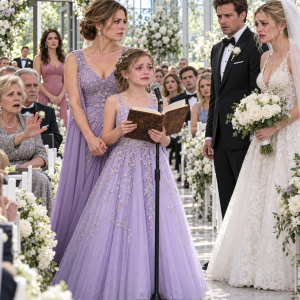
Then the speeches began. My father praised Mallory’s drive. Denise talked about loyalty and the importance of cherishing family. Graham thanked his parents for teaching him generosity and honesty. Finally, Mallory rose in a champagne-colored dress and took the microphone.
She thanked her friends, the Whitakers, and the people who had traveled to celebrate. Then she turned toward the back of the ballroom.
Toward me.
“And of course, I can’t forget my stepsister, Elise.”
Heads turned. I kept my hands folded in my lap.
“She’s just a respiratory therapist, so we’re lucky she could get away from the hospital for our special weekend.”
A few people gave the uncertain laugh people use when they are trying to work out whether a joke is meant to be funny.
Mallory lifted her glass.
“We even put her near the service doors, in case anybody needs a quick breathing lesson after dessert.”
More laughter followed, thinner this time. A few guests glanced at me and then away. I looked toward my father. He was smiling, perhaps because he thought that was the easiest thing to do. Denise raised her glass as if Mallory had just offered a charming toast.
For twenty years, I had learned to swallow the small humiliations, telling myself that keeping quiet was the same as keeping the peace. But something in me settled into a cold, steady clarity. I was tired of pretending that a hurtful remark became harmless when delivered with a smile.
I pressed my hands against the table, preparing to stand and leave. At that exact moment, a chair scraped sharply across the ballroom floor near the head table.
Walter Whitaker was on his feet.

The Man Who Remembered the Pearls
Mallory’s smile brightened when she saw Walter approaching the microphone. She seemed to assume that he was about to offer a warm toast to the families. He took the microphone from her gently, but he was not looking at her.
He was looking toward Table Seventeen.
“Elise, would you mind standing for a moment?”
The ballroom grew quiet. I rose slowly, unsure what he wanted.
“Of course, Mr. Whitaker.”
He studied my face, then the pearls at my ears.
“Were you driving near Williamsburg during a heavy storm about three years ago?”
My heart beat harder.
“Yes. I was.”
“Did you stop near Route 17 to help someone in an SUV?”
For a moment, the ballroom disappeared. I could hear rain striking the roof of the car, see the blurred red lights behind him, and remember the pale face at the window.
“That was you?” I asked.
Walter nodded, and his wife, Anne, pressed one hand over her mouth. Graham looked from his father to me, trying to understand.
Walter faced the guests.
“I have been hoping to find this young woman for three years.”
No one moved. He described the storm, the SUV, and the frightening confusion of sitting in a damaged vehicle while his mind raced ahead of what he could safely do. Then he told them that a woman had come to his window, called for help, and stayed beside him until the paramedics arrived.
“I remember her pearl earrings,” he said. “I remember her telling me they belonged to her mother, and I remember what she kept saying: ‘Stay with me. Help is almost here.’”
My fingers rose to one of the pearls.
“I remember that night too,” I said.
Walter explained that the doctors had later found a neck injury, and that the emergency team had praised the care taken to keep him still until they arrived. He did not pretend to know what might have happened if I had driven past. He only said that, during a frightening night, I had made him feel less alone.
“I tried to find her afterward,” he continued. “But I didn’t know her full name. I remembered Elise, her voice, and those pearls. Tonight, I heard someone call that woman ‘just a respiratory therapist.’”
Mallory’s face had lost its bright composure. Walter stepped away from the microphone and walked toward me.
“Elise, there is nothing small about the work you do. That night, you could have kept driving home. Instead, you stopped and stayed with a stranger until help arrived.”
Tears blurred the room around me.
“I was doing what I knew to do.”
“And you did it with kindness. I have never forgotten that.”
Graham began to clap. Anne joined him, then one of the guests by the windows, and another near the dance floor. Soon most of the room was standing, applauding me while I remained beside my chair, scarcely able to believe that the work my family dismissed had become the very reason a roomful of strangers could see me clearly.
The Question She Couldn’t Answer
Mallory crossed the floor with a smile that looked as though it had taken effort to arrange.
“Elise, this is wonderful. Why didn’t you ever tell us?”
I looked at her calmly.
“You never asked.”
Her expression held still. Graham stepped closer.
“Mallory, you told me Elise barely worked at a small clinic.”
“I didn’t mean it that way.”
“You knew she worked in emergency care.”
Mallory glanced toward the guests.
“Can we talk about this later?”
Graham’s voice remained low, but there was no mistaking the disappointment in it.
“You were comfortable making jokes about her in front of everyone.”
My father approached, looking deeply uncomfortable.
“We have always been proud of Elise. This has all been a misunderstanding.”
For the first time, I answered him without trying to protect him from the truth.
“Dad, you laughed when she made fun of me.”
He started to speak, then stopped.