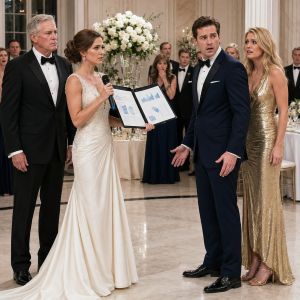
“I failed your mother,” Lorraine said through tears. “She was the first person who tried to help me.”
“Then why did you do this to me?”
“After my father was gone, I wanted to erase the evidence. I blamed Walter’s money for everything, and when Ethan married you, I believed I could finally close the past.”
“You sent him to find me.”
“Yes.”
“And when I tried to leave, you drugged me.”
Lorraine’s voice broke. “I wanted time to search your belongings.”
Walter leaned toward the phone. “You nearly took my daughter away from us.”
For several seconds, Lorraine said nothing.
Then she whispered, “I’m going to finish what Helen started.”
The call was traced to Hale Meridian’s oldest cold-storage warehouse, the building where Walter and Raymond had started the company. Police found Lorraine inside beside stacks of old financial boxes.
She claimed Malcolm had lured her there and intended to destroy the final records. Moments later, smoke rose from a rear storage room. Malcolm appeared on an upper walkway, cornered and furious, while officers ordered him to surrender.
Walter pulled Natalie toward an exit. Lorraine turned toward a staircase.
“The original ledger is upstairs,” she cried. “It proves everything.”
Walter seized her arm. “No record is worth losing another person.”
“Helen paid for my fear.”
“Then honor her by walking out.”
They reached the loading bay before smoke filled the building. Officers safely detained Malcolm, and the fire crew contained the damage.
Outside, Natalie suddenly remembered something else. Helen had placed a small brass key in her hand before leaving her beside the road.
Walter had kept it in a box for twenty-two years.
The key was stamped B-17. It opened a secure storage compartment in an Atlanta bank under Helen’s maiden name. Inside were a videotape and a signed statement showing that Malcolm had participated in Harold Whitcomb’s financial scheme long before marrying Lorraine.
Helen’s final handwritten addition was directed toward Walter:
“Do not punish Lorraine merely for being afraid. But if she ever harms Natalie, fear is no longer an excuse.”
What Justice Could Not Return
Lorraine accepted responsibility for drugging Natalie, concealing evidence, and participating in the long financial conspiracy. Malcolm faced the most serious consequences for his role in the old scheme, the warehouse fire, and his attack on Ethan. Raymond cooperated with investigators and answered for the money he had diverted decades earlier.
Ethan admitted his treatment of Natalie and entered a plea. Before sentencing, he surrendered primary custody of Caleb.
His written statement said:
“My son deserves to grow up knowing that love is not control. Until I can prove that I understand the difference, Natalie should decide what is safe for him.”
Natalie cried after reading it.
Walter sat beside her. “Do you still love him?”
“Part of me remembers the person I thought he was.”
“That isn’t the same as wanting him back.”
“No.” She folded the statement. “I’m crying because, for once, he chose Caleb over himself.”
Six months later, Natalie moved into a small yellow house ten minutes from Walter. It had a wooden swing, a vegetable garden, and a room Caleb painted pale blue. Walter offered her a waterfront property, but she refused.
“I want a home, Dad, not a monument.”
While removing the remaining stars from her childhood ceiling, they found one more folded page written by Helen.
“Walter will build something enormous because he has never known how to dream small. My fear is that Natalie may inherit not only his success, but everyone else’s hunger for it. Teach her that wealth should protect freedom, never purchase obedience.”
Caleb wandered into the room and found both adults crying.
“Why are you sad?”
Walter wiped his eyes. “Your grandmother is correcting me from twenty-two years away.”
Caleb nodded solemnly. “Can she also tell you to make pancakes?”
Natalie’s laughter filled the room, carefree and bright, and Walter realized how long it had been since he had heard that sound.
Natalie did not want Hale Meridian handed to her. Instead, she asked Walter to create a foundation in Helen’s name. It provided emergency housing, legal guidance, childcare, and transportation for adults leaving unsafe homes.
Natalie became its director.
At the first shelter, she greeted a woman who arrived carrying a grocery bag and a sleeping toddler.
“I feel so foolish,” the woman whispered.
Natalie took the bag from her. “You are not foolish. You cannot act on a truth no one has allowed you to see. You are here now, and that matters.”
Walter overheard from across the lobby and quietly stepped outside before she noticed his tears.
Lorraine sent Natalie one letter from prison.
“I failed your mother, and then I failed you. Fear taught me cruelty, but I continued choosing cruelty after I was free. I am sorry. You owe me nothing.”
Natalie did not forgive her that day. She simply stopped believing she had to decide immediately.
That, too, was freedom.
A Door Left Open
Two years after Walter drove through the Prescott gate, Hale Meridian launched a national transportation program for families leaving dangerous households.
Walter attended the opening in the same canvas jacket he had worn at 1:12 that morning.
Jonathan examined the torn sleeve. “You own half the refrigerated warehouses between Georgia and Virginia.”
“Not half.”
“That correction makes the jacket worse.”
“It has ventilation.”
Natalie called Walter onto the stage.
“This began because my father answered his phone,” she told the audience. “He did not arrive perfectly or quietly, and a certain gate may never fully recover, but he came.”
The audience rose as Walter joined her. Caleb, now seven, stood beside them in a tiny navy suit.
Years later, Walter stepped away from Hale Meridian. At his retirement ceremony, he looked toward Natalie, Caleb, Jonathan, and the many employees who had helped build the company.
“I once believed success meant creating something no one could take from you,” he began. “I was wrong. Success means building something people are free to leave without fear—whether it is a company, a marriage, a family, or a home. If someone must be frightened into staying, then you have not built love. You have built a cage.”
He glanced at Caleb.
“And if someone puts your daughter in a cage, an old pickup may occasionally become useful.”
Jonathan covered his face while the room erupted in laughter.
The bent section of Lorraine’s gate was later found in storage when the Prescott estate was sold. Natalie bought it and installed it in the courtyard of the Helen Hale Freedom Center. A small plaque beside it carried seven words:
THERE IS ALWAYS A WAY BACK HOME.
Over time, healing arrived without pretending that the past had vanished. Ethan continued counseling and slowly became a responsible co-parent, though Natalie never resumed their marriage. Lorraine eventually returned to the community under supervision, living simply and volunteering anonymously at a neighborhood kitchen.
She was not immediately welcomed into Natalie’s life. Trust came in inches: first a school performance watched from the back row, then coffee in a public place, and much later, lunch.
On the tenth anniversary of Natalie’s rescue, families gathered beneath two lemon trees transplanted from Walter’s old yard. Caleb, now fifteen, unloaded donated clothing. Jonathan complained about his knees. Ethan dropped Caleb off and exchanged a respectful nod with Natalie before leaving.
Lorraine arrived carrying flowers and stopped outside the courtyard.
For several seconds, she and Natalie looked at one another through the old bent gate.
“They’re for Helen,” Lorraine said.
Natalie accepted the flowers. Then she opened the gate.
“You may come in.”
Walter looked toward the evening sky and imagined Helen smiling—not because everything had been erased or easily forgiven, but because the pattern had finally been broken.
Fear had produced secrecy. Secrecy had fed greed. Greed had demanded control. Control had wounded an entire family.
One quiet phone call had interrupted it.
After the visitors left, Walter and Natalie sat beneath the lemon trees. The damaged gate stood across the courtyard, no longer guarding anyone and no longer keeping anyone inside.
“You know I never repaired the truck,” Walter said.
Natalie smiled. “The one you used on the gate?”
“Sentimental value.”
She rested her head against his shoulder.
“Dad?”
“Yeah?”
“I’m glad you came.”
For years, Walter had judged himself by all the moments when he had waited, doubted, or remained silent. Helen’s letters had taught him that a life could not be measured only by the times a person failed to act. Sometimes it was measured by the moment he finally answered.
Walter took his daughter’s hand.
“I will always come.”
Natalie looked across the courtyard, toward the shelter doors standing open beneath the warm lights.
“I know.”
And there, beside the gate that had once represented pride, humiliation, and captivity, they sat inside the one thing Walter’s fortune had never been able to purchase but his daughter’s courage had finally helped them rebuild:
a safe place to come home.