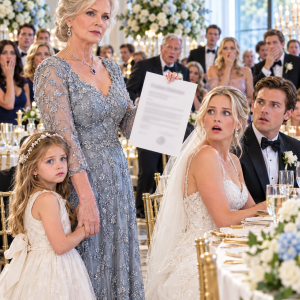
Part One: The Day I Stopped Calling It Home

The first thing I remember after tumbling down the staircase was the sound of my husband’s mother speaking on the telephone, her voice carrying through the entrance hall with the same crisp impatience she used whenever a housekeeper misplaced something or a dinner reservation wasn’t quite to her liking.
“Come get your daughter, Arthur. We’ve done everything we can for her, and frankly, she’s become more trouble than she’s worth.”
I was lying against the cold marble floor, struggling to draw a comfortable breath, while my husband, Preston Whitcomb, stood several feet away without making any effort to correct his mother’s account of what had happened.
My father must have said something she found amusing, because she gave a short laugh before answering, “You really don’t understand who you’re dealing with.”
Then she held the telephone away from her ear, and I heard my father’s voice clearly enough to recognize the quiet determination beneath it.
“If my daughter has been harmed, Eleanor, I expect every person involved to answer for what happened.”
She ended the call without saying goodbye.
Until that morning, I had spent nearly nine years convincing myself that the Whitcombs were merely difficult people, accustomed to wealth and uncomfortable with anyone who questioned their decisions, but as I watched Preston straighten his cuffs while I waited for the ambulance, I finally understood that their polished manners had concealed something far more troubling than ordinary family pride.
By the time I reached the hospital in Richmond, Virginia, the doctors had identified two fractured ribs, a badly strained shoulder, and injuries that would require weeks of careful recovery, although the physical discomfort was hardly the worst thing occupying my thoughts.
My seven-year-old daughter, Lily, had been upstairs when the argument began, and I had no idea whether anyone had explained what had happened or whether Preston’s parents intended to keep her away from me.
I worked as a part-time speech therapist at a neighborhood elementary school, earned enough to contribute to our household, and had always arranged my schedule around Lily’s needs, but I knew how easily my husband’s family could make my ordinary life sound inadequate beside their enormous house, expensive attorneys, and influential acquaintances.
When a distinguished-looking attorney entered my hospital room that afternoon carrying a worn leather portfolio, I assumed he had come on Preston’s behalf.
Instead, he introduced himself as Jonathan Hale and explained that my father had retained him.
“Your daughter is with your father, Mrs. Whitcomb,” he assured me before I could ask. “She’s safe, and we have already taken steps to make sure she stays that way.”
Relief made my eyes fill immediately.
Then he placed a legal document beside my hospital blanket and explained that Preston’s family had requested emergency custody, describing me as emotionally unreliable, financially irresponsible, and temporarily incapable of caring for Lily.
I could scarcely believe what I was reading.
“They know I take care of her,” I whispered. “They know I’m the one who takes her to school, helps with homework, and stays home when she’s sick.”
Jonathan nodded, but there was something unusually serious in his expression.
“Your father knows that too, and he’s spent his professional life making sure people cannot replace evidence with a convenient story.”
I looked at him, confused, because my father lived in a modest brick house outside Charlottesville, drove an aging sedan, and had always described his former government employment as administrative legal work.
Jonathan hesitated before explaining that Arthur Dawson had actually spent decades supervising complex federal investigations involving financial misconduct, public corruption, and influential organizations whose leaders believed their reputations placed them beyond scrutiny.
The revelation was almost impossible to reconcile with the man who clipped grocery coupons, repaired his own porch railing, and never missed Lily’s school concerts.
Yet when Dad arrived a few minutes later, carrying his familiar brown cardigan over one arm, I saw something in his bearing that I had never noticed before.
He looked at me first, not at the attorney or the documents, and whatever professional authority he possessed disappeared behind the tenderness in his face.
“There you are, sweetheart,” he murmured, taking my hand.
I began crying before I could answer.
For years, Dad had gently questioned whether I was truly happy in my marriage, and I had interpreted his concern as an inability to appreciate the life Preston had provided, particularly because the Whitcombs never hesitated to remind me how fortunate I was to belong to their family.
Now, sitting beside my hospital bed, he didn’t remind me of those conversations or ask why I hadn’t listened.
Instead, he said, “We’re going to deal with what happened, one fact at a time, and you won’t have to do it alone.”
That was when Jonathan opened a second folder.
And I discovered that the custody petition was only one part of a much larger problem.
Part Two: The Signature That Wasn’t Mine

The Whitcomb family owned a regional commercial property company that developed shopping centers, medical offices, and residential communities throughout Virginia and the Carolinas, and although Preston occasionally discussed construction schedules over dinner, he had always insisted that the financial details were too complicated to concern me.
I had believed him, partly because my own work involved children rather than business contracts, and partly because I had grown accustomed to accepting his reassurances whenever a question made him uncomfortable.
Jonathan explained that several transactions involving the family company had recently attracted scrutiny from financial investigators, particularly payments to consulting firms with questionable business histories and loans supported by unusually complicated guarantees.
Then he showed me a document bearing my name.
According to the paperwork, I had personally guaranteed a substantial business obligation for one of the Whitcombs’ subsidiary companies.
At the bottom of the final page was a signature that resembled mine closely enough to fool someone who had never watched me write.
I studied the letters for several seconds before noticing that the final curve was wrong and that the capital D had been formed in a way I had never used.
“I didn’t sign this,” I told him.
“That’s what your father suspected,” Jonathan replied. “And there may be records that help us establish exactly what happened.”
I remembered Preston bringing documents home after dinner, spreading them across the kitchen table while I prepared Lily’s lunch for the following day, and assuring me that everything concerned insurance renewals or routine household matters.
Whenever I asked to read something carefully, he would sigh and remind me that his family’s accountants had already reviewed it.
I had sometimes signed simply because I was tired of being made to feel foolish for asking.
Dad listened without interrupting.
When I finally admitted how embarrassed I felt, he squeezed my hand.
“Marriage is supposed to make trust possible, not turn it into something another person can exploit.”
Jonathan then showed me several credit reports containing unfamiliar inquiries, along with a summary of the accusations Preston’s attorneys intended to use against me.
A late utility payment from the previous winter had been described as evidence of irresponsibility, while the fact that Preston managed most household investments was being presented as proof that I lacked financial independence.
The picture they were constructing bore almost no resemblance to the woman I knew myself to be, yet every small detail had been selected to support the same conclusion.
I was supposedly incapable of making decisions without my husband.
Dad had already contacted Jonathan because he specialized in complicated family disputes involving concealed assets and disputed financial documents, but what troubled me most was learning that my father had been quietly gathering information for several months.
“Why didn’t you tell me?” I asked.
He looked genuinely uncomfortable.
“Because I didn’t want suspicion to become an accusation before I had something solid, and because I knew how much you wanted your marriage to work.”
He explained that his concerns had begun the previous spring, when Preston asked me to sign a broad authorization allowing him to manage certain financial affairs on my behalf.
I had telephoned Dad before signing, and he had advised me to request a clearer explanation.
Preston had been irritated for days afterward.
Now I wondered whether that refusal had prevented something much worse.
Before Jonathan could answer another question, his telephone rang.
He listened carefully, then stepped into the hallway.
When he returned, he told us that someone claiming to represent the Whitcomb company’s insurer had contacted the hospital requesting information about my admission and visitors.
The hospital had declined to provide it.
Dad’s expression became thoughtful.
“They aren’t simply trying to control the story,” he said. “They’re trying to find out what we know.”
For the first time, I wondered whether my fall had given Preston’s family an opportunity they had been waiting for.
Part Three: The Blue Book

That evening, a nurse helped arrange a short visit with Lily, who arrived wearing her favorite lavender sweater and carrying a folded drawing in both hands.
She approached my bed with unusual caution, clearly trying to obey the instructions she had received about being gentle, and the sight of her worried little face nearly undid all the composure I had managed to recover.
“Grandpa says you’re getting better,” she told me.
“I am, honey. I just need some time.”
She climbed onto the chair beside me and unfolded her picture, revealing a small house surrounded by flowers, with bright blue windows and a yellow front door.
“That’s where we’re going to live,” she announced.
I smiled, although I had no idea where we would be living a month from then.
“Why did you make the windows blue?”
Related Posts
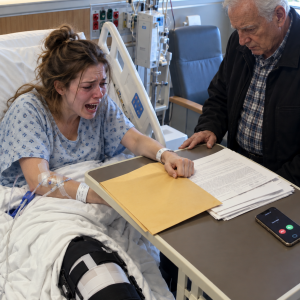
“Stop Using Your Baby as an Excuse to Make Everyone Feel Sorry for You! Your Sister Doesn’t Pull This Nonsense!” My Mother Snapped When I Begged Her to Care for My Six-Week-Old Daughter After a Car @ccident. She Boarded Her Caribbean Cruise While I Lay in the Hospital, Even Though I’d Paid Her $4,500 a Month for Nine Years. I Didn’t Argue. I Hired a Nurse and Canceled Every Payment. But Hours Later, Grandpa Arrived With an Envelope in My Late Father’s Handwriting. When I Mentioned It to Mom, She Suddenly Asked, “You Haven’t Opened That, Have You?”

“Quit Acting Like a Spoiled, Ungrateful Princess! Just Because You Bought This House Doesn’t Mean You Get to Boss Me and My Family Around!” My Husband Snapped Six Days After I Gave Birth. Then He Changed the Gate Code to My $2.4 Million Colorado Mansion and Flew to Miami With His Mother and Sister, Leaving Me Outside in the Rain With Our Daughter. “Go Cry to Your Sister. Maybe She’ll Put Up With Your Attitude!” He Texted. I Didn’t Beg or Argue. I Called My Attorney and Said, “Sell It.” But When She Opened Our Prenuptial Agreement to Page Eleven, She Asked, “Does Your Husband Remember What He Signed?”

“Please Don’t Leave Us.” The Little Boy Begged While His Mother Lay Unconscious On The Sidewalk. I Promised I Would Stay—Then She Turned Her Face Toward Me. It Was The Woman I Had Abandoned Five Years Earlier. Moments Later, Her Son Pulled Out An Old Photograph Of Us And Raised Four Fingers When I Asked His Age.