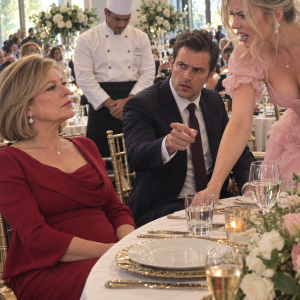
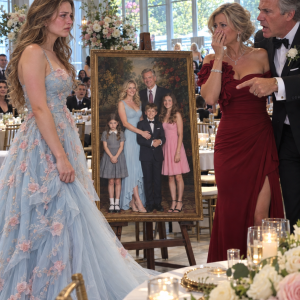
“Who told you that?”
“Martin Sloane.”
Grant recognized the name immediately.
Martin had managed his private schedule and business correspondence for more than a decade.
He had left the company shortly after Grant’s divorce.
“Martin had no authority to make that decision.”
Laurel gave him a sad smile.
“Perhaps not. But he spoke for you every time I called.”
Grant remembered one telephone conversation from London.
He had been exhausted after a difficult meeting.
Laurel had asked whether he had received her message.
He had assumed she wanted to argue about their marriage again.
“I told you to stop finding reasons for us to stay connected,” he whispered.
Laurel nodded.
“You did. And after that, I couldn’t bring myself to call again.”
Grant sat down slowly.
For years, he had remembered their divorce as an unfortunate but necessary ending.
Now he understood how much he had failed to hear.
The Little Boy Who Loved Saturn
A bedroom door opened.
A small boy appeared in the hallway, rubbing his sleepy eyes.
“Mommy, I dreamed the moon fell into our backyard.”
Laurel immediately knelt beside him.
“Oh, sweetheart. Did you help put it back?”
The boy nodded seriously.
Then he noticed Grant.
“Who’s that man?”
Grant felt his throat tighten.
Laurel glanced at him before answering.
“This is Mr. Whitcomb. He helped your school get the new telescopes.”
The little boy’s face brightened.
“You’re the telescope man?”
Grant knelt.
“I suppose I am. What’s your name?”
“Wyatt. My brother is Owen, but he’s sleeping because he says astronauts need lots of rest.”
Grant smiled.
“Your brother sounds very smart.”
“He is. But I’m better at finding Saturn.”
“Saturn is my favorite planet.”
Wyatt looked delighted.
“Really? Then maybe you can come see my space pictures someday.”
Grant glanced toward Laurel.
She said nothing.
He turned back to the boy.
“I’d like that very much, Wyatt.”
Laurel gently guided her son toward the bedroom.
“Come on, little astronaut. You have school tomorrow.”
Wyatt waved.
“Good night, telescope man.”
When the bedroom door closed, Grant wiped his eyes.
Laurel returned and sat across from him.
“If you want to be part of their lives, we need to do this carefully.”
“I want a paternity test. Not because I think you’re lying, but because we both deserve certainty.”
“I agree,” she replied.
Then her expression changed.
“There’s something else, Grant. Something about the night the boys were born that I’ve never fully understood.”
A Test That Changed Everything
They arranged the test through an independent medical practice selected by Laurel.
Grant agreed to every condition.
He did not send a driver to collect them.
He did not arrive with gifts.
He simply appeared at the clinic at the agreed time.
Owen entered carrying his astronomy notebook, while Wyatt held a small stuffed dinosaur.
Both boys recognized him.
“Telescope man!” Wyatt shouted.
Grant smiled.
“Good morning, astronauts.”
The nurse collected cheek-swab samples from all three.
Afterward, the boys asked whether they could have hot chocolate.
Grant looked toward Laurel.
“Would that be all right?”
She considered his question.
“One small cup each.”
They sat together in a café near the clinic.
For almost an hour, Grant listened to the boys talk about school, dinosaurs, and the rocket they hoped to build.
He learned that Owen loved drawing but disliked loud noises.
Wyatt enjoyed making up stories and insisted that dinosaurs could have traveled to space if someone had built them a large enough rocket.
Grant laughed more that afternoon than he had in months.
Yet every small discovery carried an ache.
He should have known these things already.
Two days later, his attorney called.
“Grant, the laboratory results are conclusive. Both boys are your biological children.”
Grant closed his office door.
He sat quietly for several minutes.
He was a father.
He had been a father for four years.
And somewhere across Chicago, two little boys had grown up without knowing his name.
The Promise That Money Could Not Buy
That evening, Grant returned to Laurel’s apartment.
She opened the door and immediately understood.
“The results came?”
He nodded.
“They’re my sons.”
Laurel looked down.
“I thought they were. But hearing it confirmed still feels different.”
Grant held the envelope carefully.
“I want to support them. I want to know them. I want to make up for everything I missed.”
Laurel motioned for him to sit.
“You cannot give them four years back, Grant. Neither of us can.”
“Then let me give them something better from now on.”
She studied him.
“They don’t need expensive vacations or rooms full of toys. They need someone who remembers their school events, listens when they’re worried, and keeps promises even when work gets complicated.”
“I can do that.”
“Then prove it slowly.”
They agreed that Grant would visit every Saturday morning.
At first, Laurel would remain present.
There would be no unexpected trips, expensive presents, or sudden announcements.
The boys would learn who he was when they were emotionally ready.
Grant accepted every condition.
Before he left, Laurel stopped him.
“And Grant, please don’t mistake this for a promise that we’ll become a couple again.”
He nodded.