The Red Crayon Between Us

A Seat I Was Never Supposed to Leave
On the afternoon before Christmas, when snow had begun to soften the hard edges of Minneapolis and every departure board at the airport seemed to be flashing another delay, I believed the most important thing in my life was a contract waiting for my signature in Chicago, a contract worth more money than my grandfather would have known how to imagine and important enough, according to six attorneys and my operations director, to determine the future of the medical-equipment company I had spent fifteen years building.
My name is Grant Whitaker, and at forty-one I had become the sort of man business magazines described with words like disciplined, relentless, and visionary, although the people who had once known me before the tailored suits and private conference rooms might have chosen less flattering language. I built hospital monitoring systems, employed nearly four thousand people, and could explain the condition of any major account without looking at a report, yet I had not spent Christmas morning anywhere except a hotel or an airport lounge in seven years.
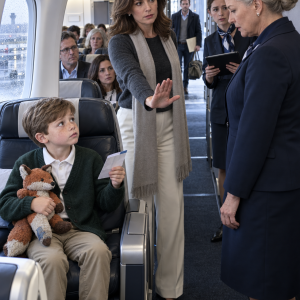
I was seated in the front cabin, reviewing the final purchase terms on my tablet, when a red crayon rolled beneath the curtain and stopped against my shoe. A little boy of perhaps four appeared a moment later, his pale hair sticking up behind one ear and his expression grave with responsibility.
“That’s mine,” he said.
I picked it up. “I suspected it belonged to somebody.”
“I’m drawing a flying house.”
“That sounds structurally complicated.”
He considered this, then smiled with one dimple in his left cheek, the same dimple I saw in my own face every morning, and something in me went completely still.
A woman called from several rows back. “Owen, please come sit down.”
I knew that voice before I turned, though nearly four years had passed since I had heard it. Claire Bennett stood in the aisle holding a sleepy little girl against her shoulder, her auburn hair twisted into a loose knot and her face thinner than I remembered, but still unmistakably hers. The girl had Claire’s mouth, the boy had my eyes, and in the space of one breath the contract on my screen became nothing more than light behind glass.
Claire looked at me as if every fear she had carefully packed away had suddenly been opened in public. “Grant.”
The boy glanced between us. “Mom, you know the serious man?”
I almost laughed, though my hands had begun to tremble. Claire recovered first and guided him back toward their row, but I followed, hardly aware that the flight attendant was asking me to return to my seat before departure.
“How old are they?” I asked.
Claire closed her eyes briefly. “Three and a half.”
I did the arithmetic even though there was no need. We had separated almost four years earlier, after an argument in which I had chosen a factory crisis in Wisconsin over the conversation she had begged me to stay and have.
“Are they mine?”
Her face hardened, not with cruelty but with the weariness of someone who had carried a truth alone for too long. “This is not a conversation we’re having over their heads.”
She was right. Owen was watching me, while his sister, Maisie, clutched a gray rabbit by one ear. I asked the attendant whether there was an empty seat nearby, and after some rearranging I found myself in the last open middle seat, wedged between Claire and two children who did not know that the stranger beside them might be their father.
As the plane climbed through the snow, Owen showed me his picture. Three figures stood beneath a red house with wings, while a fourth figure waited at the edge of the page, drawn only as a circle and two uncertain lines.
“Who is that?” I asked.
He shrugged. “I haven’t decided.”
My phone vibrated. My operations director, Nathan Cole, had sent three messages reminding me that the directors of Hartwell Medical would be waiting when we landed. I turned the phone facedown.
Claire noticed. “You should answer.”
“In a minute.”
“You used to say every unanswered message cost money.”
“I used to believe cost and value were the same thing.”
She studied me without replying, and I understood that one polished sentence would not repair what years of absence had broken.
Eleven Letters With Nowhere to Go
When the twins finally fell asleep beneath airline blankets, Claire reached into her canvas bag and removed eleven envelopes bound with a faded green ribbon. My name appeared on every one in her handwriting, along with addresses in Milwaukee, Chicago, and the temporary apartment my company had once rented for me in Madison. Several envelopes bore the same impersonal message: RETURN TO SENDER.
“What are these?” I whispered.
“Every way I tried to tell you.”
The first letter had been written four days after I left for Wisconsin. Claire explained that she had suspected she was expecting when she asked me to remain home that morning, but I had taken a call while she spoke, kissed her forehead, and promised we would talk when I returned. I remembered the black car, my assistant waiting by the curb, and Claire standing barefoot in our hallway with one hand resting protectively against her stomach, a detail I had somehow preserved without ever understanding it.
“I called your office when the doctor confirmed it,” she said. “Your assistant told me you were unavailable. I called again the next day, then sent emails, then came to your headquarters.”
“You came there?”
“I waited in the lobby for nearly two hours. Security eventually said I needed an appointment, so I left one of the letters at reception. Three weeks later it came back with the others.”
I recognized the routing label on the envelope. During the most frantic year of the company’s expansion, I had ordered all personal correspondence screened by an executive communications unit because I could no longer tolerate what I called distractions. The system had worked exactly as I designed it to work, efficiently carrying the mother of my children farther away from me.
I opened the first letter. Claire had written that she was not asking me to repair our relationship or make promises I could not keep; she was asking me to call because a child deserved two honest parents. Farther down, added in darker ink after another appointment, she had written that there were two babies, that she was frightened and joyful at once, and that she wished I had answered.
My eyes blurred. “I would have come.”
“I believe that now.”
“But you didn’t then.”
She shook her head. “A few weeks after the letters came back, a woman called from a blocked number. She knew things about your schedule and the company that made her sound credible. She said you had received my messages, that you wanted no involvement, and that if I continued contacting you, your attorneys would handle it.”
“Claire, I never said that.”
“I know that now too, but at the time I was carrying twins, sleeping three hours a night, and trying to understand why the man who had once loved me would not give me five minutes. I moved to Duluth to stay with my mother because I needed somewhere steady.”
Every instinct I possessed urged me to find the caller, fix the records, arrange housing, transfer money, hire help, and compress three and a half missing years into a furious week of activity. Claire saw that machinery starting behind my eyes.
“Don’t do what you always do,” she said.
“What is that?”
“Turn regret into a project. They aren’t a problem for you to solve.”
I looked at Owen sleeping against the window and Maisie curled beside her mother. “Then tell me what to do.”