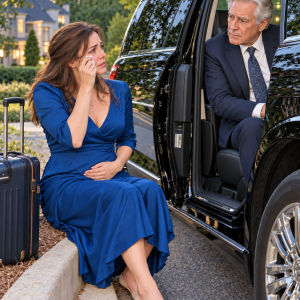
Caroline looked at the red marks circling her wrists.
“You’re describing an unjustified detention and unnecessary physical restraint as though they were a minor disagreement.”
Rourke lowered his voice.
“We apologize for the confusion. You’re free to leave whenever you’re ready.”
He seemed desperate to end the encounter.
But neither officer knew Caroline’s vehicle was equipped with a dashboard camera that continuously recorded video and audio.
The system had captured their initial approach, their threats, the physical restraint, and their sudden change in attitude.
Her telephone had also preserved relevant footage through an automatic secure-backup system.
The encounter had been documented long before they discovered her identity.
Caroline retrieved her scattered documents and returned to her sedan.
She closed the door, steadied her breathing, and examined her wrists.
Then she made one telephone call.
“This is Investigator Mercer. I need a field supervisor at my location concerning a documented allegation of officer misconduct.”
PART 4 — THE SUPERVISOR WHO SAW EVERYTHING
Approximately fifteen minutes later, another police vehicle arrived.
Captain Michael Bennett stepped out with two departmental representatives.
He was an experienced supervisor who had previously worked with Caroline on professional matters.
His expression became concerned when he noticed the marks around her wrists.
“Caroline, are you injured? Do you need medical attention before we discuss what happened?”
She shook her head slightly.
“I’m able to speak, Captain. But I want my injuries properly documented and all relevant evidence preserved.”
She showed him the recording.
Bennett watched without interrupting.
The video showed Rourke refusing to provide a specific reason for the traffic stop.
It captured him throwing Caroline’s documents onto the roof.
Then Dawson grabbed her wrist when she attempted to use her telephone.
Bennett’s jaw tightened as the officers pulled her from the sedan and restrained her.
The recording continued through their threats and the moment they discovered her credentials.
When the video ended, Bennett remained silent.
Then he approached Rourke and Dawson.
“Sergeant Rourke, Officer Dawson, you’re both relieved of field duties pending a formal investigation.”
Rourke immediately protested.
“Captain, she challenged our authority. We believed we needed to regain control of the situation.”
Bennett looked directly at him.
“The recording doesn’t show threatening behavior that would justify the force you used. Your report will need to explain that discrepancy.”
Dawson stared at the ground.
The captain instructed both officers to surrender their departmental firearms and badges in accordance with suspension procedures.
Their expressions shifted from anxiety to disbelief.
“Sir, please give us a chance to explain before making this decision,” Dawson pleaded.
“You’ll have that opportunity during the investigation. You’ll also be expected to provide accurate statements.”
Bennett assigned another officer to secure the patrol cruiser, its onboard recordings, and relevant dispatch records.
He also arranged for Caroline’s injuries to be photographed and documented.
Caroline refused any suggestion that the matter should be settled informally.
“I want this investigated under the same standards that would apply if I were an ordinary civilian without professional connections.”
Bennett nodded.
“Then we’ll preserve every relevant record and examine the circumstances of the initial stop as well as everything that followed.”
Caroline drove home later that evening.
Her hands remained steady on the steering wheel, but her thoughts were unsettled.
She had personally experienced the kind of conduct she spent her career investigating.
What disturbed her most wasn’t how frightened the officers became after recognizing her credentials.
It was how comfortable they had seemed before learning who she was.
If another woman had been stopped on that road, someone without official identification or recording equipment, the encounter might have ended very differently.
That possibility troubled Caroline long after she reached home.
PART 5 — THE THREE COMPLAINTS NOBODY HAD TAKEN SERIOUSLY

The following morning, Caroline submitted a formal report.
She documented the encounter chronologically, including the initial stop, the officers’ statements, their physical actions, and their failure to identify a clear reason for detaining her.
She attached the recordings and available medical documentation.
Writing about her own experience proved unexpectedly difficult.
In previous investigations, she had reviewed complainants’ accounts with professional distance.
Now she understood the emotions hidden behind phrases such as unnecessary force and fear of retaliation.
At one point, she considered omitting the fact that her voice had trembled while the handcuffs were tightened.
Then she included it.
The truth mattered more than maintaining an appearance of perfect composure.
Within days, investigators began examining earlier complaints involving Sergeant Rourke.
Three reports attracted particular attention.
The first involved a delivery driver stopped outside the city boundary who claimed officers searched his vehicle without adequate justification.
The second came from an elderly woman who alleged that an officer matching Rourke’s description threatened to impound her car unless she paid a fine directly in cash.
The third concerned a teenager restrained during a traffic encounter involving a damaged taillight.
All three complaints had been closed without the thorough review their allegations appeared to require.
The records contained incomplete explanations and unanswered questions.
Caroline examined the files with growing concern.
“These complaints involve different people, but the same pattern of intimidation appears repeatedly,” she told her supervisor.
The investigator assigned to the review agreed.
“We need to revisit the original evidence and determine why these allegations weren’t investigated more carefully.”
Additional interviews revealed that several complainants had felt discouraged from continuing their cases.
Some feared retaliation.
Others believed their statements would never carry as much weight as an officer’s account.
Caroline understood their frustration.
For years, those people had lived with experiences that the department treated as insignificant.
Now the clear video evidence in her case had forced supervisors to reconsider the broader pattern.
The investigation expanded to include complaint-handling procedures and employees involved in earlier dismissals.
Caroline deliberately avoided directing the investigation concerning her own detention.
She cooperated as a witness and provided evidence, allowing independent investigators to evaluate the facts.
She wanted accountability rather than preferential treatment.
A colleague asked whether she felt satisfied that Rourke’s conduct was finally receiving attention.
Caroline considered the question.
“I’m relieved the allegations are being taken seriously. But I’m disturbed by how many people apparently suffered before that happened.”
This was no longer simply about two officers behaving improperly.
It was about whether an institution had failed to listen when ordinary citizens asked for protection.
PART 6 — THE HEARING WHERE THEIR EXPLANATIONS FELL APART
Several weeks after the roadside encounter, the disciplinary proceedings began.
Caroline attended as a witness while an independent panel reviewed the evidence.
Rourke had served in law enforcement for twelve years.
Throughout much of the hearing, he maintained that his actions were justified because Caroline had been uncooperative.
“Her repeated questions made it difficult to maintain control of the traffic stop,” he told the panel.
The chairperson examined his statement.
“Can you identify the specific behavior that created an immediate threat requiring physical restraint?”
Rourke hesitated.
“She attempted to retrieve her telephone. We were concerned the situation might escalate.”
The panel replayed the recording.
Caroline remained seated inside her vehicle.
She spoke calmly.
She made no threatening movement.
Her questions concerned the reason for the stop and the officers’ identification.
The chairperson turned back toward Rourke.
“The recording shows a driver requesting basic information. It does not show someone attempting to harm either officer.”
Rourke’s expression tightened.
When asked why he had thrown Caroline’s documents onto the roof, he claimed he was trying to regain control of the encounter.
The panel found that explanation unconvincing.
Dawson testified afterward.
Unlike his senior partner, the younger officer acknowledged that the encounter had become improper before Caroline was handcuffed.
“I knew we hadn’t established sufficient justification for the detention,” he admitted. “But I followed Sergeant Rourke because I was afraid to challenge him in front of the driver.”
The panel asked whether that fear justified grabbing Caroline’s wrist.
Dawson lowered his head.
“No. It doesn’t. I should have intervened instead of participating.”
Caroline listened quietly.
She appreciated his acknowledgment.
But regret could not erase his actions.
During her testimony, she described the encounter without exaggeration.
“Their behavior didn’t change because I became aggressive. It changed after they discovered my professional identity.”
The panel reviewed the recordings again.
Her account matched the evidence.
The proceedings also examined Dawson’s responsibility to intervene when another officer acted improperly.
Caroline described the physical pain and fear she experienced when she was pulled from her vehicle and pressed against its metal surface.