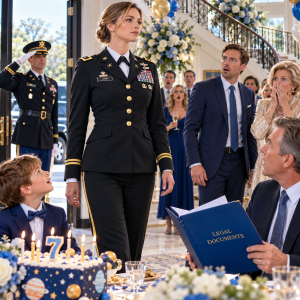
We walked toward the gate while Grant called after us.
I didn’t turn around.
Inside the car, I secured both boys in their booster seats and watched them settle against their cushions.
Oliver studied me through the rearview mirror.
“Did that man know about us when we were babies, even though he never came to visit?”
I considered how to answer truthfully without burdening him with adult cruelty.
“Yes, Oliver, he knew you had been born, but he made decisions that separated us for a long time.”
Caleb hugged his helicopter.
“I’m glad you found us, Mommy, because I like being part of our family.”
I swallowed the sudden tightness in my throat.
“Finding you both was the most important thing I’ve ever done, and nothing will change how deeply I love you.”
When we reached our small brick house, the boys hurried inside to watch cartoons.
I remained beside the kitchen sink, trying to steady my hands.
The past had finally entered our home.
This time, however, I intended to discover every piece of the truth.
PART 4 — THE ENVELOPE FROM THE HOSPITAL
I called my family attorney, Meredith Shaw, while Oliver and Caleb built an elaborate fortress from colorful plastic blocks.
Meredith had helped establish my parental rights after investigators discovered that the twins’ original foster placement lacked a valid court authorization.
She also knew how many unanswered questions remained surrounding their birth.
“Grant recognized both children immediately, Meredith, and his mother seemed genuinely shocked that they were alive.”
Meredith listened carefully before suggesting that we request access to the remaining sealed administrative records.
She warned that uncovering additional misconduct could disturb the security we’d fought so hard to establish.
I looked into the living room, where Caleb was laughing as Oliver balanced a plastic helicopter above their fortress.
“I spent three years searching for my sons, and I won’t allow the people responsible to remain protected by missing paperwork.”
Ten minutes later, the doorbell rang.
Evelyn stood outside wearing a plain beige cardigan instead of the expensive outfit she’d worn to the party.
Her eyes were swollen from crying.
“I’m not asking to come inside, Allison, but I need you to know that I never understood what Grant had done.”
I believed she hadn’t known the entire truth, although her years of defending Grant made unquestioning trust impossible.
She explained that he’d told her my pregnancy ended before twelve weeks and that I couldn’t bear anyone mentioning it.
Then she removed an aged envelope from her handbag.
“I found this behind Grant’s old school yearbooks last month, and your name appears on the front beside a hospital postmark.”
I accepted the envelope without opening it.
Evelyn asked whether she might someday know her grandsons.
“That depends on whether you’re willing to respect their needs instead of protecting Grant from the consequences of his decisions.”
She nodded and left without another request.
After the boys went to bed, I sat beneath the kitchen light and carefully opened the envelope.
Inside was a hospital memorandum dated December 17, seven years earlier.
Its heading identified my maternity admission and an internal case designation, 47-B.
At the bottom, handwritten in faded blue ink, was an instruction that made me feel physically sick.
Do not disclose infant survival to the mother.
I photographed the memorandum and sent the images to Meredith through her secure office account.
Then I telephoned her.
“Someone inside that hospital deliberately ordered the staff to conceal the fact that my babies were alive.”
Meredith’s response was immediate.
“Preserve the original document carefully, Allison, because this may be evidence of a coordinated criminal fraud rather than an administrative mistake.”
She began preparing requests for additional hospital records.
I locked the memorandum inside my fireproof safe and returned to the boys’ bedroom.
They were sleeping peacefully beneath matching patchwork blankets.
For years, their existence had been treated as a secret worth protecting.
I gently adjusted Caleb’s blanket and silently promised that the secrecy was ending.
PART 5 — THE LOCKBOX UNDER HIS DESK

The next morning, Evelyn called again, sounding more frightened than she had the previous evening.
“Grant has a fireproof lockbox in the study of our old family house, and he’s rushing there today to remove documents before the property is sold.”
She explained that the house was vacant and that she still possessed a lawful key.
I contacted Meredith before agreeing to meet her, and my attorney instructed us not to force locks or damage anything.
Evelyn and I arrived at the property shortly afterward.
The neglected roses near the entrance reminded me of the years I’d spent there hoping to build a family.
Inside, the study smelled of dust and old furniture polish.
A small cabinet beneath Grant’s mahogany desk stood partially open, its lock already damaged.
Evelyn recognized the metal box inside and confirmed that it belonged to the family records she was authorized to access.
We documented its position before examining the unlocked contents.
Two tiny hospital identification bracelets lay beneath a stack of papers.
Their labels identified two male infants associated with case 47-B.
Beside them was a billing statement for seventy-two hours of advanced neonatal respiratory care, addressed directly to Grant.
Another medical record showed that both infants had begun breathing independently within forty-eight hours and later remained under observation for three weeks.
There was also a carbon copy of a private transfer agreement.
Grant’s unmistakable signature appeared beneath language authorizing the placement of two newborn boys into private custody.
My hands shook as I examined the documents.
“He paid for their treatment, signed their transfer, and still looked into my eyes afterward and told me they were dead.”
Evelyn sank into a leather chair.
“My son abandoned his own children, and he allowed everybody to believe you had imagined a future that never existed.”
A loud noise sounded near the front entrance.
Grant appeared in the study doorway several moments later.
His gaze moved from Evelyn to the opened lockbox.
The color drained from his face.
“You have no right to search through my personal records, and I expect both of you to leave immediately.”
I held up the hospital bracelets.
“Tell me why these exist, Grant, and explain how you received bills for living babies while I was grieving their deaths.”
He stepped backward.
For several seconds, he attempted to blame the medical staff.
Then Evelyn demanded that he explain the signed transfer agreement.
His expression collapsed.
“I was twenty-nine years old, facing a major promotion, and I believed two premature babies would destroy everything I’d worked to achieve.”
I stared at him.
“You decided that becoming a senior vice president mattered more than allowing your children to remain with their mother?”
Grant admitted that a family attorney, Victor Hale, had arranged the private placement.
He claimed the children would be adopted by wealthy parents and that the process would spare everyone additional difficulties.
I told him the truth about David and Ruth Keller, the ordinary licensed foster parents who’d cared for our sons.
Grant appeared genuinely surprised.
Then he acknowledged that money had passed through Hale’s office and helped pay off the mortgage on the old family property.
“I never intended for you to discover any of this, Allison, and I thought everybody would eventually move forward.”
I stared at the man I’d once trusted completely.