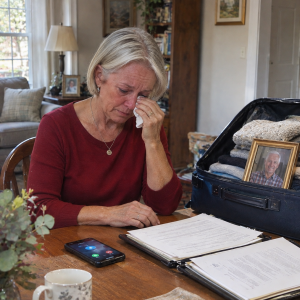
“This belonged to my mother, Olivia, and neither you nor Ethan ever had permission to take it from my possession.”
Ethan approached me with an expression I’d once mistaken for genuine remorse.
“Claire, I had no idea she was planning something like this with Grant, and maybe we can work together to repair the damage.”
I looked at him.
“You knew you were trying to force me out of my own home, Ethan, and discovering somebody else was deceiving you doesn’t erase what you did.”
He asked whether our marriage could be saved.
I refused.
The threats he’d made on my father’s death anniversary had already revealed how little he valued my dignity.
Susan explained that the property dispute, divorce, and possible business misconduct would be handled through separate legal procedures.
We wouldn’t allow a chaotic family argument to replace evidence, negotiation, or due process.
Before leaving, I carefully placed my graduation photograph in my bag.
I also informed Ethan that any future removal of belongings or attempted financial transactions affecting the house needed to be addressed through counsel.
No one would be forced out merely because another person shouted an ultimatum.
The next steps would require appropriate legal agreements or court orders.
Outside, I stood beside my car for several moments, feeling a profound exhaustion I’d been suppressing since the cemetery visit.
Susan asked whether I needed a moment.
I nodded.
For nine years, I’d worked to preserve a marriage in which every compromise seemed to require another surrender from me.
Now the documents in my bag contained evidence of how thoroughly that trust had been exploited.
But they also contained a way forward.
PART 6 — THE HOUSE MY FATHER WORKED THIRTY YEARS TO GIVE ME
The months following our confrontation were consumed by legal proceedings and independent financial investigations.
The proposed $450,000 refinancing was abandoned because the necessary approvals had never been obtained.
Investigators reviewed the Crestline invoices, the payments associated with Grant, and the Sarasota real-estate transaction.
The company’s financial condition deteriorated as clients learned about the accounting problems and questioned its reliability.
Eventually, Northstar Fresh Logistics entered Chapter 7 bankruptcy proceedings after its remaining operations could no longer sustain its obligations.
I didn’t celebrate the closure.
Ordinary employees lost jobs, and suppliers faced unpaid invoices because the company’s leadership had failed to protect its finances.
The appropriate authorities pursued the evidence relating to Olivia and Grant’s alleged financial misconduct.
Assets connected to the disputed transfers became subject to legal proceedings, while the parties challenged responsibility through their attorneys.
Ethan also faced scrutiny concerning the transactions he’d authorized.
Our divorce proceeded separately.
Through negotiations informed by the property records, Ethan agreed to transfer his twenty-percent interest in the house to me as part of the overall settlement.
The final agreement addressed the parties’ respective financial claims rather than pretending that a property transfer automatically settled every possible debt.
When the new deed was properly executed and recorded, I stood on the porch holding a certified copy bearing my name.
Claire Foster.
I had restored my maiden name.
For a long time, I looked at the house and remembered my father’s hands.
He had spent freezing mornings unloading produce so that I could attend school and eventually build an independent life.
He’d worn the same winter coat for years, insisting that replacing it was unnecessary while mine still needed to be purchased.
Shortly before our wedding, he’d handed me the keys and said he wanted me to have somewhere peaceful to return, whatever happened in my life.
That afternoon, I finally understood the meaning of his gift.
It wasn’t merely a valuable house.
It was security.
It was a place where nobody could make me feel unwanted simply because I refused to surrender my judgment.
Ethan moved into a small apartment and found employment with a local transportation company.
Margaret lost the financial support she’d expected from his former business.
Her daughters were unwilling to assume responsibility for her living expenses.
Several months later, she telephoned me asking whether she could stay in my attic bedroom temporarily.
I listened without interrupting.
Then I declined.
“I hope you find appropriate support, Margaret, but you cannot return to a home where you repeatedly helped make me feel unwelcome.”
She reminded me that we’d been family for nine years.
“We were related by marriage for nine years, but you never treated me as someone whose dignity or grief mattered.”
I ended the conversation politely.
For once, setting a boundary didn’t leave me feeling guilty.
It left me feeling peaceful.
PART 7 — THE ONLY HOME I EVER NEEDED TO COME BACK TO

Six months after the divorce settlement, I completed renovations that made the house feel like mine again.
I repainted the walls in warm neutral colors, replaced furniture associated with painful memories, and arranged a small reading table beside a window overlooking the maple trees.
The house no longer felt like a place where every room belonged to someone else’s expectations.
I had also taken care to preserve the details my father loved.
The kitchen still contained the wooden shelves he installed during his last visit.
His old gardening tools remained in the shed, cleaned and organized exactly as he would have wanted.
I reframed our graduation photograph in oak and placed it prominently in the living room.
Beside it stood the velvet box containing my mother’s sapphire ring.
One Sunday morning, I sat beside the window drinking coffee while autumn leaves drifted across the lawn.
The silence was extraordinary.
Nobody criticized how long I spent reading.
Nobody complained that I was wasting money on flowers or that visiting my father’s grave was an unnecessary emotional indulgence.
I could make ordinary decisions without preparing a defense.
My accounting career continued, and I began taking on additional clients who valued the experience I’d gained reviewing complicated financial records.
I had spent years using those skills to protect Ethan’s business while neglecting my own financial security.
Now I was finally applying the same discipline to my future.
Later that afternoon, I purchased white lilies and drove to Lakewood Cemetery.
I knelt beside my father’s grave, brushed away several fallen leaves, and arranged the flowers carefully.
“Dad, I protected the house we worked so hard to buy, and I wish I could tell you how much your sacrifices still mean to me.”
The breeze moved gently through the trees.
I remembered his laughter, his advice, and the quiet confidence he placed in me when I was young.
For a moment, I wished he’d been there to see the woman I was becoming.
Then I realized he’d already given me the tools to become her.
He taught me to work carefully, respect the truth, and refuse to confuse wealth with character.
He also showed me that genuine love didn’t require someone to become smaller to make another person feel important.
Ethan once threatened that leaving the house would end our marriage and that I’d never be welcome back.
In the end, the marriage did end.
But the house remained mine, and the person who’d tried to banish me was the one who had to leave.
I returned home that evening beneath a sky glowing with the last colors of sunset.
I unlocked the front door, stepped inside, and placed my keys on the table beside my father’s photograph.
There was no argument waiting for me.
No demand for an apology.
No voice insisting that I owed someone my obedience.
There was only the quiet home my father wanted me to have and the future I was finally free to choose.
THE END