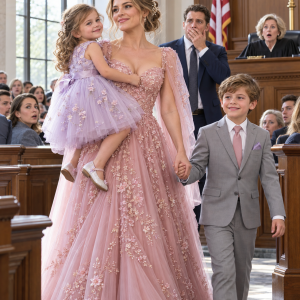
When mother and son finally reunited, the encounter was quieter than anyone expected.
Alexander stood before her without moving.
For several moments, neither knew what to say.
Then Eleanor reached for him.
“I never wanted you to believe that I left because I didn’t love you.”
He embraced her.
“I spent years thinking you had chosen a life without me.”
“I chose what I believed would keep you alive, and I have regretted every year we lost.”
They held each other while the rest of us remained respectfully silent.
No explanation could return those missing years.
But the truth gave them the opportunity to begin again.
PART 7 — THE MANSION BECAME SOMETHING DIFFERENT

In the months that followed, the mansion gradually lost its association with secrecy and suspicion.
The property and protection arrangements were reviewed so they could serve the purpose originally envisioned by Alexander’s grandmother.
Instead of being treated as a private luxury gift, the house became part of a properly administered charitable effort supporting families facing housing insecurity, coercion, and serious legal difficulties.
Rebecca continued living there with Lily while appropriate long-term arrangements were made.
She also began building a life no longer defined solely by her position as Alexander’s assistant.
Her experience gave her a strong interest in helping families who faced the same uncertainty she had endured.
The Whitaker family’s old protection fund became an opportunity to create something meaningful from a painful history.
Olivia, my closest friend, joined the charitable organization’s communications team after investigators traced the anonymous package she had received.
She initially felt guilty about sending me the property documents.
I reminded her that she had no way of knowing the package had been deliberately designed to mislead.
“You didn’t create the deception, Olivia. You gave me the first clue that something important had been hidden.”
She embraced me.
“Next time someone sends me mysterious property documents, I’m calling you before forwarding anything.”
I laughed.
“I’d strongly prefer there never be a next time.”
Meanwhile, Alexander and I began rebuilding our marriage carefully.
We did not pretend that the discovery of a criminal conspiracy automatically repaired his secrecy.
I needed him to understand why his silence had hurt me.
He needed to learn how to discuss difficult circumstances before turning them into private decisions.
There were uncomfortable conversations.
Sometimes he slipped into old habits, attempting to reassure me before explaining what had actually happened.
When that occurred, I reminded him that reassurance without information was not the same as trust.
He listened.
Our son grew steadily, bringing small moments of ordinary happiness into a family recovering from extraordinary events.
Lily became particularly fond of him.
During visits to the mansion, she entertained him with picture books and showed him the colorful stars decorating her bedroom walls.
Eleanor spent time with her son and grandson, slowly learning the rhythms of a family she had once believed she might never see again.
Theodore also began confronting the consequences of his choices.
His authority had once depended on controlling what other people knew.
Now he was learning to answer questions he had avoided for decades.
None of those changes happened immediately.
But for the first time, the Whitaker family was moving forward without treating every uncomfortable truth as an enemy.
PART 8 — THE PROMISE THAT MONEY COULDN’T BUY
One cool autumn evening, Alexander invited me to dinner at the mansion.
I expected a meeting involving the charitable foundation.
Instead, I discovered a beautifully arranged table beneath the old oak trees in the garden.
Small lights hung overhead, while the final colors of sunset spread across the lawn.
Eleanor sat beside Charles.
Theodore occupied a chair near the end of the table, his walking cane resting against his knee.
Rebecca and Lily arranged place cards, while Olivia discussed flowers with one of the staff members.
Our son slept peacefully in a portable bassinet beside my chair.
I looked at Alexander.
“What’s all this supposed to be?”
He smiled.
“Dinner with the people who helped our family find its way back.”
The evening was imperfect in the most comforting way.
There were awkward silences, unfinished conversations, and occasional disagreements about old memories.
But nobody walked away simply because the truth became uncomfortable.
After dessert, Alexander stood and raised his glass.
He first addressed Rebecca.
“I’m sorry I made decisions affecting you and Lily without making certain you understood what was happening.”
She nodded.
Then he turned toward Eleanor.
“I’m sorry we lost so many years, Mom. I wish I’d known how hard you fought to protect me.”
Her eyes filled with tears.
He looked toward his father and grandfather.
“I inherited the belief that secrecy was strength, and I used that belief to justify shutting people out.”
Theodore lowered his gaze.
Finally, Alexander turned toward me.
“Caroline, I made you feel like an outsider in a marriage we were supposed to build together.”
My throat tightened.
“You did, Alexander. And it hurt more than you realized.”
He approached my chair and knelt on one knee.
Then he removed a folded sheet of paper from his jacket.
“I considered buying you something expensive, but I realized another extravagant gift would only prove that I still haven’t understood what matters.”
A few guests smiled.
He unfolded the paper.
“This is something I wrote myself. It isn’t a legal document, a financial guarantee, or another promise hidden behind complicated arrangements.”
I looked at him.
“Then what is it?”
“A promise to tell you the truth before deciding what you’re capable of handling.”
He continued reading.
“I promise to ask for your help before confusing control with protection. I promise that our marriage will never again become a place where the most important decisions happen without you.”
His voice trembled.
“I promise to let you see me when I’m frightened, uncertain, or imperfect, instead of hiding everything until I believe I’ve found a solution.”
He glanced toward our sleeping son.
“And I promise our children will learn that family history is something to face together, not something to bury until it becomes dangerous.”
Tears filled my eyes.
“That’s what I’ve needed from you all along.”
He lowered the paper.
“I can’t promise I’ll never make another mistake, Caroline. But I can promise I won’t deliberately hide those mistakes from you.”
I accepted the handwritten page and helped him stand.
Then I kissed him.
Lily immediately began applauding, making several people laugh.
Our son stirred in his bassinet, while Eleanor wiped her eyes and Theodore allowed himself a faint smile.
Later that evening, I walked through the mansion’s quiet library.
Eleanor’s portrait still hung above the fireplace.
Once, that painting had represented a family’s painful history of separation and secrecy.
Now it reminded me of a woman who had refused to surrender the truth, even when powerful people wanted it buried.
Alexander joined me.
“Do you still hate this house?”
I considered his question.
“No. It doesn’t feel like a secret anymore.”
He took my hand.
Outside, Lily was showing our little boy a constellation she had drawn on the garden pathway.
Rebecca followed them carrying a blanket.
For generations, the Whitaker family had confused protection with control.
Now the mansion sheltered families who needed safety without requiring them to surrender their independence.
Rebecca had discovered a purpose beyond being someone’s assistant.
Eleanor had regained the son she never stopped loving.
Theodore had finally begun speaking about the past.
And Alexander and I were learning to build a marriage where truth mattered more than appearances.
“Ready to go home?” he asked.
I smiled.
“Isn’t this home now?”
He looked toward the garden.
“I think it finally is.”
We walked outside together beneath the first stars of the evening.
For the first time, the Whitaker name felt less like an inheritance of power and more like a responsibility we had chosen to accept.
My husband’s greatest gift was never the luxury he could afford, the property he controlled, or the influence he possessed.
It was the truth he had finally learned to share.
THE END