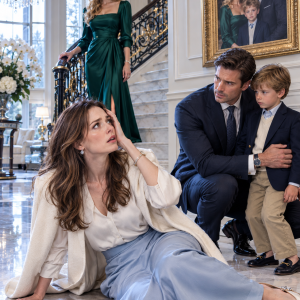
One year after my divorce, my former husband stopped me outside the maternity wing of a major Boston hospital, pointed toward the one-year-old boy resting against my former best friend’s shoulder, and announced loudly enough for strangers to hear that I had never been capable of giving him a child. What he did not know was that the director of reproductive medicine was already riding the elevator toward us with a sealed review of the treatment records that had shaped our marriage, my self-worth, and the story my former husband had spent years teaching everyone else to believe.
Part 1 – The Family He Wanted Me to See
I noticed Brooke Hayes before I allowed myself to look directly at Daniel Mercer.
Brooke had once been my closest friend, the person who sat beside me during fertility appointments, brought me water after procedures, and squeezed my hand while telling me that failed treatment did not make me less of a woman. Now she stood beside my former husband outside the maternity wing of Harbor Point Medical Center, holding a one-year-old boy against her shoulder while wearing pearl earrings Daniel had given me on our fifth wedding anniversary.
The symbolism would almost have been ridiculous if it had not hurt so badly.
Daniel smiled when he recognized me.
“Evelyn, I did not expect to see you here.”
I looked toward the child.
Before I could answer, Daniel placed a protective hand against the boy’s back and added, “I suppose this is awkward, considering everything.”
Brooke shifted uncomfortably.
Then Daniel delivered the sentence he had apparently been waiting to use.
“You could never give me a child, Evelyn. Brooke could.”
Several people near the elevators looked toward us.
A year earlier, public humiliation from Daniel would have made me lower my eyes.
This time, I did not move.
Our divorce had been finalized almost exactly twelve months earlier, although emotionally Daniel had left long before the paperwork arrived. Three days after my final failed fertility treatment, while my abdomen remained bruised from injections and I could barely shower without crying, he entered our bedroom carrying divorce documents.
I had asked for one week.
Just seven days in which I could recover enough to think clearly.
Daniel had looked at me and said, “There is nothing left to wait for.”
Within weeks, Brooke and Daniel were openly together.
I became the devastated wife everyone pitied.
Daniel kept our house, retained control over the charitable foundation I had spent six years building, and carefully explained to mutual friends that fertility treatment had changed me into someone emotionally unstable, resentful, and impossible to live with.
Because I was ashamed, I rarely defended myself.
That silence helped his version survive.
I moved into a modest apartment above a neighborhood bakery, stopped returning calls, and avoided anyone who asked whether I was “doing better” because I knew what they really meant.
Had I finally accepted that Daniel had been right to leave?
For many months, part of me believed he had.
Then, four months before the confrontation at Harbor Point, I consulted a new reproductive specialist about several unresolved medical questions.
Dr. Samuel Whitaker, director of Harbor Point’s Center for Reproductive Medicine, spent nearly an hour reviewing the records I still possessed before asking something unexpectedly simple.
“Who told you that you were infertile?”
I stared at him.
“Everyone, apparently. We tried for years, underwent treatment repeatedly, and nothing worked.”
He adjusted his glasses.
“I see infertility within the marriage. I do not see documentation establishing that the primary cause originated with you.”
That sentence followed me home.
That night, I opened the cardboard box containing every fertility document I had kept from my marriage.
Some reports were there.
Others were missing.
Several pages I remembered briefly seeing had disappeared entirely, including reports Daniel folded and put away before I could finish reading them.
For the first time, I stopped asking what had been wrong with my body.
I started asking why I had never been permitted to see the entire medical picture.
Part 2 – The Records Daniel Never Wanted Me to Read
I requested archived records connected with my own treatment history.
The first complete packet changed everything.
My ovarian reserve had been within normal parameters for the relevant period. My hormonal profile had remained within expected ranges, and my body had responded appropriately to treatment.
Then I encountered a phrase appearing repeatedly throughout the documentation.
Severe male-factor infertility.
Daniel’s name appeared beside it.
I read the same lines several times because my mind refused to accept what they meant.
During years of treatment, I had been the person injecting medication into bruised skin, rearranging work commitments, undergoing procedures, apologizing after every failed cycle, and asking Daniel whether he regretted marrying me.
He had watched me carry all of that.
He never once said the medical concern might not be mine.
Dr. Whitaker carefully explained that some information remained Daniel’s private medical information and could not simply be disclosed to me. However, he could discuss records that directly affected my own treatment history and clarify the conclusions documented during our shared fertility care.
Over the following months, he reconstructed enough of the archived timeline to confirm something painful.
The medical record never supported Daniel’s claim that I alone caused our infertility.
Now Daniel stood outside the maternity wing with Brooke and a child he considered proof that every doctor had been wrong.
“A whole year has passed,” Daniel said, apparently interpreting my silence as weakness. “I finally have the family I always wanted.”
I looked at Brooke.
Her thumb moved nervously across the finger where she wore her ring.
She had always done that when hiding something.
“Everything you wanted?” I asked.
Daniel’s smile became rigid.
“A real family.”
I glanced toward the elevator display.
The numbers were descending.
Daniel followed my gaze.
“Are you still pretending you know something I do not?”
Before I answered, the elevator chimed.
The doors opened.
Dr. Whitaker stepped into the hallway carrying a sealed hospital envelope.
Brooke saw him first.
Every trace of color disappeared from her face.
The baby bottle slipped from her hand, struck the polished floor, and rolled beneath a row of chairs while milk spread across the tile.
Daniel frowned.
“Brooke, what is wrong?”
She stared at Dr. Whitaker.
“Why is he here?”
That question mattered.
She was afraid before he opened the envelope.
Dr. Whitaker walked toward me.
“I completed the final review you requested.”
Daniel looked from the sealed packet toward my face.
“Review of what?”
I did not answer him.
Dr. Whitaker asked, “Would you prefer that we continue somewhere private?”
A year earlier, I would have accepted immediately because avoiding Daniel’s anger had once controlled too many of my decisions.
This time, I said, “Please explain the parts concerning my treatment history here.”
Daniel stepped forward.
“You cannot discuss my private medical information in a hospital hallway.”
Dr. Whitaker remained composed.
“I will not disclose information that belongs exclusively to you. I can discuss clinical conclusions directly affecting Ms. Parker’s own care and the shared treatment history in which she participated.”
Daniel’s expression tightened.
That was when I understood something important.
He did not look afraid of discovering new information.
He looked afraid that old information would finally be spoken aloud.
Part 3 – The Diagnosis He Turned Into My Shame

Dr. Whitaker opened the certified treatment summary.
He explained first that my records did not contain a diagnosis justifying the claim that I had been solely responsible for our infertility. My ovarian reserve had been appropriate for the period examined, my hormone results fell within expected limits, and my treatment response had been clinically adequate.
Daniel interrupted immediately.
“Nobody ever said she was completely responsible.”
I stared at him.
“You told me repeatedly that I could not give you children, and you said exactly the same thing five minutes ago.”
Daniel waved one hand impatiently.
“That was emotional language, not a medical statement.”
Dr. Whitaker continued.
The shared treatment record repeatedly identified severe male-factor infertility as the principal documented concern.
The words seemed to hang between us.
Brooke stopped rocking the baby.