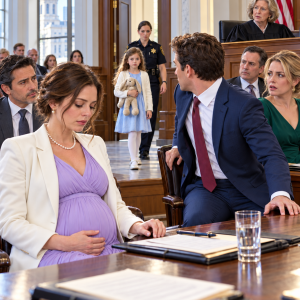
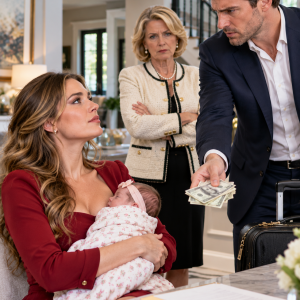
Fear I could not fully name.
“I told you not to tell Adrian?”
“For two weeks.”
“Then he found out?”
“Yes.”
“Was he angry?”
“That is what I expected.”
He was not.
The next morning, Adrian came to Evelyn’s office and asked how to contribute part of his own ownership to the same protective structure.
For one painful moment, I remembered him assembling Sophie’s crib near midnight, refusing help while studying every instruction twice.
He had looked frightened.
He told me he was thinking about what kind of father he wanted to become.
I had buried that memory because remembering good moments made his later cruelty harder to understand.
“What happened between that man and the hospital room?”
Evelyn shook her head.
“That is the question I could never answer.”
Then she showed me something stranger.
After our divorce, someone filed documents attempting to dissolve Whitmore-Cole Systems.
Adrian’s signature appeared on the filing.
Three days later, another attorney withdrew it.
His name was Jonathan Reed.
I had never heard of him.
“Who did he represent?”
Evelyn answered carefully.
“Someone connected to your father.”
My father had died when I was nineteen.
He had been a high-school mathematics teacher.
I stared at her.
“That is impossible.”
“The representation began years before his death.”
Then she explained that my father created a small trust containing approximately forty thousand dollars to support the software work I would eventually build.
I had never known.
PART 9 – WHAT MY MOTHER FINALLY TOLD ME
That evening, Evelyn and I met my mother at her modest home outside Philadelphia.
She listened silently while I described Whitmore-Cole, Sophie’s trust, and the forty-thousand-dollar fund.
Then she began crying.
My father had inherited a small amount from an uncle and saved most of it without telling me.
He believed I would refuse financial help if I thought my parents had sacrificed too much.
Before he died, he created the trust to support education or technical work.
My mother became trustee.
Years later, when my consulting business began growing, she quietly authorized legitimate seed expenses through the trust.
“Why did you never tell me?”
“Because your father asked me to wait until you believed in yourself without needing his money to prove it.”
That sounded like him.
Then her expression changed.
Adrian learned about the trust during our marriage because he found old tax documents.
At first, he treated the discovery as another family story.
Later, when Cole Dynamics needed capital, an outside adviser suggested consolidating Whitmore-Cole completely into the larger company.
My father’s trust language complicated that transfer because part of the original software development had been funded through protected assets.
“Who convinced Adrian that keeping me away from Whitmore-Cole protected the company?”
My mother looked ashamed.
“A corporate attorney named Malcolm Pierce.”
Pierce represented one of Adrian’s early investors.
He argued that my independent ownership created financing risk and that motherhood made my future involvement unpredictable.
Adrian listened.
I signed documents without understanding the full strategy.
Nothing excused what Adrian did at the hospital.
Nothing excused the affair.
But the corporate separation had begun before either event, shaped by people who viewed my contribution as a problem to be managed.
The past was not becoming kinder.
It was becoming more accurate.
PART 10 – SAVING THE COMPANY WITHOUT SAVING ADRIAN

Our legal review lasted several weeks.
Whitmore-Cole remained active.
I still controlled fifty-one percent.
Sophie’s trust held twenty percent of Adrian’s original interest.
The remaining ownership and licensing arrangements required correction before any financing could proceed.
Cole Dynamics still possessed valuable engineering talent and viable technology.
It also had an executive structure that could no longer continue unchanged.
Whitmore Capital eventually offered rescue financing, but not the deal Adrian originally requested.
The terms required independent governance, a new chief executive search, corrected licensing agreements, lender consent, and protection of Sophie’s trust.
Adrian would lose operational control.
He sat across from me during the final negotiation.
“So this is how you get rid of me.”
I shook my head.
“No. Your balance sheet, governance failures, and hidden ownership problems created that result.”
“You could have simply rejected the company.”
“Four hundred employees are not responsible for our marriage.”
He looked tired.
“Do you hate me?”
I considered the question.
“Not enough to make a bad investment because of you.”
He almost smiled.
Then I asked something I had postponed for three years.
“Why did you create Sophie’s trust and then walk away?”
His face changed.
For a long time, he said nothing.
“I was terrified of becoming my father.”
I waited.
“When the company started failing internally, I became obsessed with controlling everything. Camille became an escape. Then the birth nearly killed you, and instead of confronting what I had become, I chose the ugliest possible way to leave.”
That was not absolution.
It was not enough.
But it was finally an answer that did not pretend cruelty was efficiency.
“Sophie is happy,” I said.
He closed his eyes briefly.
“Does she know about me?”
“She knows she has a father who lives somewhere else.”
“Can I meet her?”
“Not because your company needs my money.”
He nodded.
“Fair.”
Any relationship with Sophie would happen separately, slowly, and only through appropriate legal and parental boundaries.
For once, Adrian did not argue.
PART 11 – WHAT I ACTUALLY WON
Cole Dynamics survived.
Adrian stepped away from day-to-day leadership.
Camille remained temporarily through the restructuring and later left for another company.
Evelyn helped correct the ownership records that should have been addressed years earlier.
Sophie’s trust remained untouched.
I did not merge Whitmore-Cole completely into Cole Dynamics.
Instead, we established a transparent licensing structure that compensated the entity fairly and preserved my controlling ownership.
The forty-thousand-dollar trust my father created had grown into something far more meaningful than its original balance.
It represented the first person who invested in my mind before I knew how to price my own work.
One Sunday morning, I took Sophie to my mother’s house.
She wore yellow rain boots and carried three crayons because she believed every adult home needed emergency art supplies.
My mother made pancakes.
Sophie asked whether her grandfather had ever met her.
“No, sweetheart,” I told her. “He died a long time before you were born.”
“Would he like me?”
My mother laughed through tears.
“He would be completely unreasonable about you.”
Sophie accepted that answer.
I looked around the small kitchen where I had arrived three years earlier carrying a newborn and one suitcase.
Back then, I believed Adrian had taken my life away.
He had not.
He had taken access cards.
A house.
A marriage I thought existed.
The rest had still belonged to me, even when I could not see it.
My skill.
My judgment.
My father’s quiet investment.
My daughter.
My ability to begin again.
I did not build Whitmore Capital to defeat Adrian.
I built it because Sophie needed breakfast, shoes, preschool, stability, and a mother who remembered she was capable.
Eventually, I built it because I loved the work.
That difference became the most important one.
Adrian once told me I was useful until I became expensive.
Three years later, I finally understood the error hidden inside that sentence.
People are not assets whose value disappears when their needs increase.
Marriage is not an acquisition.
Motherhood is not a liability.
And building something beside another person does not erase the part that came from you.
Sophie climbed into my lap holding a pancake shaped vaguely like a star.
“Mommy, Grandma says this one is yours because it broke.”
I looked at the crooked pancake.
“Why do I get the broken one?”
My mother answered from the stove.
“Because apparently you have experience making damaged things useful.”
I laughed.
For once, the past did not feel like a wound reopening.
It felt like a record finally corrected.
THE END