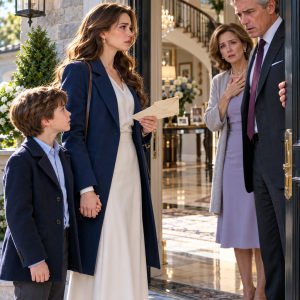
“You are trying to make me homeless over a cup of coffee.”
I looked at the medical dressing against my skin.
“You threw it at my face.”
“It was not boiling.”
The officer holding the emergency-room report looked directly at him.
“The temperature does not need to reach boiling for liquid to cause burns.”
Grant stopped talking.
The officers photographed the kitchen, the broken mug, the stains on the cabinets, and the suitcases.
They also photographed several cardboard boxes I had begun packing earlier that week.
Grant assumed those boxes contained my belongings.
They did not.
They contained his.
For three months, I had been quietly preparing for separation.
The coffee changed only the timing.
When the officers eventually instructed Grant to collect essential personal items and leave pending the emergency protective process, his disbelief became rage.
“You planned this.”
I answered carefully.
“I planned to leave this marriage. I did not plan for you to throw hot coffee at me.”
Madison whispered something to him.
Grant turned toward the bedroom.
One officer blocked his path.
“You are taking clothing, medication, identification, and necessary personal items tonight. Nothing else.”
Madison glanced toward the safe.
That glance was enough.
The officer noticed.
So did I.
Grant left forty-three minutes later carrying one duffel bag.
At the elevator, he turned around.
“You are going to regret humiliating me.”
The nearest officer immediately stepped between us.
“Mr. Parker, threatening statements are a very poor choice under the circumstances.”
The elevator doors closed.
For the first time since our wedding, silence inside my home felt peaceful.
3. The Abuse I Had Renamed

The following morning, a domestic-violence advocate met me at the hospital resource center.
Her name was Nicole Reyes.
She listened while I explained the coffee, the jewelry, and Grant’s temper.
Then she asked something that seemed simple.
“Has anything like this happened before?”
I started to say no.
Then memories arrived.
Grant monitoring every large purchase on my credit cards even though I earned more than he did during several years of our marriage.
Grant insisting on passwords to accounts held solely in my name.
Grant taking my phone from my hand during arguments because I was “too emotional to communicate responsibly.”
Grant punching the wall beside the refrigerator.
Grant blocking the doorway when I tried to leave conversations.
Grant telling Madison she could enter our condo whenever she wanted.
Grant laughing when I objected because, according to him, “Family does not need invitations.”
There had also been another kitchen incident four months earlier.
He knocked a saucepan from my hand during an argument.
Hot water splashed across my wrist.
I told the pharmacist it happened while cooking.
Nicole watched my face.
“Your answer changed.”
I nodded.
“He had never done something this obvious before.”
“Obvious to whom?”
That question remained with me.
Over the next several weeks, investigators interviewed neighbors.
Mrs. Feldman, an eighty-year-old woman across the hallway, described hearing Grant shouting late at night.
Another neighbor recalled seeing me wearing sunglasses indoors after an argument.
The pharmacist confirmed my earlier purchase of burn cream.
Building security logs documented repeated occasions when Madison entered using a guest-access code Grant had provided without my permission.
Then investigators recovered text messages.
Grant had sent several after leaving the condo.
You destroyed our marriage.
Everyone will know what you really are.
You are going to die alone in that apartment.
One message said:
Madison deserved those pieces more than you ever did.
My attorney nearly laughed when she read that one.
“It is remarkable how often people document their own motives.”
4. The Hearing
At the preliminary hearing, Grant appeared in a navy suit beside a criminal-defense attorney who looked increasingly exhausted as the morning progressed.
Grant maintained that the coffee incident was accidental.
The prosecutor displayed photographs of my injuries.
Then she played footage from an officer’s body camera.
Grant’s own voice filled the courtroom.
“Madison is coming tonight, and Caroline is giving her the jewelry. If Caroline wants to behave like a stranger in my home, she can pack her things and leave.”
The judge looked at Grant.
“You called the residence your home several times.”
His attorney shifted slightly.
The prosecutor placed the deed on the evidence display.
“Your Honor, title records identify Mrs. Parker as the sole owner. The property was acquired years before the marriage.”
Grant looked down.
The judge continued.
“Did you know that when you told your wife to leave?”
His attorney advised him not to answer.
The hearing also included building footage showing Madison arriving with empty luggage and protective packing materials.
Nobody had opened her suitcases without permission that night. She eventually consented after officers explained why they were asking.
Inside were jewelry pouches, bubble wrap, and several small protective boxes.
Madison later insisted she thought Grant was giving her decorative items rather than heirloom jewelry.
Perhaps that explanation was partly true.
It did not change what Grant had promised her.
The court extended the protective order.
Grant was prohibited from contacting me directly or approaching the condo except through approved arrangements supervised by counsel.
The criminal case continued.
5. The Marriage Behind the Evidence

The legal process forced me to examine six years of marriage as though I were auditing somebody else’s records.
Patterns looked different when organized chronologically.
Year one contained jokes about my independence.
Year two contained complaints about my friends.
Year three contained questions about why I needed accounts Grant could not access.
Year four contained slammed doors and broken objects.
Year five contained insults followed by elaborate apologies.
Year six ended with coffee burning my face.
Nothing had begun dramatically.
That was precisely why I tolerated it.
Each violation arrived only slightly worse than the previous one.