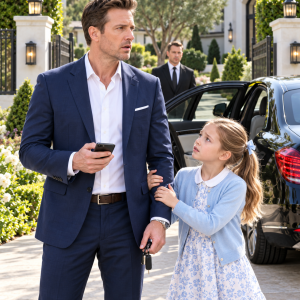
“He failed to check important work carrying his name. Now he is telling the truth and accepting what happens because of that failure.”
Harper considered the distinction.
“So he did something wrong without wanting Dad hurt?”
“That is what the evidence shows.”
“People can be wrong and still decide to become better?”
Grace brushed the child’s hair away from her forehead.
“They can decide to try. Becoming better requires more than saying it.”
The Thursday He Failed to Appear
Federal and state investigations continued for more than a year.
Thomas faced charges involving falsification of safety records, fraud, obstruction, and criminally negligent homicide. Richard was charged with conspiracy, misuse of Jonathan’s electronic signature, witness manipulation, and obstruction of justice.
ReedLearn paid substantial regulatory penalties and lost several transportation licenses. The company sold the logistics division and created an independent safety office with authority to stop operations without executive approval.
Grace filed a wrongful-death lawsuit based upon the newly disclosed evidence. A jury awarded damages placed inside a transparent trust managed by an independent fiduciary. The money funded Harper’s education, counseling, and long-term care rather than becoming a private corporate settlement.
Grace directed another portion toward legal assistance for families facing commercial transportation accidents.
Jonathan approved every corporate obligation but exercised no control over the trust.
He believed disappearing from Harper’s life would be the respectful choice. He did not want her connecting him with the company responsible for Michael’s death, so he stopped volunteering at Brookfield Elementary.
He missed three consecutive Thursday reading sessions.
On the fourth Thursday, his assistant delivered an envelope without a return address.
Inside was another paper flower and a sentence written in purple pencil.
You said people should not leave children waiting.
Jonathan understood that retreating to reduce his own guilt could create another form of abandonment.
He called Grace.
“I do not want to confuse Harper or take a place that belongs to Michael.”
Grace remained silent before answering.
“Then never pretend you can replace him.”
“I would not.”
“Do not promise expensive trips, presents, or impossible futures. Arrive when you say you will arrive, call when you cannot, and allow her to talk about her father without becoming uncomfortable.”
“I can do that.”
“Consistency will decide whether you can.”
Jonathan returned the following Thursday as a library volunteer. No photographers accompanied him, and he brought nothing except a stack of books.
Harper watched the door until he entered.
“You were late for three Thursdays,” she said.
“I was wrong. I thought staying away would make things easier, but I should have asked instead of deciding for you.”
“Mom says apologies need actions.”
“Your mother is correct.”
He read with her for an hour.
The next Thursday, he returned again.
The Person Who Stayed Without Replacing Anyone

Over the following months, Jonathan helped Harper with reading and mathematics while listening to stories about Michael.
She described how her father burned pancakes, sang incorrectly to radio songs, and set the microwave clock eleven minutes ahead because he believed it prevented lateness.
Jonathan mentioned Michael’s name naturally. He learned that honoring a person did not require silence and that silence had already allowed his own family to rewrite the dead man’s story.
Grace observed carefully.
Some afternoons, Jonathan’s presence helped Harper feel secure. Other days, seeing him reopened Grace’s anger because his company name remained connected to the worst moment of her life.
Neither pretended the situation was simple.
Trust developed through small actions rather than public declarations. Jonathan arrived on schedule, gave advance notice when traffic delayed him, avoided extravagant gifts, and respected every boundary Grace established.
Harper gradually stopped staring toward doors whenever adults ran late.
Her therapist explained that loving another trustworthy adult did not betray Michael. Children could preserve grief and welcome safety at the same time.
A year after the original dance, Brookfield Elementary replaced the Father-Daughter event with a Family and Trusted Person Celebration. Mothers, grandparents, siblings, foster parents, teachers, and mentors could participate without children explaining why their family did not match an invitation.
Harper arrived wearing a light blue dress and carrying three paper flowers.
She placed the first beside Michael’s framed photograph on a memorial table. She pinned the second to Grace’s sweater.
Then she stood before Jonathan and placed the final flower inside his jacket pocket.
“This is not because you are my dad,” she said seriously.
“I understand. Your father is Michael.”
“It is because you came back after you were wrong.”
Grace joined them on the gymnasium floor. She remained slightly apart until Harper took both their hands and pulled them closer.
They danced beneath cardboard stars created by the students.
No cameras recorded the moment. The school had adopted a policy prohibiting images of children without written permission, supported by a privacy grant Jonathan established without placing his name on it.
Halfway through the song, Harper looked toward the lights above them.
“I think Dad would like this dance better because nobody has to stand alone.”
Grace closed her eyes.
Jonathan felt the paper flower move against his chest.
What Redemption Could Never Purchase
Years later, Harper studied child psychology and worked with children experiencing grief, displacement, and family trauma.
The red bicycle Michael had purchased was restored and displayed inside the community center Grace created with part of the legal award. A bronze plaque beside it read:
Memories need safe places where they can continue growing.
Jonathan kept Harper’s first paper flower inside a frame on his office desk. Beneath it rested the note she had written at six years old.
Dad, please do not let people forget me.
Whenever an executive proposed hiding a failure to preserve market value, Jonathan looked at those words and remembered that institutions often called concealment strategy when the people paying its price remained invisible.
Richard and Thomas lost their authority, freedom, and reputations. Marianne faced criminal consequences and spent years isolated from the granddaughter she had claimed to protect.
ReedLearn survived, although it became smaller, less celebrated, and more accountable.
Michael did not return.
No settlement restored Grace’s husband or Harper’s father. No public confession erased the months during which they believed his death resulted from unavoidable weather and driver error.
Jonathan’s presence did not complete their family or repair every wound.
Redemption was not a financial transaction, and it could not be purchased through donations, reforms, or sympathetic headlines.
It required telling the truth when the truth destroyed something valuable, accepting consequences without demanding forgiveness, and continuing to arrive after the audience disappeared.
One afternoon, long after the legal cases ended, Harper visited Jonathan’s office before leaving for graduate school.
She studied the framed flower.
“You kept it all this time.”
“It reminds me what happens when leaders stop seeing the people beneath their decisions.”
“Do you still feel responsible for Dad?”
Jonathan answered carefully.
“I was not present when the truck was kept in service, but I led a company where people believed using my name without review would protect them. Responsibility is not always identical to intention.”
Harper nodded.
“Mom says you never tried to make us forgive you.”
“Forgiveness belonged to both of you. My responsibility was to become someone safer whether you offered it or not.”
She smiled and handed him a new paper flower, made with steadier hands than the first.
“This one is not about guilt.”
“What is it about?”
“Staying.”
After she left, Jonathan placed the second flower beside the first.
The company skyline outside his window looked smaller than it once had.
That no longer troubled him.
A child waiting alone inside a school gymnasium had taught him that the value of leadership was not measured by how much authority a person accumulated. It was measured by what that person was willing to lose when protecting others required the truth.
THE END