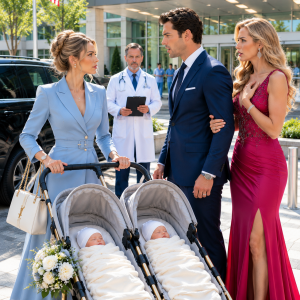
“Since everyone refuses transparency, we decided to hear exactly what Samuel left you,” Brooke announced.
Jonathan closed his portfolio and regarded them with surprising calm.
“Your timing is useful because Samuel prepared instructions for relatives who questioned his wife’s intentions.”
Part Three: The Family That Wanted an Accounting

Brooke entered without waiting for permission, while Diane remained near the doorway with her phone held upright. Michael looked uncomfortable but followed them inside.
“We only want assurance that Evelyn did not influence a vulnerable patient into changing his estate,” Brooke said.
Jonathan asked whether their concern had motivated any of them to meet Samuel while he was alive. Nobody answered because they had declined every invitation, claiming the circumstances made them uncomfortable.
“We are her family, and that gives us a legitimate interest in protecting her,” Diane insisted.
“Were you equally interested in protection when Evelyn entered foster care at thirteen?”
My aunt lowered the phone slightly.
“My household could not manage another grieving teenager, and the situation was more complicated than outsiders understand.”
I had heard that explanation throughout adulthood, although complexity had never provided me with a permanent bed, a private drawer, or someone who attended school meetings.
“The situation became complicated for me the night my belongings were placed inside trash bags,” I said.
Michael asked me not to revive old accusations during a memorial period.
“You were nineteen and living nearby, while I was thirteen and being transferred between strangers.”
“I did not have the money or authority to become your guardian.”
“You had enough authority to visit, call, or remember my birthday.”
Jonathan opened Samuel’s estate documents before the argument could erase the reason everyone had arrived.
Samuel’s Green Lake house would not become my private residence or be sold for personal profit. He directed that it be renovated into a community library and support center for teenagers experiencing foster placement, family loss, or unstable housing.
A charitable trust, funded through property Samuel inherited from his grandfather and later sold, would support the center for twelve years. Samuel appointed me as executive director, with a professional board responsible for financial oversight.
Brooke’s expression changed when she heard the word trust.
“How much money did he place under her control?”
Jonathan explained that independent trustees would approve expenditures and conduct annual audits. My compensation would reflect the executive position, but I could not withdraw trust assets for personal use.
“Then Samuel gave Evelyn a job rather than an inheritance,” Michael observed.
“He gave her a mission supported by governance, funding, and complete freedom to decline.”
I felt overwhelmed by the difference between receiving wealth and receiving responsibility. Samuel had not attempted to purchase my future; he had created a structure through which shared values could continue after him.
Brooke still claimed that charitable language did not prove I had avoided manipulating him. Jonathan removed another letter prepared specifically for that accusation.
To anyone measuring what Evelyn received from me: she gave me ten peaceful days in which illness did not erase my humanity.
I proposed because I wanted the person holding my hand to be someone who understood presence without possession. Evelyn asked repeatedly whether fear influenced my decision, and every independent evaluation confirmed my capacity.
She did not ask about my property, investments, or will. She believed I was a former teacher living inside an aging house, which was entirely accurate but deliberately incomplete.
Jonathan continued reading while my relatives became increasingly still.
Evelyn lost her parents, home, neighborhood, and confidence that relatives would protect her. If you arrived after my memorial to calculate her inheritance, consider whether curiosity has once again replaced the care you failed to provide.
Diane lowered her phone completely.
“We did not realize how abandoned you felt during those years.”
“You knew where I lived, how often I moved, and why I stopped asking to spend holidays with you.”
My voice remained controlled because the truth required no dramatic performance.
“Calling abandonment a complicated family decision made it easier for everyone except the child carrying garbage bags.”
Michael covered his face, while Brooke stared toward the floor. Their discomfort could not rewrite the past, but speaking openly removed its power to remain hidden.
Jonathan placed a ring of keys beside Samuel’s journal.
“Your husband requested that you visit his house tomorrow, because one locked room contains the complete plan for the center.”
Part Four: The Room at the End of the Hall
Samuel’s house smelled faintly of books, chamomile tea, and the cedar oil used on his furniture. Our final word-game board remained on the coffee table, with unfinished letters stored inside a blue cloth pouch.
A grocery list in his handwriting rested beside the refrigerator: bread, tea, lemon drops, and tell Evelyn about the room if there is time.
There had not been enough time.
The locked room stood at the end of a narrow hallway. The key turned reluctantly, as though the house had spent years guarding what waited beyond it.
I expected legal records, boxes, or family possessions. Instead, the room contained shelves filled with children’s books, journals, historic photographs, and research about foster-care transitions.
A large map of western Washington covered one wall, marked with locations of schools, shelters, community centers, and neighborhoods where teenagers lacked consistent support. Warm reading lamps occupied several tables, while comfortable chairs formed small circles rather than formal rows.
A handwritten sign rested upon the central desk.
For anyone whose belongings were packed before anybody asked where home should be.
Samuel had been planning the center long before his diagnosis. His teaching notes included strategies for helping displaced teenagers understand local history, document personal stories, and recover ownership over experiences other people summarized for them.
One folder contained letters from his former students. They described a history teacher who waited patiently through difficult answers, never completed a student’s sentence, and allowed silence without turning it into embarrassment.
His childhood stutter had never prevented him from becoming the teacher that impatient customer once said he could never become.
The final envelope carried my name.
Evelyn, if you are reading this, my voice failed before courage succeeded.
I did not search for you to collect repayment for an afternoon beside the watch shop. When you entered my house as a volunteer without recognizing me, I received something more meaningful than gratitude.
You changed the subject when illness trapped my words, exactly as you once spoke about a thieving crow until a frightened boy could breathe again. You remained yourself despite everything that tried to convince you kindness was dangerous.
Samuel wrote that I could reject the executive position without betraying him. The trust would continue through another qualified director if leadership became too painful.
That freedom made accepting the responsibility possible.
I sat on the floor and cried with an intensity the memorial had not allowed. My tears belonged to the boy who preserved a maple leaf, the teacher who wrote birthday wishes into silence, and the husband who offered me purpose without converting love into debt.
Six weeks later, the house reopened as Maple Room Community Library. I avoided a large ceremonial event because Samuel had disliked speeches performed for cameras.
We prepared coffee, sandwiches, pastries, and long tables covered with books and art supplies. Former students, neighbors, palliative-care volunteers, social workers, and several teenagers attended the first afternoon.
A sixteen-year-old girl named Riley remained outside near the sidewalk, carrying her possessions inside an overfilled backpack. Her social worker explained that Riley had recently entered a new foster placement and refused to participate in group activities.
I sat several feet away without asking about her circumstances. A crow landed on a nearby fence and tilted its head toward us.
“That bird has almost certainly stolen several watches, although nobody has gathered enough evidence for prosecution.”
Riley glanced at me with visible confusion.
“Why would a crow want watches?”
“Controlling time represents an obvious advantage for any ambitious criminal organization.”
Her reluctant smile appeared before she could prevent it.
In that instant, I understood that Samuel’s memory did not require a monument. It needed a room where nobody had to explain pain before receiving companionship.