News

1,000-Year-Old Warrior May Have Been Non-Binary

DNA suggests body buried in feminine attire with swords had Klinefelter syndrome, researchers say

Modern analysis of a 1,000-year-old grave in Finland challenges long-held beliefs about gender roles in ancient societies, and may suggest non-binary people were not only accepted but respected members of their communities, researchers have said.

According to a peer-reviewed study in the European Journal of Archaeology, DNA analysis of remains in a late iron age grave at Suontaka Vesitorninmäki in Hattula, southern Finland, may have belonged to a high-status non-binary person.

First discovered in 1968 during building work, the grave contained jewellery in the form of oval brooches as well as fragments of woollen clothing suggesting the dead person was dressed in “a typical feminine costume of the era”, the researchers said.

But unusually, the grave also held a hiltless sword placed on the person’s left side, with another sword, probably deposited at a later date, buried above the original grave – accoutrements more often associated with masculinity.
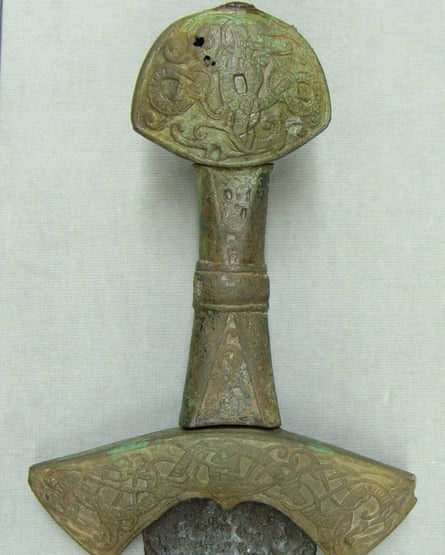
A sword buried found buried with the remains of a 1,000-year-old Finnish person, who DNA analysis suggests could be non-binary.
A sword found buried with the remains of a 1,000-year-old Finnish person, who DNA analysis suggests could be non-binary

For decades, the researchers said, archaeologists had assumed either that two bodies, a man and a woman, had been buried in the Suontaka grave, or that it was evidence strong female leaders, even woman warriors, existed in early medieval Finland.

“The buried individual seems to have been a highly respected member of their community,” said the study’s lead author, Ulla Moilanen, an archaeologist from the University of Turku. “They were laid in the grave on a soft feather blanket with valuable furs and objects.”

DNA analysis, however, showed the grave held the remains of only one person – and that they had Klinefelter syndrome. Usually, a female has two X chromosomes (XX) and a male has one X and one Y (XY). In Klinefelter syndrome, a male is born with an extra copy of the X chromosome (XXY).

Males with the syndrome, which affects about one in 660 men, are still genetically male and often do not realise they have the extra chromosome, but the condition can cause enlarged breasts, a small penis and testicles, a low sex drive and infertility.

The Finnish researchers warned that the DNA results were based on a small sample and only a relatively small number of genetic sequences could be read, meaning they had to rely to some extent on modelling.

But they said that based on their data, it was likely that the body in the Suontaka grave had the chromosomes XXY. The high-status burial led them to conclude the person may have identified as outside the traditional gender divisions.

“The overall context of the grave indicates that it was a respected person whose gender identity may well have been non-binary,” they wrote.

If the characteristics of Klinefelter syndrome were evident, Moilanen said, the person “might not have been considered strictly a female or a male in the early middle ages community. The abundant collection of objects buried in the grave is proof that the person was not only accepted, but also valued and respected.”

The finding challenges the idea that “in the ultramasculine environment of early medieval Scandinavia, men with feminine social roles and men dressing in feminine clothes were disrespected and considered shameful”, the researchers said.

The person may also have been accepted as a non-binary person “because they already had a distinctive or secured position in the community for other reasons”, the researchers said, such as coming from a wealthy or influential family or being a shaman.

Paleogeneticists and academics with expertise in ancient DNA analysis contacted by the Livescience website generally said the study was “convincing” in showing the person buried in Suontaka was likely to have been non-binary.

Archaeologists and historians also backed the findings, saying it was “exciting” to see new work engaging with questions of gender and identity. Leszek Gardeła of the National Museum of Denmark said the study showed early medieval societies “had very nuanced approaches to and understandings of gender identities”.

Our journalism is powered by people like you

In September 2023 we launched Guardian Europe, a digital edition of the Guardian to help bring journalism about the world to Europe and journalism about Europe to the world. The period since we launched has been dramatic but, thanks to growing support from readers like you in Vietnam, we’ve been there to capture moments of intense political peril, extraordinary people power and progressive fightbacks, not to mention sporting joy in Paris and beyond.

Powered by an expanded network of correspondents and commentators, Guardian Europe has helped us to turn a renewed focus on new stories from across the continent. If you are a regular reader of the Guardian and appreciate what we do, please support our journalism today.

Our readers in Europe have a global perspective. They come to us for expert coverage of international affairs and to understand a complex world. But Guardian Europe allows us to share deeply reported European stories with the rest of the world, too, from the impact of a surging far right, to a housing crisis impacting millions. We’ve covered extreme heat and overtourism as well as untold sporting stories, artistic gems from across the language barrier and great ideas on how to live from countries who are getting things right.

All of this coverage is powered by you, our readers. Quality global journalism is extremely difficult and expensive to produce and the economic conditions of the news industry are increasingly precarious.

If you believe in the importance of independent and trustworthy reporting, power our future and become a supporter from $3 a month – but with just a little more, you can unlock exclusive digital extras from $15 a month. Thank you.

Related Posts

My Husband Threw My Hospital Bag Onto the Lawn While I Was in Labor and Called Me “Dead Weight.” The Very Next Morning, He Walked Into My Hospital Room Holding Another Woman’s Hand, Ready to End Our Marriage—Neither of Them Had Any Idea I Had Secretly Become the CEO of the Company That Was About to Decide Both of Their Futures.

The Morning He Thought He Had WonThe first thing Lauren Bennett remembered after giving birth was not the sound of her son’s cry.It was the click of expensive...

When the ER Doctor Questioned My 16-Year-Old Daughter’s “Fall,” My Husband Said I Was Overreacting and His Mother Claimed Our Child Was Making It Up—By Sunrise, They Were Already Trying to Take Her Away From Me, but Then I Checked the Necklace I Had Given Her and Found My Own Name Inside a Plan That Had Started Long Before That Night

The Night My Daughter Finally SpokeI still remember the exact way the emergency room physician looked at me before he spoke, because there are moments when a stranger’s...

After Four Hospital Visits Found Nothing, My 12-Year-Old Son Woke Me Before Dawn Clutching His Stomach—Then He Pointed at My New Wife and Whispered, “She Knows Why”… That Was When Our New Nanny Stepped Into the Room and Said, “He’s Telling the Truth.”

The Nights No One Could ExplainThe first time twelve-year-old Benjamin Hale woke his father before dawn, Nathan believed it was a stomach virus.The second time, he wondered whether...

At His Luxury Wedding, My Brother Sent Me to the Kids’ Table and Whispered, “You Don’t Belong With Important People”—Then the Billionaire CEO He’d Spent 18 Months Trying to Impress Walked Past Every Executive, Pulled Up a Tiny Chair Beside Me, and Said My Name Like He’d Been Searching the Room…

The Seat in the Far CornerThe first thing my brother said to me on his wedding day was not that he was glad I had come, or that...

My 9-Year-Old Granddaughter Whispered, “Grandma, Mom And Dad Aren’t Away On Business… They’re Trying To Take Everything From You.” I Pretended I Knew Nothing—Until They Came Home To Changed Locks And A Note On My Kitchen Table: “I Know Everything.”

The Whisper in the Upstairs BedroomThe night my nine-year-old granddaughter warned me about her parents, I was standing beside her bed with a quilt folded over my arms.Outside,...

Để lại một bình luận

Email của bạn sẽ không được hiển thị công khai. Các trường bắt buộc được đánh dấu *