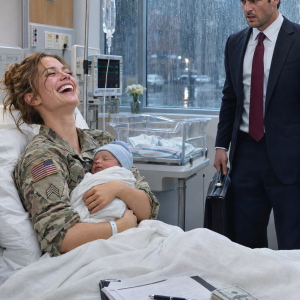
PART 1 — THE LETTER MY DAUGHTER NEVER GOT TO GIVE ME
“Your daughter trusted me with this letter ten years ago, Mrs. Dawson. I should have given it to you the day she died.”
The woman standing beside my daughter’s grave held out a yellowed envelope, and I felt the ground shift beneath my feet. My name was written across the front in Hannah’s familiar handwriting. I hadn’t seen those looping letters in a decade, yet I recognized them before the woman said another word.
“Who are you?” I demanded. “And why do you have something that belongs to my daughter?”
Her eyes filled with tears. “My name is Brenda Collins. I was one of Hannah’s nurses when she gave birth. There’s something about Owen’s father you don’t know.”
Before I could answer, my grandson called from the cemetery path. Brenda glanced toward him, then lowered her voice.
“Please don’t open it in front of the boy. Whatever you think happened ten years ago, it wasn’t the whole story.”
I stood there holding the envelope while Owen ran toward us with a handmade birthday card for his mother. He was ten years old that morning, the same age as the secret this woman had apparently been carrying.
And for the first time since we buried Hannah, I wondered whether I’d spent an entire decade blaming the wrong person.
My name is Margaret Dawson. I’m sixty-four, a retired medical billing clerk, and I’ve raised my grandson in the same modest Boise, Idaho, house where I raised his mother. Owen and I have our routines. I make pancakes on Sundays, drive him to Little League practice, and remind him to take his muddy shoes off before he tracks half the backyard through my kitchen.
He calls me Grandma, but I’ve been the only parent he’s ever really known.
Hannah was eighteen when she became pregnant. She’d graduated from high school, was considering community college, and had been talking about finding a part-time job at a veterinary clinic. Then one evening, she sat across from me at our kitchen table and told me she was having a baby.
I remember setting down my coffee so abruptly that it spilled onto the tablecloth.
“Hannah, sweetheart, are you sure?”
She nodded, staring at her hands.
“Does the father know?”
“Yes, Mom.”
“Then where is he?”
Her face tightened. “Can we please not start with that?”
I told myself I was being practical. Her own father had left when she was twelve, and I’d spent years working overtime to keep our little family afloat. I knew what it meant to raise a child without dependable help. The thought of Hannah facing that same struggle frightened me more than I wanted to admit.
So I kept asking.
I asked who the boy was, whether his parents knew, and whether he intended to help. Hannah answered less and less. Eventually, she stopped mentioning him altogether.
“You can’t protect somebody who won’t tell you the truth,” I told her one evening.
She looked at me with tired eyes. “Maybe I just need you to listen for once.”
I remember being offended by that. I thought listening was exactly what I’d been doing.
Now, ten years later, I wasn’t so certain.
After the woman at the cemetery left, Owen asked who she was. I told him she’d known his mother at the hospital, which was true, but I didn’t mention the letter. He was already excited about the small birthday dinner I’d planned, and I didn’t want to introduce something I couldn’t yet explain.
That night, after he’d gone upstairs, I sat at the kitchen table with the envelope.
Inside was a photograph of Hannah standing beside a teenage boy. He had dark hair, a shy smile, and an old leather baseball glove tucked beneath one arm. I recognized him immediately, though I couldn’t remember his name.
He’d come to our house twice during Hannah’s pregnancy.
I’d assumed he was a friend from school.
The letter itself was written on lined notebook paper.
Dear Mom,
I know you’re angry because I won’t tell you who the baby’s father is. But I’m not keeping his name from you to hurt you.
He knows about the baby. He wanted to stay with me, but his parents keep telling him he’ll ruin his future if he becomes a father now. He’s scared, Mom. I can see that. And I’m scared too.
I told him not to come back until he was ready to choose us for himself. I don’t want you forcing him to do the right thing, because I need to know whether he’ll do it when nobody is standing over him.
I stopped reading and looked toward the stairs.
For ten years, I’d believed Hannah had been abandoned by a boy who never cared enough to acknowledge his child.
But she’d known exactly who he was.
She’d made a decision I hadn’t understood.
I forced myself to read the final paragraph.
I know you’re trying to protect me. But every time I come to you, you ask about him before you ask how I’m doing. I’m scared about the hospital. I’m scared I won’t be a good mother. Sometimes I just want you to sit beside me and tell me we’re going to figure it out.
I love you, Mom. I hope you know that.
I read those words three times.
Then I remembered an evening during Hannah’s seventh month. I’d been sitting at the kitchen table, trying to balance the checkbook, when she appeared in the doorway.
“Mom, can I talk to you about something?”
I’d barely looked up.
“If this is another conversation where you won’t tell me who the father is, Hannah, I can’t do it tonight.”
She stood there for a moment.
“Never mind,” she whispered. “It can wait.”
I hadn’t followed her upstairs.
For ten years, I’d remembered that evening as another example of Hannah shutting me out. Now I could see the possibility that she’d come downstairs because she needed her mother, and I’d turned her away before she could say a word.
I pressed the letter against the table and cried.
Not because I believed I’d caused what happened to Hannah. Her death had been a medical tragedy, and I knew better than to pretend a conversation could have changed that.
I cried because she’d spent those final months frightened, and I’d been so busy trying to solve her problems that I hadn’t always noticed.
The next morning, I called Brenda.
“I read the letter,” I said when she answered. “Now I want to know why you kept it from me.”
She asked to meet at a diner near the hospital.
Brenda was waiting in a back booth when I arrived. She looked to be in her late sixties, with silver hair and the exhausted expression of someone who hadn’t slept well in a long time.
I sat across from her and placed the envelope on the table.
“Ten years, Brenda. My grandson has spent ten years asking questions, and you had this the whole time.”
She stared at the envelope.
“I know. I don’t expect you to understand.”
“Then explain it anyway.”
Brenda told me Hannah had handed her the letter during the early hours of labor. She’d asked Brenda to give it to me if something went wrong and the baby’s father didn’t come to the hospital.
“She wasn’t expecting to die,” Brenda said. “She was frightened, like a lot of young mothers are. I think she wanted to make sure you understood her if she couldn’t explain things herself.”
“Then why didn’t you give it to me?”
Brenda swallowed.
“I saw you afterward. You were holding that baby, and you looked completely lost. I told myself the letter would only hurt you more.”
“That wasn’t your decision to make.”
“You’re right.”
She admitted that she’d put the envelope away, intending to contact me after the funeral. Weeks became months. Eventually, she was ashamed to explain why she’d waited.
“I retired this spring,” she said. “I found it while clearing out a box of personal things. I realized I’d spent ten years telling myself I was protecting you when I was really protecting myself.”
I looked at her for a long moment.
“You didn’t just keep Hannah’s letter from me. You kept it from her son.”
Brenda lowered her head.
“I know.”
I pulled the photograph from the envelope and slid it across the table.
“Do you recognize him?”
She studied it carefully.
“I don’t know his name. But I think I saw him at the hospital.”
My hand tightened around my coffee cup.
“When?”
“Shortly after Hannah died. A young man came to the maternity floor asking about her. He matched the description she’d given me.”
“Did you speak to him?”
Brenda hesitated.
“No. By the time I understood who he might be, he’d already seen you.”
“Seen me doing what?”
“Walking out of the nursery with Owen in your arms.”
I stared at her.
“He saw his baby?”
She nodded.
“He stood there for a moment. Then he turned around and left.”
I felt something cold settle in my stomach.
For ten years, I’d imagined a boy who hadn’t bothered to show up.
Now I was hearing that he’d come close enough to see his newborn son, then chosen to walk away.
“And you watched him leave?”
Brenda wiped her eyes.
“Yes.”
I pushed the photograph back into the envelope.
“You know what hurts the most, Brenda? Owen has asked me whether his father ever wanted him. I told him I didn’t know. All that time, you knew there was a man who’d come to the hospital, and you never thought that might matter to him.”
“I’m sorry, Margaret.”
I stood.
“I’m sure you are. But being sorry doesn’t give us those years back.”
I left before she could answer.
That afternoon, I pulled Hannah’s storage box from the hallway closet. I hadn’t opened it properly in years. There were school programs, birthday cards, old photographs, and the inexpensive silver charm bracelet she’d worn almost every day.
Near the bottom, I found another picture of the boy with the baseball glove. Behind it was a torn notebook page containing Hannah’s handwriting.
Buy diapers. Finish thank-you cards. Ask Mom about night classes. Tell Mom the truth.
I sat on the bedroom floor, staring at those last four words.
Hannah had planned to tell me.
She’d planned to finish school, raise her baby, and work through the difficult conversations we’d been avoiding. She hadn’t expected her life to end at eighteen.
“Grandma?”
Owen stood in the doorway with his backpack hanging from one shoulder.
“What are you doing?”
I showed him the box.
“Looking at some of your mom’s things.”
He sat beside me and began examining the photographs.
“Was she good at baseball?”
I smiled. “Not particularly. She was better at telling everybody else how to play.”
He laughed, then noticed the picture of the teenage boy.
“Who’s that?”
I hesitated.
“Someone who was important to your mom.”
Owen looked at the photograph, then at me.
“Is he my dad?”
I could have lied. I could have told him I didn’t know and hoped he’d forget about it.
Instead, I said, “I think he is, sweetheart. I’m trying to find out for certain.”
He was quiet for a moment.
“Did that lady from the cemetery tell you about him?”
“She told me some things.”