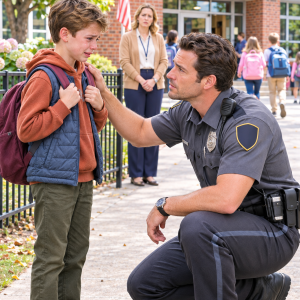
The Call That Brought Me Home

At 1:47 on a rainy Thursday morning, I was standing inside a military operations center in Virginia when my twenty-four-year-old daughter called and whispered something no mother should ever have to hear.
“Mom, Uncle Russell and Uncle Wade hurt me. They kept taking turns, and I couldn’t make them stop.”
By the time I learned she had fourteen fractures and was being treated at a hospital hundreds of miles away, I knew that the family I had spent years trying to escape had finally crossed a line that could never be erased.
What I did not yet understand was why they had chosen that particular night, or why my former mother-in-law seemed almost pleased when she left a message warning me that her sons would never face consequences.
I had spent twenty-three years serving in the United States Army, learning how to remain composed when everything around me seemed uncertain, but nothing in my training had prepared me for the sound of my daughter’s frightened voice.
And when my commanding officer heard the recording, he looked at me for a long moment before reaching for his telephone.
“Go take care of your girl, Colonel,” he said. “I’ll make sure the right people know what happened.”
A Mother’s Worst Phone Call
My name is Lieutenant Colonel Caroline Foster, and for most of my adult life, I believed that being strong meant keeping my emotions under control, particularly when other people depended on me to make difficult decisions.
That belief had carried me through deployments, long separations from home, and the painful end of a marriage that had once seemed full of promise.
My daughter, Natalie, had grown up understanding that her mother sometimes missed birthdays and holidays because of military responsibilities, although I had always tried to make certain she never doubted how deeply she was loved.
At twenty-four, she was finishing a graduate program in environmental planning at a university in southern Indiana, where she had recently accepted a part-time position with a small consulting firm.
She was independent, thoughtful, and stubborn in the best possible way, with a quiet determination that often reminded me of my own mother.
When her name appeared on my phone that Thursday morning, I initially assumed she had forgotten I was working overnight.
Then I answered and heard her struggling to speak.
“Natalie, sweetheart, tell me where you are.”
For several seconds, all I could hear was uneven breathing and a faint mechanical humming in the background.
“I don’t know exactly,” she whispered. “Somewhere outside Briar Glen. There’s an old building, and I can see a loading door.”
I moved away from the other officers and leaned against the wall, forcing myself to concentrate on the details rather than the fear rising inside me.
“Are you alone?”
“I think so. They left a little while ago.”
“Who left?”
“Dad’s brothers. Russell and Wade.”
My former husband’s family had been a source of tension for years, but even with everything I knew about them, I could scarcely comprehend what my daughter was telling me.
She explained that her uncles had taken her to an abandoned storage facility and demanded that she sign documents concerning property her father had placed in a trust before he passed away in a highway accident four years earlier.
When she refused, the argument turned into something far more serious.
“They had this heavy metal tool, Mom. I tried to protect myself, but my arm hurts so much, and I can’t stand up.”
I asked her to keep talking while I contacted emergency services through another phone, giving the dispatcher every detail she could remember about the building and the surrounding roads.
Then, just as Natalie began describing a faded sign near the entrance, I heard a vehicle approaching.
Her breathing quickened.
“Mom, somebody’s coming back.”
“Stay on the phone with me.”
There was a brief rustling sound, followed by a man’s distant voice.
The connection ended.
I stood motionless for a moment, staring at the screen, before returning to the operations desk and asking a fellow officer to help coordinate with Indiana authorities.
Twenty-seven minutes later, a county dispatcher confirmed that deputies had located Natalie near an abandoned farm equipment warehouse.
She had been transported to the nearest hospital, where physicians were evaluating multiple serious injuries.
The first detailed report arrived shortly afterward.
Fourteen fractures, including injuries to her arm, wrist, ribs, collarbone, fingers, and facial bones.
I read the report twice, unable to reconcile the medical terminology with the little girl who used to fall asleep holding my hand during thunderstorms.
Then another notification appeared.
It was a voicemail from my former mother-in-law, Eleanor Whitfield.
Her voice was unmistakable.
“Caroline, I hear Natalie has been causing trouble again. You should have taught that girl to respect her father’s family. Russell and Wade aren’t going anywhere, and neither is our influence around here. My husband has spent thirty years making this county what it is. You’d be wise to remember that.”
She gave a small, satisfied laugh before ending the call.
I listened again, saved the recording, and walked directly to the office of my commanding officer, Colonel Martin Ellis.
He had known me for more than a decade and understood that I rarely brought personal problems into my professional life.
After hearing the message, he asked about Eleanor’s husband.
“Harold Whitfield,” I explained. “Former county sheriff, now chairman of the county development board. He still has close relationships throughout local government.”
Martin considered that information carefully.
“Do you believe the investigation will be handled fairly?”
“I want to believe it will. But I’ve seen what happens when people challenge that family.”
He nodded, reached for his phone, and began contacting the appropriate federal liaison office to ensure that my concerns were documented and referred for independent review.
Before I left, he reminded me that my daughter needed her mother more than she needed another officer trying to solve everything alone.
It was advice I would remember long after the case ended.
The Girl in Room 318

By the following evening, I was driving through the familiar streets of Briar Glen, Indiana, a place I had once called home and had spent nearly fifteen years trying to leave behind.
The town looked much as I remembered it, with its brick storefronts, aging courthouse, and quiet residential streets lined with enormous maple trees.
I drove directly to Riverside Memorial Hospital.
Natalie was in Room 318.
When I entered, she was resting beneath a pale blue blanket, her injured arm supported by pillows and a protective brace fitted around her shoulder.
There was swelling along one side of her face, and her usually bright eyes looked exhausted.
She turned toward me when she heard my footsteps.
“Mom, you came.”
I crossed the room and carefully wrapped my arms around her, mindful of the places that hurt.
“Of course I came, sweetheart. There was nowhere else I was going to be.”
For several minutes, neither of us said anything.
I simply held her hand while she cried, and when her breathing finally settled, she began telling me what had happened.
Three evenings earlier, Natalie had attended a small birthday dinner for a college friend at a restaurant near the town square.
As she walked toward her car afterward, Russell Whitfield approached and said he wanted to discuss some unfinished matters involving her father’s estate.
Natalie had never trusted Russell, who had a habit of treating every disagreement as a personal insult, but she had not expected him to become aggressive.
When she declined to speak with him, his younger brother, Wade, appeared near the parking lot.
Together, they pressured her into accompanying them to an isolated property outside town.
At the warehouse, they presented a folder of documents and demanded that she surrender her interest in forty-six acres of land inherited through her father’s trust.
“Russell said Grandpa Harold had already made arrangements with a lawyer,” Natalie explained. “He told me signing would make everything easier, and that I was being selfish for refusing.”
She paused, staring at the blanket.
“I told them Dad had left that land to me for a reason.”
When she refused to cooperate, the brothers became increasingly hostile, and the confrontation left her seriously injured.
I did not ask her to describe every painful moment.
She had already given an initial statement to hospital staff, and I understood that repeating the experience unnecessarily could make her recovery more difficult.
Instead, I asked whether she remembered anything about the paperwork.
“There was a law firm’s name at the top,” she said. “Something with three names. I remember the first one was Pritchard.”
I wrote it down.
“Anything else?”
“There was a map. Russell kept pointing at the property and saying I had no idea what it was worth.”
That detail stayed with me.
My former husband, Andrew Whitfield, had inherited the land from an elderly relative years before our marriage ended.
As far as I knew, it consisted mostly of neglected pasture and low-lying fields, hardly the sort of property that would explain such extraordinary pressure.
Before I could ask another question, a deputy entered without knocking.
His nameplate read Thomas Rourke.
He announced that he needed to ask Natalie additional questions about what he described as a family disagreement.
I stood beside her bed.
“She’s already given a statement, Deputy. Her physician has asked that she rest.”
He glanced at the notebook in my hand.
“There are some details that don’t quite add up, ma’am.”
“Then her attorney can help arrange an appropriate interview.”
His expression hardened.
“You military people come back here thinking you can tell everybody how to do their jobs.”
I kept my voice even.
“I’m asking you to respect a patient’s medical condition and her right to legal representation.”
He hesitated, then left with a warning that the matter was more complicated than I understood.
After the door closed, Natalie squeezed my hand.
“That’s what they keep saying, Mom. Everybody says it’s complicated.”
I pulled my chair closer.
Related Posts

“Know Your Place!” My Father Snapped at My 9-Year-Old Daughter When She Begged for a Seat in His Heated SUV. While My Brother’s Two Sons Rode Comfortably Inside, He Made Her Walk Nearly Three Miles Through the Freezing Snow. When I Found Her Shivering, I Didn’t Argue. I Quietly Canceled the $8,700 Monthly Payment I’d Been Making for Six Years to Keep His Construction Company Alive. By Morning, He’d Called Me 14 Times, Panicking Over the Bank’s Sudden Decision. But He Had No Idea What I Was About to Do Next…

My Husband Offered Me $20 Million to Walk Away From Our 8-Year-Old Son. “Take the Money, Emilia. You’d Be a Fool to Turn This Down,” He Said, While His New Woman Sat Beside Him Smiling. I Looked at My Little Boy, Clinging to My Hand, and Made a Choice My Husband Never Expected. He Laughed as I Walked Out of That Room Like I’d Just Made the Biggest Mistake of My Life. But What Happened Years Later Was Something Neither of Us Could Have Imagined.
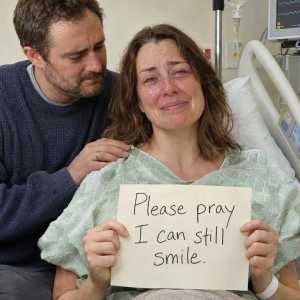
“TOMORROW, SURGEONS WILL REMOVE PART OF MY FACE. PLEASE PRAY THAT I CAN STILL SMILE,” THE 47-YEAR-OLD MOTHER WROTE — BUT HER DAUGHTER’S REACTION AFTER SURGERY CHANGED EVERYTHING
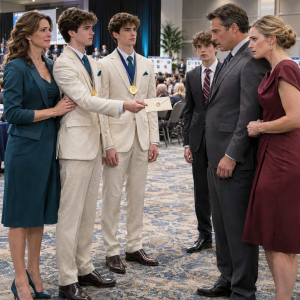
Five Years After Our Divorce, I Brought Our Twin Sons to a Statewide Academic Competition—My Ex-Husband Turned on Me at the Registration Desk and Whispered, “You Have No Right to Be Here.” I Kept Walking, but When Our Boys’ Names Rang Out During the Awards Ceremony, One of Them Crossed the Auditorium and Placed a Sealed Envelope in His Father’s Hands