PART 1 — THE PHONE CALL THAT CHANGED EVERYTHING
“Mrs. Bennett, your son is safe, but you and your husband need to come to the school immediately because two police officers are waiting in my office.”
Those words nearly made me drop the telephone onto the kitchen floor.
My name is Caroline Bennett, and my husband, Nathan, and I had spent years teaching our six-year-old son, Caleb, at home before finally enrolling him in a traditional elementary school in Columbus, Ohio.
Caleb has Down syndrome, and although he learns differently from some children, he possesses an extraordinary curiosity about the world.
He loves planets, dinosaurs, insects, and complicated machines whose functions he insists on understanding.
Sometimes his questions continue long after bedtime, when Nathan and I are exhausted and Caleb still wants to know why Saturn has rings.
For years, we worried that a conventional classroom might not provide the patience, encouragement, and individualized support he needed.
Our decision to homeschool him came from love, but it also came from fear.
We feared children would mock his speech.
We feared teachers would underestimate his abilities.
Most of all, we feared that an unkind experience might convince him he didn’t belong among other children.
But Caleb wanted friends.
Whenever we passed the neighborhood school, he watched children playing together and asked when he would get to carry a backpack into a classroom.
After consulting educational specialists and meeting with the school administration, Nathan and I decided he deserved that opportunity.
The first four days seemed wonderful.
On Monday, Caleb returned home describing his classroom, his teacher, and the enormous collection of picture books near the windows.
On Tuesday, he told us about a boy named Mason who sat beside him.
On Wednesday, he proudly announced that several classmates had invited him to sit with them during lunch.
By Thursday, he was preparing his backpack before breakfast and asking whether he could arrive early.
Then Friday came.
I had just finished folding laundry when Principal Andrew Collins called.
“Mrs. Bennett, Caleb isn’t injured, but there has been an incident involving several students, and we’d appreciate having both parents here as soon as possible.”
I asked what had happened.
He explained only that two school resource officers were present and that the situation required a discussion with us.
I immediately called Nathan.
Within minutes, we were driving toward the school, our conversation interrupted by long stretches of frightened silence.
When we entered the principal’s office, Caleb sat beside a window clutching his bright blue backpack.
His eyes were red.
The moment he saw me, he began crying.
“Mommy, please don’t make me stop going to school, because I really love being here with my friends.”
I knelt and wrapped my arms around him.
I had arrived expecting to protect my son from whatever danger had occurred.
Instead, I discovered that his greatest fear was losing the school he’d only just begun to love.
PART 2 — WHAT THE CAFETERIA CAMERA REVEALED
Nathan sat beside Caleb while I turned toward the two uniformed officers standing near Principal Collins’s desk.
One introduced herself as Officer Jennifer Hayes.
She immediately reassured us that Caleb hadn’t committed any offense and wasn’t facing disciplinary action.
“Your son has done nothing wrong, Mrs. Bennett, and our presence relates to a situation that staff members initially feared might escalate into a physical confrontation.”
I felt some relief, but the uncertainty remained unbearable.
Principal Collins explained that several children had been teasing Caleb during lunch.
Another boy had intervened, and when one of the students pushed him, the situation became disorderly enough for supervising staff to seek assistance.
The principal placed a tablet on his desk.
“We reviewed the cafeteria security footage, and I believe you should see what happened before we discuss the school’s response.”
I moved closer.
The recording showed Caleb sitting at a lunch table, carefully opening a container of sliced strawberries.
Three boys stood around him.
One held a smartphone close to Caleb’s face while another leaned across the table.
The footage included audio from the surrounding area.
“Hey, Caleb, tell everybody what you’re going to be when you grow up, because we want to hear your big plan!”
My son smiled.
“I’m going to become a famous scientist and learn everything about space!”
The boys laughed.
At first, Caleb appeared to believe they were laughing with him.
Then one child told him to repeat his answer more loudly, while another exaggerated the way he pronounced certain words.
A third boy imitated his speech.
Caleb’s smile slowly disappeared.
He looked from one face to another, searching for some indication that they were still being friendly.
My hands began trembling.
Caleb had spent countless afternoons building miniature rockets from cardboard tubes and asking us about scientific discoveries.
Now children were treating that beautiful ambition as entertainment.
Suddenly, another boy entered the recording.
He was wearing a navy sweatshirt and carrying a lunch tray.
I recognized him from Caleb’s enthusiastic descriptions.
Mason.
“Stop recording Caleb and making fun of the way he talks, because he hasn’t done anything to deserve this!”
One of the boys laughed and insisted they were joking.
Mason placed his tray on the table.
“It isn’t a joke when the person you’re laughing at doesn’t think it’s funny, and you need to leave him alone.”
A boy pushed Mason’s shoulder.
Mason stepped backward, raised his arm to keep the other child away, and accidentally knocked against a metal chair.
The chair scraped loudly across the cafeteria floor.
Several children stood up.
Then the recording stopped.
Nathan rose from his seat, struggling to control his anger.
“How long has this been happening, and why are we only learning about it after another child had to intervene?”
Principal Collins acknowledged that the school was still investigating.
I returned to Caleb and gently took his hands.
“Sweetheart, have those children been making fun of you before today, or was this the first time something like that happened?”
He looked down at his sneakers.
“They did it on Wednesday and Thursday too, but I thought they might become nicer if I kept sitting with them.”
Wednesday.
The day he’d come home so excited about being invited to another lunch table.
I remembered how proudly he’d described it.
I suddenly understood that he had mistaken their attention for acceptance.
PART 3 — THE REASON HE NEVER TOLD US

I moved a chair beside Caleb so we could speak without making him feel surrounded by worried adults.
His fingers twisted around the straps of his backpack.
“Caleb, you can tell Mommy and Daddy whenever something hurts your feelings, and you will never be in trouble for telling us the truth.”
He glanced toward Nathan.
“But you said I could learn at home again if school was too hard, and I don’t want to leave.”
His words struck me with unexpected force.
The evening before his first school day, I’d told him that if the experience became overwhelming, he could always return to homeschooling.
I’d intended to reassure him.
I wanted him to know he had choices and that we wouldn’t force him to remain somewhere he felt unsafe.
But Caleb had heard something entirely different.
He believed that admitting he was struggling might cause us to remove him from school.
To him, telling the truth meant risking everything he’d been waiting years to experience.
“I thought if I told you those boys were mean, you’d say school wasn’t working and I had to stay home again,” he explained.
I felt tears gathering.
Nathan knelt beside us.
“Caleb, being treated badly doesn’t mean you’re doing school wrong, and we aren’t going to punish you because somebody else made an unkind choice.”
Caleb looked toward me.
“Even when I get sad during lunchtime, I can still come back tomorrow and see Mason?”
Related Posts
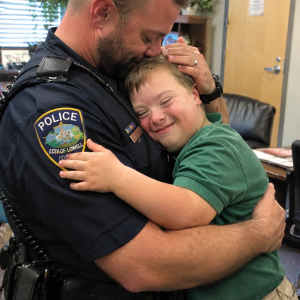
“MRS. PARKER, COME TO SCHOOL IMMEDIATELY. THE POLICE ARE HERE.” It Was Only My 6-Year-Old Son’s Fifth Day at School After Years of Homeschooling Him Because He Had Down Syndrome. He’d Come Home Smiling Every Day, Excited About His New Friends. But When My Husband and I Arrived, We Found Him Clutching His Backpack, His Eyes Filled With Te@rs. He Ran Into My Arms and Whispered, “MOMMY, PLEASE DON’T MAKE ME LEAVE SCHOOL.” I Thought I Was There to Protect My Son. I Had No Idea What He’d Been Keeping From Us…
“PUT THOSE GLOVES ON, OLD MAN! LET’S SEE HOW TOUGH YOU REALLY ARE!” The 19-Year-Old Black Belt Challenged Me in Front of My Daughter While His Wealthy Father Laughed. I Was Just a Widowed Dad Who’d Spent Years Keeping His Past Quiet. I Asked Him to Walk Away, but He Wouldn’t Listen. What That Cocky Young Man Didn’t Know Was Who He’d Just Challenged—or Why I’d Spent So Many Years Hiding That Part of My Life. And When I Noticed the Strange Smile on His Father’s Face, I Had a Feeling This Wasn’t Going to End the Way Either of Them Expected…
“Would You Want Me, Too?” I Asked the Billionaire Who Knelt Beside My Wheelchair After Three Families Rejected Me on Adoption Day. I Was Only Six, Sitting Alone Beneath an Oak Tree, When He Promised to Come Back—and He Kept His Word. Three Months Later, While Preparing to Adopt Me, He Discovered My Original Birth Certificate. The Moment He Saw My Last Name and My Mother’s Identity, His Face Went Pale. A Secret Hidden for Seven Years Was About to Change Everything…