The Woman They Thought They Knew

For nearly seven years, my husband’s family believed I spent my days behind a government desk, answering phones, filling out forms, and collecting the kind of modest paycheck they considered evidence that I had never done much with my life.
I never corrected them.
My name is Caroline Hayes, and at the time this happened, I was a brigadier general in the United States Army, serving in a senior command position at Fort Liberty, North Carolina, after more than two decades in uniform. I had led soldiers overseas, advised people whose names appeared regularly in national newspapers, and spent more nights than I could count inside windowless briefing rooms discussing matters I could never bring home to the dinner table.
None of that was something I talked about casually.
My husband, Daniel Mercer, had known exactly who I was when we met. He knew about the deployments, the long hours, the responsibility, and the strange reality of holding a position that could make hundreds of people straighten their backs when I entered a room while still requiring me to remember to buy milk on the way home.
But shortly after our wedding, Daniel made an unusual request.
“Could we keep the rank thing quiet around my parents?”
I remember looking at him across our kitchen island.
“Why?”
He rubbed the back of his neck.
“My father has this thing about status. If he knows exactly what you do, every dinner will turn into some competition. Just tell them you work for the Army. It’ll make life easier.”
At the time, it seemed harmless.
I had never needed strangers to be impressed by me, and I certainly did not need applause from my in-laws, so I agreed.
That decision became a family joke I never intended to create.
Daniel’s father, Richard, started calling me “the office soldier.” His mother, Barbara, occasionally asked when I planned to find a career that would allow me to “settle down properly.” At Thanksgiving, Richard once looked at my twelve-year-old SUV in the driveway and told Daniel, loudly enough for everyone to hear, that a successful man should make sure his wife drove something respectable.
I smiled and passed the mashed potatoes.
The Army had taught me that not every provocation deserved a response.
There was only one person whose opinion could truly reach me, and that was my daughter, Lily.
She was sixteen that winter, my daughter from an earlier marriage, with gray-blue eyes, a stubborn little dimple in her left cheek, and the kind of quiet intelligence that made adults underestimate how much she noticed.
Lily knew what I did.
More importantly, she knew who I was when the uniform came off.
And she was proud of both.
Christmas Eve
That Christmas Eve, I was supposed to meet Daniel and Lily at his parents’ home outside Raleigh by six.
At 4:30 that afternoon, an operational issue landed on my desk, and by five I knew I wasn’t leaving anytime soon.
Daniel was irritated when I called.
“It’s Christmas Eve, Caroline.”
“I know.”
“My parents have been waiting all day.”
I looked through the glass wall of the conference room, where three officers were waiting for me to return.
“I can’t walk away from this.”
He sighed.
“Fine. Lily can ride with me. Come when you’re finished.”
I almost asked him to leave her home.
I wish I had.
At 9:17 that evening, my phone rang.
I had just stepped out of the command center.
Lily’s name appeared on the screen.
“Hey, sweetheart. I’m leaving now.”
There was no answer.
Then I heard her breathing.
“Lily?”
“Mom?”
Her voice was trembling.
I stopped walking.
“What’s wrong?”
“Can you come get me?”
Something in her tone changed everything.
“Where are you?”
A pause.
“Outside.”
“Outside where?”
“Richard and Barbara’s house.”
I was already moving toward my office.
“Why are you outside?”
Another pause, longer this time.
“Richard told me to leave.”
I grabbed my coat.
“Where’s your coat?”
“Inside.”
My hand froze on the zipper.
Outside my window, snow had been falling for almost an hour.
“Lily, where is Daniel?”
She said nothing.
“Sweetheart, where is Daniel?”
When she finally answered, her voice was so small that I barely recognized it.
“He’s inside with them.”
I don’t remember walking to my vehicle.
I remember driving.
I remember the windshield wipers pushing snow aside and the dashboard clock changing minute by minute while I tried to keep my voice steady through the car speakers.
“Stay under the porch light. Keep moving your hands. I’m coming.”
“Okay.”
“Don’t hang up.”
“I won’t.”
Thirty-eight minutes later, I turned onto Richard and Barbara’s street.
Their house was glowing with Christmas lights.
A wreath hung on the front door. Candles shone in the windows. Through the dining-room glass, I could see people sitting around a table covered with food.
And beneath the porch light stood my daughter.
She was wearing jeans, sneakers, and a thin cream sweater.
Her arms were wrapped tightly around herself.
I parked badly, half on the curb, and ran.
The moment Lily saw me, whatever strength she had been using disappeared.
“Mom.”
I pulled off my coat and wrapped it around her.
“I’m here.”
She pressed her face against my shoulder.
For several seconds, I didn’t ask questions.
I simply held her.
Then I looked through the dining-room window.
Daniel was sitting at the table.
He wasn’t searching for her.
He wasn’t putting on his coat.
He wasn’t coming outside.
He was eating dinner.
Something inside me became remarkably calm.
I took Lily’s hand.
“Come with me.”
The Folder on the Table
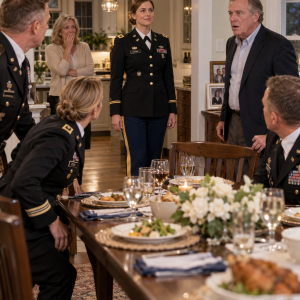
Conversation stopped when we entered the dining room.
Richard leaned back in his chair as though our arrival were an inconvenience.
“Well,” he said, “look who finally got released from her desk.”
I didn’t respond.
Barbara glanced at Lily.
“She didn’t need to bring all this drama back inside.”
I looked at Daniel.
“What happened?”
He stood.
“Caroline, don’t start.”
“I’m asking what happened.”
Richard placed his napkin beside his plate.
“I told her to leave.”
“Without her coat?”
He shrugged.
“She was being disrespectful.”
Lily’s fingers tightened around mine.
“What did she say?”
Barbara answered.