Part 1 — The Seventy-Two Hours That Changed Everything
According to the physician standing at the foot of my hospital bed, the next seventy-two hours would determine whether my body recovered or failed completely.
I was forty-eight years old, lying almost motionless in a private room at St. Anne Medical Center in Nashville, Tennessee.
Intravenous antibiotics flowed into both arms while a serious blood disorder, complicated by systemic infection, pushed every laboratory result in the wrong direction.
Three weeks earlier, I had convinced myself that exhaustion explained everything.
I managed an upscale residential restoration company, and late summer always turned my life into an endless cycle of contractors, imported materials, insurance disputes, demanding homeowners, and emergency calls before sunrise.
When dark purple bruises began spreading across my thighs, I blamed work.
When climbing one flight of stairs left me breathless, I blamed stress.
When night sweats soaked through my pajamas, I blamed perimenopause.
My husband, Stephen Walker, blamed me for complaining.
Several days before I was hospitalized, I had ended up sitting against the kitchen cabinets because I suddenly could not remain standing.
Stephen looked down at me and snapped:
“You’ve spent the entire month saying you’re exhausted, Allison, but you refuse to slow down or listen to anybody.”
By lunchtime that same day, I was in the emergency department.
By evening, I had been admitted.
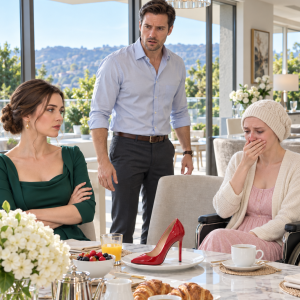
Now Dr. Natalie Foster stood beside my bed wearing the carefully neutral expression physicians use when they need to communicate danger without creating panic.
Stephen stood near the window with both hands in his trouser pockets.
His mother, Vivian, occupied the visitor chair, clutching an expensive leather handbag across her lap.
Dr. Foster explained that my blood disorder had left me dangerously vulnerable to infection.
The infection itself was affecting my entire system.
My white blood cell count remained critically unstable.
Treatment was already aggressive.
And my body had not responded as quickly as the team had hoped.
Stephen spoke first.
“How much time are we actually talking about?”
Dr. Foster glanced toward me before answering.
“We’re monitoring her continuously, and the next seventy-two hours are especially important because they’ll show us whether the current treatment is working.”
Vivian leaned forward.
“Important in what sense?”
Dr. Foster did not soften the meaning.
“Important in the sense that we need to see improvement. Right now, our priority is giving Allison every possible chance to stabilize.”
After the doctor left, the heavy hospital-room door closed behind her.
For several seconds, nobody spoke.
Then Vivian whispered the words I would remember for the rest of my life.
“Three days.”
Stephen did not correct her.
His mother exhaled almost with satisfaction.
“Three days, then. Fine. I want the downstairs suite once everything is settled.”
For a moment, I wondered if medication or fever had distorted what I was hearing.
Then Stephen laughed.
It was not nervous laughter.
It was relief.
“And after three days, I’ll finally be free to marry Rachel.”
Rachel Monroe.
The name cut through the fog in my mind.
Rachel was around forty-five, divorced, and worked as a pharmaceutical sales representative based in Louisville.
Stephen had always described her as a colleague he sometimes encountered through regional healthcare accounts.
But the explanation had never quite matched what I saw.
She called after ten at night.
She stood too close to him in company photographs.
Once, I had found a hotel receipt from Franklin dated on a Wednesday when Stephen claimed he had driven straight home after a conference.
I asked questions.
Then accepted his answers.
Seventeen years of marriage made suspicion feel more frightening than denial.
Vivian’s voice pulled me back.
“Will Rachel move into the house eventually?”
Stephen answered without hesitation.
“Eventually, yes.”
Then Vivian began mentally redecorating my home while I lay less than ten feet away fighting an infection that might kill me.
“I want the downstairs bedroom because the morning light is better there. My old armoire would fit perfectly on the west wall.”
Stephen sighed.
“Mom, maybe wait until Allison is actually gone before you start measuring for curtains.”
Vivian chuckled.
The sound hurt more than the IV line in my arm.
I had spent nearly twenty years treating that woman like family.
I had paid for a replacement furnace when hers failed before Christmas.
Driven her to medical appointments when Stephen claimed to be too busy.
Sat beside her during gallbladder surgery.
Now she was claiming rooms in a house that did not belong to her son.
The property had been transferred solely to me by my family years before Stephen and I married.
I had allowed him to live there as though ownership did not matter because I believed marriage was bigger than title documents.
Apparently, my generosity had been mistaken for entitlement.
When Stephen and Vivian finally left to get coffee, I opened my eyes.
My phone sat on the rolling table just beyond easy reach.
It took several painful attempts to pull it toward me.
Then I called my father.
Thomas Avery answered quickly.
“Sweetheart?”
My throat felt raw.
“Dad, I need you.”
A long silence followed.
When he spoke again, his voice became dangerously calm.
“Before I do anything, Allison, I need you to answer one question honestly. Are you finally finished protecting Stephen?”
I thought about seventeen years of compromises.
Excuses.
Financial resentment.
Passive-aggressive remarks.
Every moment I had chosen peace because confrontation felt exhausting.
Then I thought about Vivian selecting curtains while my husband planned a future with another woman.
“Yes, Dad. I’m finished.”
My father exhaled.
“Good. Caroline Hayes will be in your room tomorrow morning at nine.”
Caroline was my attorney.
For the first time since hearing the seventy-two-hour prognosis, I stopped wondering whether I would survive.
Instead, I began wondering whether my marriage would.
Part 2 — The Plan I Had Postponed for Eleven Months
Caroline arrived the following morning wearing a charcoal pantsuit and carrying a slim leather portfolio.
My father had arrived ten minutes earlier with coffee for himself, herbal tea for me, and absolutely nothing for Stephen.
That omission meant more than any speech.
Thomas Avery was seventy-three years old and almost excessively polite, even with people he disliked.
Caroline sat beside my bed and opened the portfolio.
“Your father explained what happened yesterday, but before we do anything, I want to hear it directly from you.”
I told her everything.
She listened without interrupting.
Then she pulled out a familiar file.
I recognized the embossed cover immediately.
Eleven months earlier, I had quietly met with Caroline after Stephen started asking strangely specific questions about separately owned property and death.
He asked whether beneficiary designations could override a will.
Whether company shares passed automatically.
Whether a surviving spouse could challenge ownership arrangements.
He presented the questions as responsible estate planning.
My instincts disagreed.
Caroline and I drafted protective measures around my personal property, business interests, and beneficiary designations.
Then Stephen suddenly became attentive again.
Flowers.
An anniversary dinner.
Apologies for being distant.
For a while, he behaved like the husband I remembered from earlier in our marriage.
I told Caroline to put everything away.
Now she tapped the old file.
“You’re not making a panicked decision because you’re frightened in a hospital bed. You made the important decisions nearly a year ago. You just never implemented them.”
My father stared deliberately at the ceiling.
I felt embarrassed.
“Apparently denial has administrative consequences.”
Caroline ignored the joke.
“The medical crisis doesn’t let us skip legal procedure, but it does give us a reason to act quickly. We can update the documents, protect the business, secure personal accounts, and establish a limited financial power of attorney that prevents Stephen from accessing anything he doesn’t already control.”
I signed where she indicated.
Slowly.
Carefully.
Before we finished, the hospital-room door opened.
Stephen walked in carrying supermarket carnations and wearing the expression of a concerned husband performing for an invisible audience.
He noticed my father first.
Then Caroline.
Then the documents.
His smile tightened.