The Question I Could Not Forget

“If I go away, can Mama stay here?”
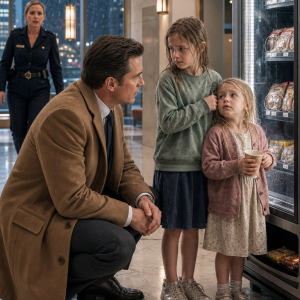
Three-year-old Maisie Cole asked me that question on a rain-dark Thursday evening, and for the first time in more years than I cared to count, I felt the careful machinery of my life stop working.
My name is Gideon Vale. In Richmond, people knew me as the founder of Vale Strategic Transport, a private freight and security company with warehouses, armored vehicles, government contracts, and enough influence to make city officials return my calls at once. There were rumors about how I had built it, and although I no longer lived by the hard rules of my early years, I still expected those rules to be obeyed.
No one entered my library without permission. No one interrupted a closed-door meeting. And no one questioned an order after I had given it.
Maisie did all three before she was old enough to read.
The first time she wandered into my library, she was barefoot and wearing a white nightgown covered with blue stars. I had come home after midnight with a gunshot injury beneath my shoulder following an attempted roadside robbery. A physician treated it, left medicine beside me, and warned me to rest. I dismissed everyone and stretched out on the library sofa.
Sometime in the deepest part of the night, I woke with my heart pounding and my right hand reaching for something that had not been there in nineteen years.
Instead, I found a tiny hand wrapped around two of my fingers.
Maisie sat on the rug beside me, holding a worn stuffed rabbit against her chest. One of its ears leaned sideways, and a green ribbon had been tied around its neck so many times that the satin had begun to fray.
“Mr. Gideon?” she whispered.
I should have summoned Wade Fletcher, the director of estate security, or called Maisie’s mother. I should at least have asked how she had opened a guarded door.
Instead, I said, “What are you doing awake?”
“Juniper heard you.”
She lifted the rabbit as if that explained everything.
“Juniper heard me?”
“You sounded sad.”
I had been making sounds in my sleep, then. No one had told me that before, perhaps because no one else would have dared.
Maisie climbed onto the sofa, placed Juniper between us, and rested her cheek near my collarbone. Within minutes, she was asleep.
Something changed after that night, though I refused to name it. I placed a small maple chair beside my library window. Maisie colored there while I reviewed contracts, stole my shortbread, and asked visiting executives questions so honest that they forgot their prepared speeches.
Her mother, Nora Cole, supervised linens and uniforms for the household staff. Quiet but never timid, she was raising Maisie alone after her husband had passed away four years earlier. I told myself that a responsible employer knew such facts. I did not admit that I had begun measuring the peace of my house by Maisie’s laughter, or that I knew Nora baked the rosemary shortbread every Thursday.
Then Nora’s brother took twelve thousand dollars from an estate emergency account.
Owen Cole had occasionally repaired vehicles and electrical systems on the property. The access code used for the withdrawal belonged to him, and when Wade brought him into my library, Owen did not offer a denial.
“I took it,” he said.
“Can you return it by sunset?”
“No.”
“Do you understand what that means?”
“I do.”
I did not ask why. In my world, a confession was the end of an inquiry, not the beginning of one.
“You have twenty-four hours,” I told Wade after Owen had been escorted out. “Nora and the child leave with him. I want the entire family off the property.”
The order took less than a minute. Its consequences began before I rose from my chair.
I did not know Maisie had been in the corridor or that she had heard enough to believe she was the problem. When she later asked whether Nora could stay if she went away, I thought she was talking about a game.
“It is past your bedtime,” I said.
She watched me with large gray eyes.
“But can Mama stay?”
“We will talk in the morning.”
Morning came. Maisie did not.
The Empty Little Bed
Her maple chair was vacant when I entered the library. There were no crayons beneath it, no half-finished drawing on my desk, and no Juniper resting against the window. At first, I felt only an irritation I could not explain. Then a housemaid came running from the service wing with the rabbit in one hand and a folded piece of paper in the other.
The letters wandered across the page in blue crayon:
MAMA STAYS. I GO.
By the time I reached Maisie’s room, Nora stood beside the small white bed in yesterday’s charcoal dress. The closet was open, and a red cardigan was missing.
Nora’s face was pale, but she was not crying. That frightened me more than tears would have.
“Where would she go?” I asked.
Nora looked at the smooth pillow. “I don’t know.”
“You know her better than anyone.”
Her eyes found mine. “I know my daughter. I don’t know what a frightened three-year-old thinks safety looks like.”
The words carried no accusation, which made them far more difficult to bear.
Wade appeared in the doorway. Every gate had been checked, and his team was reviewing camera recordings.
“Bring everyone outside,” I ordered. “Search every building and every foot of the grounds.”
“No,” Nora said.
Wade glanced at me, waiting for the response that usually followed when someone rejected my instruction. None came.
Nora took a breath. “No crowds. No cars rushing around. No one calling her name as if she has done something wrong. If she sees frightened adults running toward her, she may hide more deeply.”
She lifted Maisie’s cardigan from the floor near the dresser. The child had taken it out and then, for some reason, left it behind.
“She likes the conservatory,” Nora continued. “Mrs. Pritchard sometimes gives her berries behind the kitchen. She knows the path to the prayer garden, the laundry courtyard, and the old carriage house.”
I turned to Wade. “Do it her way.”
When he left, Nora saw the note in my hand.
“Did she speak to you last night?”
“Yes.”
“What did she say?”
I had negotiated contracts worth millions without looking away from anyone. Now I could barely hold Nora’s gaze.
“She asked whether you could remain here if she left.”
Nora closed her eyes. “She has been worried about me.”
“Why?”
“Because children notice more than adults want to believe.”
“She should not have heard my order.”
“She should not have been given a reason to fear it.”
She took the paper and read it. Her hand rose to her mouth, and she sat on the edge of the bed as tears slipped quietly over her fingers.
I had always solved problems by issuing instructions, moving money, or applying pressure. None of those methods could change what a little girl believed about herself. So I picked up Juniper and joined Nora in the search.
The Vale estate covered eighteen acres along the James River. I had added walls, cameras, gates, and enough safeguards to make it secure but never welcoming. Under the gray sky, all of it looked foolish. A small child had turned my fortress into a maze.
Nora and I followed the damp path from the main house toward the old carriage barn. Juniper hung from my hand by one crooked ear.
“Her father gave her this?” I asked.
“Yes. Before she was born.”
“Why Juniper?”
For the first time that morning, Nora almost smiled. “She named it when she was learning to speak. We told her it was a rabbit. She told us we were wrong.”
The smile disappeared as she looked at the toy.
“She never goes anywhere without it.”
That was what neither of us could say aloud: Maisie had not forgotten Juniper. She had left the rabbit deliberately, as if comfort belonged to the home from which she had decided to remove herself.
Near the conservatory path, Nora called gently, “Maisie, sweetheart, breakfast is ready. Mrs. Pritchard made cinnamon toast.”
Only birds answered.
Then a rusty gate hinge moved behind us. Arthur Grady, the seventy-four-year-old groundskeeper who obeyed rules only when they involved plants, stood at the far end of the hedge. He raised a finger to his lips and pointed toward the conservatory.
Nora ran.
Inside, beneath hanging ferns and long rows of young tomato plants, Maisie sat on a cedar bench beside Arthur’s wife, Ruth. She was wrapped in Ruth’s blue shawl and holding a mug of warm milk with both hands.
She was safe.
Nora stopped for a moment. Then Maisie looked up.
“Mama?”
Nora crossed the tiled floor and knelt before her. Maisie carefully set down the mug.
“I didn’t go far,” she said. “I was gonna go after the sun came.”