The Woman in Seat 8A

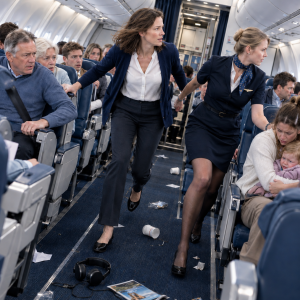
The evening flight from Boston to Seattle had been in the air for a little more than two hours when the captain’s voice came over the speakers and changed the atmosphere inside the cabin. Until then, Flight 614 had felt ordinary. Reading lights glowed above scattered seats, movies played silently on several screens, and the engines made their steady, comforting sound.
Then the captain spoke.
“Ladies and gentlemen, if there is a former or current military fighter pilot aboard, please identify yourself to a flight attendant immediately.”
There was no explanation, and the absence of one frightened people more than a detailed announcement might have. Conversations stopped. A little boy across the aisle lowered his headphones. An older couple clasped hands beneath the edge of their shared blanket, while several passengers looked around with the hopeful, uncertain expressions of people waiting for someone else to possess exactly the skill they needed.
In seat 8A, forty-year-old Rebecca Callahan opened her eyes.
She was a white American woman with light brown hair twisted into a loose knot and the tired face of a mother who had started her day before sunrise. She wore a cream cardigan and the silver bracelet her eleven-year-old daughter, Emma, had made at summer camp. To the businessman beside her, she was simply a quiet traveler who had declined dinner and fallen asleep before the plane crossed New York State.
He could not have guessed that Rebecca had once landed Navy fighters on an aircraft carrier at night, or that younger aviators had trusted her calm voice when their instruments and instincts disagreed. Nor did he know why she had traded a flight suit for a classroom and now taught physics at a community college outside Portland, Maine.
That was how Rebecca preferred it. Three years earlier, she had left military aviation with a box of commendations she never displayed and a burden she could not explain to her daughter. Since then, she had built a smaller life around school pickups, Sunday pancakes, and students who brightened when an experiment finally made sense.
The announcement came again, this time with a strain beneath the captain’s measured tone.
“If anyone aboard has tactical jet experience, please contact the cabin crew now.”
Rebecca remained still. Her first thought was of Emma spending the week with Rebecca’s sister in Oregon, waiting for her mother to arrive the next morning. Her second was an old promise she had made in the quiet after leaving the Navy: she would never again accept responsibility for a cockpit, a crew, or a decision that could follow her home.
A flight attendant named Marcy stopped beside row eight. Her polite expression was held together by effort.
“Ma’am, have you heard anyone nearby mention military aviation?”
Rebecca looked past her toward the cabin. She saw families, grandparents, and two teenage sisters pretending not to be afraid. None of them could choose what happened next. She could.
She released a slow breath and unfastened her belt.
“I flew fighters,” she said.
Marcy blinked. “You did?”
“F/A-18s. U.S. Navy. I was also a flight instructor.”
The businessman beside her stared openly. “You?”
“Yes,” she said, rising. “Me.”
The Door at the Front
As Rebecca followed Marcy toward the cockpit, whispers moved behind her in a soft wave. With each step, she felt the ordinary woman she had worked so hard to become receding, while an older version of herself returned through muscle memory: shoulders level, breathing controlled, attention moving from sound to motion to the subtle angle of the floor beneath her feet.
The cockpit door opened, releasing the smell of warm electronics and coffee. Captain Thomas Reed, a broad-shouldered man in his late fifties, occupied the left seat. His face was pale but composed. In the right seat, First Officer Evan Doyle was slumped beneath an oxygen mask while a crew member checked his pulse.
Thomas glanced at Rebecca’s cardigan, then at her eyes.
“What did you fly?”
“Super Hornets. I instructed for two years at Naval Air Station Fallon.”
“How long since your last flight?”
“Just over three years.”
His mouth tightened. “I need current hands, Commander, not a good memory.”
“It’s Ms. Callahan now, and I understand.”
Before he could dismiss her, the control column began to pulse in a quick, mechanical rhythm. The aircraft rolled a few degrees right, corrected itself, then tried to roll again. Thomas braced both hands against the controls.
Rebecca’s gaze moved over the displays. She had never flown that model of passenger jet, but machines had a language, and instability often revealed itself through patterns. The disagreement lights on two control channels were alternating instead of remaining fixed, while the aircraft’s physical motion lagged behind Thomas’s corrections.
“How long has the column been doing that?” she asked.
“Twelve minutes. Autopilot dropped offline first. Then the flight-control computer began reporting faults that contradict one another.”
“And your first officer?”
“His fingers went numb. He became disoriented, then collapsed.”
Rebecca leaned closer without touching anything. The right bank returned, and Thomas countered it.
“Ease the pressure,” she said.
He shot her a look. “If I ease it, we keep rolling.”
“The computer is reading your correction as a fresh command and sending one back against you. You’re feeding the oscillation.”
“This isn’t a fighter.”
“No, but feedback loops don’t care what name is painted on the fuselage.”
Another shudder passed through the controls. Rebecca pointed to the secondary flight-control channel showing an intermittent disagreement.
“Isolate channel three, then trim left in small increments.”
Thomas hesitated for no more than a second. Training had taught him that pride was useless when evidence was clear. He isolated the channel, reduced his pressure, and adjusted the trim. The aircraft jolted once, then settled.
The silence that followed was not peaceful, but it allowed everyone in the cockpit to breathe.
“All right,” Thomas said. “You stay.”
A passenger who had identified herself as an emergency physician appeared at the open doorway. Dr. Helen Mercer had examined Evan in the forward galley, and her careful expression suggested that the problem extended beyond exhaustion or a common medical episode.
“Captain, his symptoms are consistent with exposure to a strong sedative combined with another substance,” she said. “I can’t confirm it here, but this does not appear natural.”
Thomas turned. “He was fine at departure.”
“Did he consume anything the rest of you didn’t?” Rebecca asked.
Thomas pointed toward the console. “He brought coffee in a steel thermos.”
The space beside the chart holder was empty.
“Where is it?” Rebecca asked.
Marcy looked from the console to the floor. “It was here when I brought the doctor forward.”
The temperature in the cockpit had not changed, yet Rebecca felt cold move through her. A faulty control channel could be coincidence. A suddenly impaired first officer could be coincidence. Missing evidence made coincidence much harder to accept.
“Close and lock the door,” she said.
A Name From Before

Thomas did not argue. He ordered the cabin secured, advised air traffic control that Flight 614 required priority handling, and requested a diversion to Minneapolis, where weather conditions were better than the line of severe storms ahead. As he spoke, Rebecca watched the system messages multiply across the display. The right hydraulic circuit showed a slow pressure loss, and the indicator for the right main landing gear flickered amber.
Someone pressed the cockpit entry keypad.
Marcy answered the interphone, listened, and looked toward Thomas. “It’s Grant Holloway. He says he has corporate authority to enter.”
Rebecca knew the name before Thomas explained it. She wished she did not.
Grant Holloway was the airline’s vice president for fleet procurement, but years earlier he had worked for Asteron Dynamics, which supplied actuator-control units to military aircraft programs. He had sat across from Rebecca during the inquiry into the training flight that ended her career, courteous and so polished that every denial sounded almost reasonable.