The Call That Changed Everything
I still remember the exact words the police officer said.
“Mrs. Hollis, I think you should wait here for a little while.”
Hospitals always have their own smell. It is a mixture of disinfectant, coffee that has been sitting too long in paper cups, and the heavy scent of rain carried in on people’s coats.
That afternoon, all of it made me feel sick.
My hands were trembling so badly that I nearly dropped my car keys onto the polished floor.
“My son is in there,” I told him quietly. “He’s only nine years old. His name is Owen Hollis, and I’m his mother.”
The officer looked sympathetic, but he did not move.
“I understand, ma’am. We just need a few more minutes.”
A few minutes can feel like an eternity when your child is lying behind a closed door.
At four o’clock that afternoon, I had been sitting in my office in downtown Carmel, Indiana, finishing the final details of an audit report.
Nineteen minutes later, I was racing toward St. Andrew Medical Center with my heart pounding so hard that I could barely breathe.
Someone had called to tell me that my son had been taken to the emergency room after an accident at his friend’s house.
An accident.
That was the word they used.
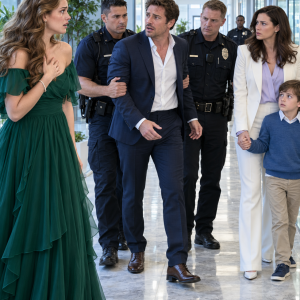
Yet the presence of two police officers standing outside my son’s room told me there was much more to the story.
The Life We Thought We Had

My name is Natalie Hollis. I had been married to my husband, Grant, for almost twelve years.
From the outside, our lives looked comfortable and ordinary.
We lived in a quiet neighborhood filled with maple trees and neatly trimmed lawns. American flags appeared on porches every summer, children rode bicycles along the sidewalks, and everyone knew the names of one another’s dogs.
I worked as a senior accountant for a large consulting company. Grant worked as a sales director for a manufacturing firm.
Our son, Owen, was the center of our world.
At least that was what I had always believed.
Grant had struggled for years with the fact that my career was advancing more quickly than his. I had never made him feel inferior, but disappointment has a strange way of growing in silence.
Eventually, I realized that resentment can settle into a person’s heart so quietly that nobody notices it until it is too late.
The Neighbor We Trusted
Two years earlier, a woman named Dana Mercer had moved into the house next door with her son, Caleb.
The boys became inseparable.
Dana seemed kind, dependable, and thoughtful. She always remembered birthdays, offered to help when someone was busy, and never forgot to send home Owen’s jacket whenever he left it behind.
I trusted her.
Looking back, I understand how dangerous trust can become when it is given without hesitation.
That Saturday morning seemed perfectly ordinary.
Sunlight poured through the kitchen windows while I prepared breakfast.
Owen came downstairs wearing his favorite blue sweatshirt.
“Mom, can I go to Caleb’s house?” he asked.
“Of course,” I answered. “Just be home before dinner.”
He smiled, grabbed his backpack, and hurried out the front door.
Grant was sitting in the living room with a basketball game playing on television while he scrolled through messages on his phone.
Nothing about that morning felt unusual.
Nothing warned me that our lives were about to change forever.
An Unexpected Reaction
The door to Owen’s hospital room finally opened.
Before I could step inside, Grant emerged.
For a moment, I simply stared at him.
His shirt was wrinkled. His hair looked damp, as though he had splashed water across his face. More than anything else, however, I noticed the expression in his eyes.
Relief.
It was there only for an instant, but it was unmistakable.
“Natalie,” he said softly.
“What happened?” I asked.
He glanced toward the officers.
“The doctors think Owen may have a concussion. They’re running tests. Sometimes accidents like this affect memory.”
He spoke carefully.
Too carefully.
Something about the way he emphasized the word memory sent a chill through me.
It almost sounded as though he wanted our son to forget something.
I stepped backward when Grant tried to touch my arm.
“What aren’t you telling me?” I asked.
“Please don’t make things more difficult than they already are.”
One of the officers looked directly at him.