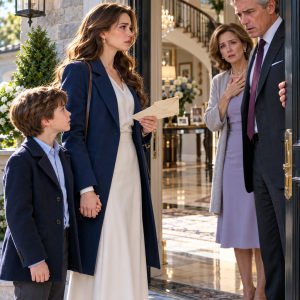
The Letter Beneath the Door

The Woman He Sent Away
“Pack your things and leave before dinner.”
Grant Holloway’s voice crossed the sunlit kitchen with the hard precision of a man accustomed to being obeyed. A moment earlier, the room had been full of laughter, flour drifting over the marble counter while his six-year-old triplets attempted to shape biscuit dough into stars. Now the three girls stood motionless, their small hands suspended above the mixing bowl.
Claire Dawson slowly lowered the youngest, Sadie, from her shoulders. Sadie clung to her for another second before allowing her feet to touch the floor.
Grant had returned early from a conference in Boston and had expected the quiet house he had grown used to during the previous year. Instead, he had walked into something almost forgotten: his daughters laughing.
Before losing their mother, Madeline, after an unforeseen medical complication, Emma had invented stories about animals that owned grocery stores, Nora had asked questions from sunrise until bedtime, and Sadie had sung while brushing her teeth. After the memorial service, all three had stopped speaking.
Grant had taken them to respected specialists, transformed the playroom into an indoor garden, and purchased every educational toy recommended to him. Nothing brought their voices back. Eventually, he did what frightened men often did when they had enough money to disguise avoidance as responsibility—he returned to work.
As the founder of a successful chain of specialty food markets headquartered in Richmond, Virginia, Grant could always find a crisis requiring his attention. A warehouse needed expanding, a contract needed reviewing, or an investor needed reassurance. Each problem had numbers, deadlines, and solutions. His daughters’ silence had none.
Claire came into their lives after the family’s longtime cook recommended her. At thirty, she worked weekdays as a family caregiver while taking weekend courses in child development. She had spent much of her youth helping raise a younger sister during a difficult period at home, and she understood that children rarely opened their hearts simply because an adult instructed them to.
She never demanded that the triplets speak. She made their lunches, brushed their hair, and hummed old folk songs while folding laundry. When the girls followed her, she welcomed them; when they withdrew, she gave them room.
One afternoon, Emma placed a drawing beside Claire’s elbow. Four women stood beneath a lavender sky, holding hands.
Claire did not question her. She merely taped the picture to the refrigerator.
Three days later, Nora pointed to the woman in the center and whispered, “That’s our mommy.”
Claire did not celebrate or summon the household. She studied the picture and replied, “She looks like someone who loved her girls with her whole heart.”
More words followed, cautiously at first, and then small conversations. Within several weeks, laughter returned to rooms that had remained painfully still for more than a year.
Grant witnessed none of it until that afternoon.
When he entered the kitchen, Claire wore a dish towel around her shoulders like a cape, and Sadie was riding on her back. Emma and Nora were stirring dough while offering very serious instructions about invisible dragons. For one brief second, hope rose inside him.
Then Sadie wrapped her arms around Claire’s neck.
What Grant felt was not anger, although anger was the name he gave it. It was guilt sharpened by jealousy. This woman had reached his daughters while he had hidden inside conference rooms and business trips.
“You were hired to care for them,” he said. “You were not hired to take their mother’s place.”
Claire’s face lost its color. “Mr. Holloway, I would never try to replace Madeline.”
“I’ve heard enough. You’re dismissed, and you are not to contact my daughters again.”
The cook stared at him in disbelief. A family counselor waiting near the doorway lowered her appointment folder, but Claire did not defend herself. She untied her apron, collected her canvas bag, and walked out with what remained of her dignity.
Grant expected the girls to protest. Instead, they looked at him, and the silence returned.
The following morning, he found a folded page beneath his bedroom door. Three names had been written across the front in purple crayon.
Inside, the first sentence read:
Daddy, Claire did not make us forget Mommy. She made remembering her feel safe.
Another line appeared in green:
We talked because Claire never told us we had to.
Then, in blue:
We stopped because you made her leave.
Grant sat down on the hallway bench. Beneath three uneven hearts, the girls had written one final plea:
Please stop sending away everyone we love.
Learning How to Ask

The triplets stood at the top of the staircase in matching pajamas, their hands linked together. Grant lifted the letter.
“I read it,” he said. “And you were right.”
None of them moved.
He knew their birthdays, allergies, tutors, and medical records, yet he did not know who feared thunderstorms, who disliked sandwich crusts, or which story they wanted before bed. Claire knew those things because she had been present long enough to learn them.
“I saw you laughing with her, and I realized she had given you something I hadn’t. I felt ashamed, but I blamed her instead of myself.”
Emma descended several steps and held out a yellow crayon. When she pointed toward the paper, Grant understood.
He turned the letter over and wrote:
I am sorry. I will bring Claire home if she is willing to forgive me.
Nora took the crayon and added:
Don’t command her. Ask her.
By seven that morning, Grant was driving through an older Richmond neighborhood, following the address the cook had reluctantly provided. Claire lived above a small bakery in a brick building with narrow stairs and peeling white trim.
She opened her door only a few inches.
“How did you find me?”
“Mrs. Porter gave me your address after I begged her.”
Claire studied him. Grant Holloway was not known for begging.
“You can say whatever you came to say from the hallway.”
He nodded. “I was cruel, and I was wrong. I accused you of replacing Madeline when you were helping the girls remember her.”
He passed the crayon letter through the opening. Claire read it slowly, pressing her lips together when she reached the final sentence.
“They believe love is temporary,” she said. “Their mother disappeared from their daily lives, you disappeared into work, and a long line of specialists came and went. Then you sent me away during an ordinary afternoon. They are learning that anyone they trust can suddenly vanish.”