Hidden Moral Stories Social Media

Nine Days After I Lost My Husband, My Father-in-Law Threw Me and My Six Children Into a Freezing Storm, Saying, “Only Real Family Belongs Here.” He Was Still Smiling When a Four-Star General Saluted Me—Then I Showed Him the Deed. But What My Son Found in My Husband’s Locked Box Revealed Why Someone Wanted Us Gone…

The Night the Doors Closed

The sleet had begun as rain somewhere north of Providence, but by the time it reached the old coastal estate outside Newport, it came sideways in hard silver sheets, striking my face and soaking through the shoulders of my field coat as I stood at the end of the circular drive with my six children gathered around me.

My youngest, ten-month-old Maisie, was pressed against my chest beneath the open front of my coat. She had been warm all afternoon, but now her little body felt far too hot, and each breath came with a faint roughness that made every instinct in me tighten. Behind me stood my other five children, ranging from six to fourteen, their hair wet, their shoes filling with icy water, their belongings stuffed into grocery sacks and old moving boxes that had been pushed onto the pavement as if they were things no one wanted.

My husband, Scott, had been gone for nine days.

Nine days since the memorial chapel at Hanscom Air Force Base had filled with blue uniforms, folded flags, and people telling me what an extraordinary man he had been.

Nine days since his parents had embraced my children in public and called them Scott’s greatest legacy.

And less than an hour since those same people had ordered us out of the only house my children remembered as home.

My father-in-law, Harrison Vale, stood beneath the wide stone portico, perfectly dry in a camel cashmere coat. He was a retired commercial real-estate developer who had spent forty years building luxury hotels along the New England coast, and he carried himself with the confidence of a man who believed ownership was not a legal condition but a personality trait.

Beside him stood his wife, Judith, elegant as always, silver-blonde hair smooth despite the weather, one hand resting on the carved front door.

Harrison pointed toward the gates.

“You heard me, Meredith. This is a family property. Scott is no longer here to justify your presence.”

My fourteen-year-old son, Owen, stiffened beside me.

I put one hand against his shoulder before he could speak.

For thirteen years I had done that in one form or another. I had quieted the children, redirected conversations, ignored remarks at Thanksgiving, swallowed insults at Christmas, and told myself that dignity sometimes meant choosing peace over response. Scott loved his parents despite everything complicated between them, and because I loved Scott, I had spent years making excuses for people who had never once extended the same generosity to me.

But that night, standing in freezing rain with a feverish baby against my heart, peace no longer looked noble.

It looked like permission.

“Harrison,” I said, keeping my voice level, “these are your grandchildren. Scott wanted them raised here. You know that.”

Judith gave a small, humorless smile.

“Scott was sentimental. That was one of his weaknesses.”

Owen moved before I could stop him.

“Dad said this would always be our house.”

Harrison turned so quickly that my younger children recoiled.

“You will not lecture me about my own son.”

Something changed inside me then—not loudly, not dramatically, but completely.

I stepped between Harrison and my boy.

“You will never speak to my child that way again.”

Harrison stared at me for half a second, then laughed.

“And what exactly will you do about it? Summon the Air Force?”

Judith lifted another plastic sack from beside the doorway and let it fall into the wet driveway. A stuffed rabbit, two school notebooks, a framed photograph, and several small sweaters spilled into the water.

My eight-year-old daughter, Paige, made a soft sound beside me.

The photograph showed Scott kneeling on the lawn with three of the children piled on his back.

I looked toward the mansion.

Every window glowed.

Relatives were inside. Neighbors. Business partners. Old family friends who had attended Scott’s memorial service and told me to call if I needed anything.

They watched from behind glass.

No one opened the door.

What Harrison did not know was that I had spent most of my adult life in rooms where panic was expensive. I had commanded Air Force cyber-defense operations across three continents, advised senior national-security officials, and carried responsibilities I rarely discussed outside secure facilities. My official title was Lieutenant General Meredith Rowe, though the Vale family had always preferred to describe me simply as Scott’s wife who traveled too much.

For years I had let them underestimate me because correcting them had seemed unnecessary.

That night, their ignorance became almost useful.

Inside the waterproof document case beneath my coat was a cream envelope Scott had placed in my hands four weeks before his final overseas assignment.

He had looked unusually serious when he gave it to me.

“Merry, promise me something.”

“That depends.”

He had smiled at my answer, but only briefly.

“If my parents ever tell you the children don’t belong in that house, open this. Not before.”

I had tried to question him, but Scott had kissed my forehead and said he was probably being overly cautious.

Now, with sleet running down my sleeves, I pulled out the envelope.

My fingers were stiff as I broke the seal.

There were legal documents inside.

A deed.

A trust agreement.

A letter.

And a business card for a Boston attorney named Evelyn Hart.

I read the first page once.

Then again.

When I lifted my head, Harrison was still watching me with that same expression of practiced superiority.

“Before you lock the door,” I said, “you may want to read this.”

He frowned.

I held up the deed.

“You are not the legal owner of this property.”

Judith’s smile disappeared.

Harrison stepped down one stair.

“What did you say?”

“The title is in my name.”

For the first time that evening, no one moved.

Then headlights swept across the iron gates.

A black government vehicle entered the drive, followed by two official security cars. Doors opened. Uniformed personnel stepped into the sleet, and behind them came General Raymond Beckett, the four-star commander under whom I had served during one of the most difficult periods of my career.

He crossed the driveway, stopped in front of me, and raised his hand in salute.

I returned it automatically while holding Maisie close.

“General Rowe,” he said, loudly enough for everyone beneath the portico to hear, “we’ve been trying to reach you. Your protective detail is ready, ma’am.”

Behind Harrison, faces appeared more clearly in the windows.

The night became very quiet.

The woman the Vale family had just pushed into a winter storm was not merely the unwanted wife of their son.

And the house they believed they controlled had not belonged to them for quite some time.

What Scott Had Prepared

General Beckett lowered his hand and immediately looked at the children.

He had known me for eleven years and understood without explanation that rank meant very little when a baby was unwell.

“What do you need first?” he asked.

I looked down at Maisie.

“Warmth. Dry clothes. A medical evaluation.”

He nodded once.

Two members of the security team moved forward, not aggressively but with the calm efficiency of people accustomed to uncertainty. One offered a coat to Owen. Another crouched near my six-year-old twins, Finn and Miles, and introduced herself gently.

Miles backed closer to his brother.

“We’re staying with Mom.”

The officer’s expression softened.

“Absolutely. Nobody is separating you.”

Only then did the twins relax.

Harrison finally seemed to recover.

“This is private property. You cannot bring a federal entourage into my home.”

General Beckett glanced at the deed in my hand.

“The question of private property appears to be exactly the issue.”

I did not wait for another argument.

“The children are going inside.”

Judith drew herself up.

“You cannot simply take over this house because Scott signed some document.”

“I’m not taking anything over,” I replied. “I’m taking my children out of the cold.”
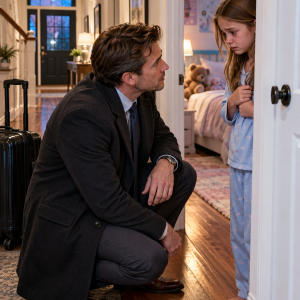
Inside, the foyer smelled of polished oak, white lilies left from the memorial gathering, and the expensive cedar candles Judith lit whenever guests were present. The children entered quietly, dripping onto the marble floor, suddenly hesitant in a place where they had once raced from room to room.

Judith stared at the water beneath their shoes.

“That runner was handmade in Turkey.”

I turned toward her.

“My baby is running a fever.”

She said nothing more.

A medical officer examined Maisie near the staircase and recommended that she be taken to a hospital that evening. The moment he said it, all five older children looked at me.

Since Scott’s passing, every departure had become complicated. The ordinary sentence I’ll be back soon no longer sounded ordinary to them.

Owen stepped closer.

“We’re coming with you.”

“Yes,” I said immediately. “All of us.”

Before we left, I asked that the children be allowed upstairs to collect warm clothes.

Harrison objected.

“There are valuables in this house.”

Owen’s face changed.

“Our clothes are upstairs.”

“You were told to leave.”

General Beckett took one quiet step forward.

“Mr. Vale, I strongly suggest you let the children collect their belongings.”

That was when Scott’s younger sister, Caroline, appeared at the edge of the foyer.

She had spent most of her life agreeing with her parents because disagreement in the Vale family had consequences. She and I had never been close, though she had always shown my children small kindnesses when no one was paying attention.

Her eyes moved over their wet clothes.

“I’ll take them upstairs.”

Judith stared at her.

“Caroline.”

Her daughter swallowed.

“They’re freezing, Mom.”

It was a small sentence, but in that family it sounded almost revolutionary.

Twenty-five minutes later, attorney Evelyn Hart arrived carrying a leather case and wearing a charcoal raincoat. She was fifty-six, sharp-eyed, composed, and clearly unimpressed by wealth.

She greeted me by rank.

“General Rowe, I’m deeply sorry about Scott.”

Then she turned toward my in-laws.

“Mr. and Mrs. Vale, I believe we have several matters to clarify.”

Harrison immediately attacked the deed as improper.

Evelyn let him finish.

Then she opened her case.

“The transfer occurred twenty months ago. Scott retained independent counsel. So did General Rowe’s trust representative. The estate was placed into a protected structure, with Meredith as titleholder and trustee and the six children as principal beneficiaries.”

I stared at her.

Twenty months.

Scott had done this while life still felt ordinary, while he was making Sunday waffles and helping Paige build a cardboard solar system for school.

“Why didn’t he tell me?” I asked.

Evelyn’s expression softened.

“Because he hoped the situation he feared would never happen.”

Harrison’s face tightened.

“My family built this property.”

“Your family nearly lost it,” Evelyn replied. “Scott acquired the outstanding interest after the Vale Heritage Fund restructuring, resolved several financial claims against the estate, and placed the residence beyond the reach of disputed business liabilities.”

Judith slowly sat down.

“What liabilities?”

Harrison answered too quickly.

“Old accounting issues.”

Evelyn looked at him for a long moment.

“Scott did not consider them old.”

Before anyone could continue, the children returned downstairs. Owen carried a small walnut box against his chest.

I recognized it immediately. It had sat for years in Scott’s study.

“Where did you find that?” I asked.

“Behind the framed picture of you in your dress uniform.”

Harrison’s gaze snapped toward the box.

The reaction lasted less than a second.

But I saw it.

So did Evelyn.

The Letter in the Walnut Box

Maisie was taken to a hospital in Providence, where the doctor told me she had a respiratory infection made worse by the cold exposure but was expected to recover well with rest, fluids, and careful monitoring.

That was the first good news I had received in days.

After the children settled beneath warm blankets in a family waiting area, I found Caroline standing alone near a vending machine.

She looked exhausted.

“I should have opened the door,” she said.

I did not comfort her.

“Yes.”

She closed her eyes.

“Dad told everyone Scott had instructed you to move after the memorial. He said you already knew.”

I looked through the glass at my children.

“Did you believe him?”

“I wanted to. Believing him was easier.”

There are apologies people offer to escape guilt, and there are apologies that cost something. I still did not know which kind hers was.

Then she said something else.

“A month ago, I heard Scott arguing with Dad in the conservatory.”

I turned.

“About what?”

“Dad said, ‘You’ll bring the whole family down.’ Scott said, ‘I’m trying to keep you from taking everyone with you.’”

Before I could ask more, Evelyn called.

Her voice was controlled, but I heard tension beneath it.

“Meredith, Scott left an emergency instruction packet.”

“Go on.”

“It references irregular transfers from the Vale Heritage Fund and something called Harbor Archive Seven.”

I looked at the walnut box beside Owen.

“Harrison reacted when he saw a box from Scott’s study.”

There was a pause.

“Then do not let it out of your sight.”

The following afternoon, after Maisie’s temperature improved, we returned to the estate with Evelyn, a locksmith, a professional mediator, and temporary security.

In daylight the mansion looked less majestic than tired, its gray stone walls streaked from the storm.

Harrison and Judith waited in the library.

Harrison was sitting in Scott’s favorite leather chair.

I looked at him until he stood.

No words were exchanged.

Some boundaries do not need speeches.

The meeting lasted nearly two hours. Evelyn explained that the children and I would remain in the house. Harrison and Judith would leave the east guest wing within three days unless I granted a written extension. Property access would be documented. Security codes would change. Private meetings involving estate matters would require counsel.

Judith stared at me.

“You’re making us leave after thirty-seven years?”

“Last night you put six children outside in a winter storm.”

Her expression faltered.

“I was upset.”

“So were they.”

Harrison struck the table with the flat of his hand, not hard, but enough to interrupt.

“This emotional performance is irrelevant. Scott was under pressure when he made these arrangements.”

I met his eyes.

“Do not use his absence to rewrite who he was.”

For once, he looked away.

Later, while the adults reviewed documents, Caroline helped the children upstairs. I found her outside Maisie’s nursery carefully drying the pages of a soaked picture book.

She looked up.

“There’s something else I never told you.”

Before she could continue, a sound came from the end of the hall.

Scott’s study.

The door stood open.

I had locked it that morning.

Inside, the desk drawer had been pulled out, and the photograph of me in uniform had been moved.

The empty space behind it was obvious.

Someone had returned for the walnut box.

Security searched the floor while Harrison complained that we were turning the house into a fortress.

Then Owen appeared at the staircase.

The box was in his hands.

“I kept it with me,” he said. “I thought somebody might try to take it.”

I felt equal parts pride and sadness.

A fourteen-year-old should not have needed that instinct.

The locksmith opened the box without damaging it.

Inside were three things.

A small digital drive.

A brass key tied with dark blue thread.

And a folded letter addressed to me in Scott’s handwriting.

My hands trembled when I opened it.

Merry,

If you are reading this because my parents tried to remove you and the kids from the house, then I waited too long to tell you the truth.

The house is yours because you made it a home. The children are protected because they are the best thing either family ever produced.

Do not let my father control the story.

Ask Evelyn about Harbor Archive Seven.

Listen to Caroline, even if she is only beginning to listen to herself.

And forgive me for the last secret. I was trying to bring someone home.

I read the final line twice.

Trying to bring someone home.

It made no sense.

I looked at Evelyn.

Her face had changed.

“You know what Harbor Archive Seven is.”

She hesitated.

That hesitation told me enough.

Harrison stepped forward.

“Give me the letter.”

I folded it carefully.

“No.”

“He was my son.”

“He was my husband.”

The two truths hung between us.

Then Judith spoke from behind him.

“What did Scott mean by bringing someone home?”

No one answered.

Caroline suddenly covered her mouth.

I turned toward her.

“What is it?”

She shook her head at first.

Then she looked directly at Harrison.

“I thought it was only a family rumor.”

His voice became sharp.

“Caroline, stop.”

She did not.

“Before Scott met Meredith, there was a woman connected to one of the Heritage Fund projects. She left Rhode Island after the financial inquiry. Dad always said she had been after money.”

My fingers tightened around the brass key.

“What does that have to do with Scott?”

Caroline’s eyes filled.

“Scott never believed Dad’s version.”

Evelyn closed her document case.

Very slowly.

I looked at her.

“Tell me.”

She drew a breath.

“Harbor Archive Seven is a private records vault in a former shipping office in Bristol. Scott asked me to help him gain legal access several months ago.”

“Why?”

No one moved.

Outside the windows, afternoon light spread across the wet lawn where Scott had once taught our children to ride bicycles, throw baseballs, and plant tomatoes badly.

Evelyn’s voice softened.

“Because Scott believed there was another child.”

The room seemed to shrink.

Judith gripped the back of a chair.

Harrison said nothing.

I could hear my own breathing.

“Scott’s child?”

Evelyn nodded once.

“He believed so. And shortly before his final assignment, he told me he may have found proof.”

I looked down at the brass key in my palm, then at the digital drive still resting inside the walnut box.

Nine days earlier, I had believed grief was the largest thing waiting for me.

I had been wrong.

Scott had left me a house, a trust, a warning, and a trail leading into a family history no one wanted opened.

And somewhere beyond the locked doors of Harbor Archive Seven, there might be a person my husband had spent his final months trying to bring home.

Related Posts

My Husband Spent Thirty-Nine Years Pretending He Loved Me While Quietly Using My Father’s Company to Build His Fortune. He Then Fastened My Pearl Bracelet Around His Mistress’s Wrist, Looked Me Straight in the Eye, and Said, “You Were Just My Way Into This Family.” He Forgot One Thing: My Father Left Behind A Secret Founder Agreement That Would Prove Who Was The Real Owner All Along.

The Empty Seat at Harbor PointThe first thing Olivia Mercer noticed wasn’t the lipstick stain on the coffee mug.It was the empty chair.For thirty-nine years, her husband had...

My Ex-Husband Texted, “Be Gone Before We Get Back—I’m Bringing My New Wife Home,” Then Flew His Other Woman and Our Children to Italy for a Dream Honeymoon… He Never Realized the Farmhouse He Claimed as His Was Protected by My Father’s Trust, and When He Returned, He Found Only Empty Land, One Legal Notice, and the Truth He Never Expected…

The Text In The Middle Of The NightAt exactly 2:13 a.m., my phone lit up on the nightstand.I noticed the time because I hadn’t slept a single minute.The...

My Husband Texted, “Save My Seat—I Wouldn’t Miss Our Daughter’s Big Night for Anything,” but She Finished Her School Play Staring at His Empty Front-Row Chair While He Chose Another Woman. Weeks Later, He Demanded a DNA Test in Court and Tried to Make Me Look Like the Liar—Until My Lawyer Held Up One Tiny Theater Program, Pointed to 6:43 P.M., and Asked a Question He Had Never Prepared to Answer…

The Empty ChairThe text arrived at 6:43 p.m.“Running behind. Save my seat. I wouldn’t miss Nora’s biggest night for anything.”Claire Bennett stared at the message until the screen...

My Billionaire Husband Paid Me $28 Million To Leave Before His Mistress Delivered Twins. He Said, “You’re No Longer Part Of This Family.” I Signed The Papers and Walked Away Quietly… But On My Wedding Night, A DNA Report Exposed The Truth They Never Wanted Me To Find.

The Divorce AgreementThe divorce papers were placed in front of me like a finished decision.Not a discussion. Not a negotiation. A conclusion already reached without me.The forty-eighth floor...

My Sister Smirked, “You Lost Your Billionaire Husband and His Fortune to Me” Four Days After Their Wedding, He Passed Away, and She Walked Into the Will Reading Expecting a Fortune—Only to Discover He Had Left Behind One Final Plan That Destroyed Her Entire Scheme

The Marriage That Was Never Meant to LastThe first warning came six months before the wedding.Not from a lawyer.Not from a detective.From a florist.Naomi Carter stood outside a...

Để lại một bình luận

Email của bạn sẽ không được hiển thị công khai. Các trường bắt buộc được đánh dấu *